
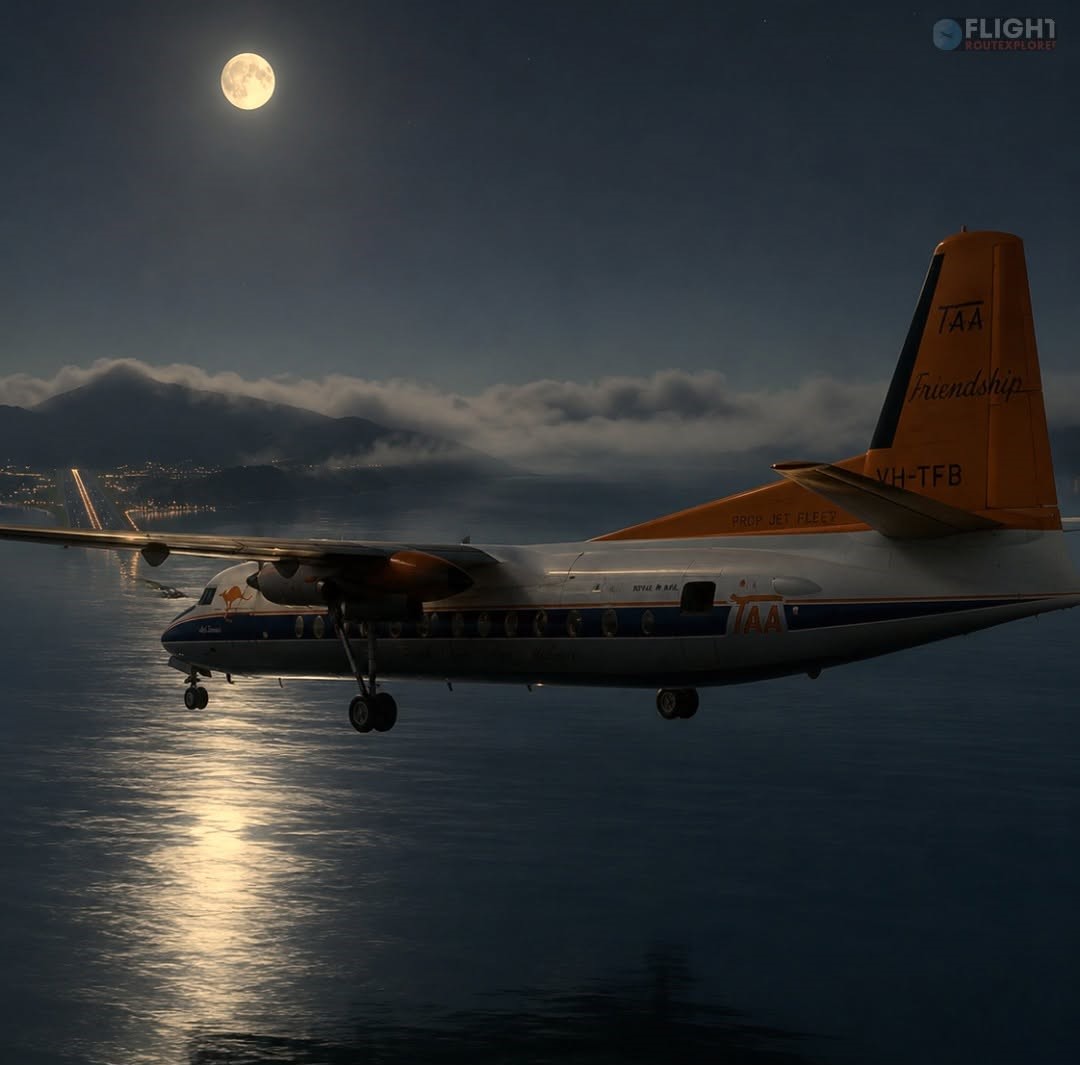
On the night of 10 June 1960, Trans Australia Airlines Flight 538 departed on what was supposed to be a routine domestic journey across Queensland. Instead, the flight ended in one of Australia’s most haunting aviation mysteries — a disaster in which investigators could never determine exactly why a modern airliner flew perfectly under control into the sea.
The aircraft involved was a Fokker F-27 Friendship 100, registered VH-TFB and named Abel Tasman. It was a significant aircraft for Australia, being the first Fokker F-27 operated by TAA and one of the earliest examples of the advanced turboprop airliner outside Europe.
Flight 538 departed Brisbane at 5:11 PM local time with scheduled stops at Maryborough and Rockhampton before continuing to its final destination, Mackay. The first two segments of the journey were completed without incident. On board the final leg were 25 passengers and four crew members, including Captain Francis Pollard and First Officer Gordon Davis.
As the aircraft approached Mackay late that evening, weather conditions had deteriorated. A layer of low cloud and fog covered the coastline, reducing visual references over the dark waters of the Coral Sea. The crew attempted an approach to Mackay Airport but was unable to complete the landing and initiated a missed approach.
The aircraft climbed away and prepared for a second attempt. At approximately 10 PM, while descending over the sea toward the runway, the aircraft unexpectedly flew too low and struck the water around 7 miles (11 kilometers) from Mackay Airport. There was no evidence of an explosion, fire, or structural failure before impact. The aircraft was destroyed, and all 29 people on board lost their lives.
The crash was one of Australia’s worst peacetime aviation disasters at the time and shocked the nation. Search crews recovered wreckage and the bodies of the victims from the sea, but the ocean impact had severely damaged many components, making the investigation exceptionally difficult.
Investigators examined every possible explanation. They considered whether the aircraft’s altimeters may have malfunctioned or whether the pilots could have misread the instruments during the difficult nighttime approach over dark water, where the lack of visual cues can create dangerous spatial illusions. However, the evidence was insufficient to prove any single theory.
The official inquiry concluded that the accident was a controlled flight into terrain — meaning the aircraft was functioning normally but was unknowingly flown into the water. The exact reason for the loss of altitude remained undetermined, making TAA Flight 538 one of aviation’s enduring mysteries.
Although the cause was never solved, the disaster produced a revolutionary change in aviation safety. Investigators emphasized the importance of recording what happened inside the cockpit during an accident. As a result, Australia became the first country in the world to require the installation of cockpit voice recorders on commercial airliners, a decision that helped shape modern “black box” regulations used worldwide.
More than six decades later, the story of TAA Flight 538 remains a reminder that even an unsolved tragedy can lead to changes that save countless lives in the future.