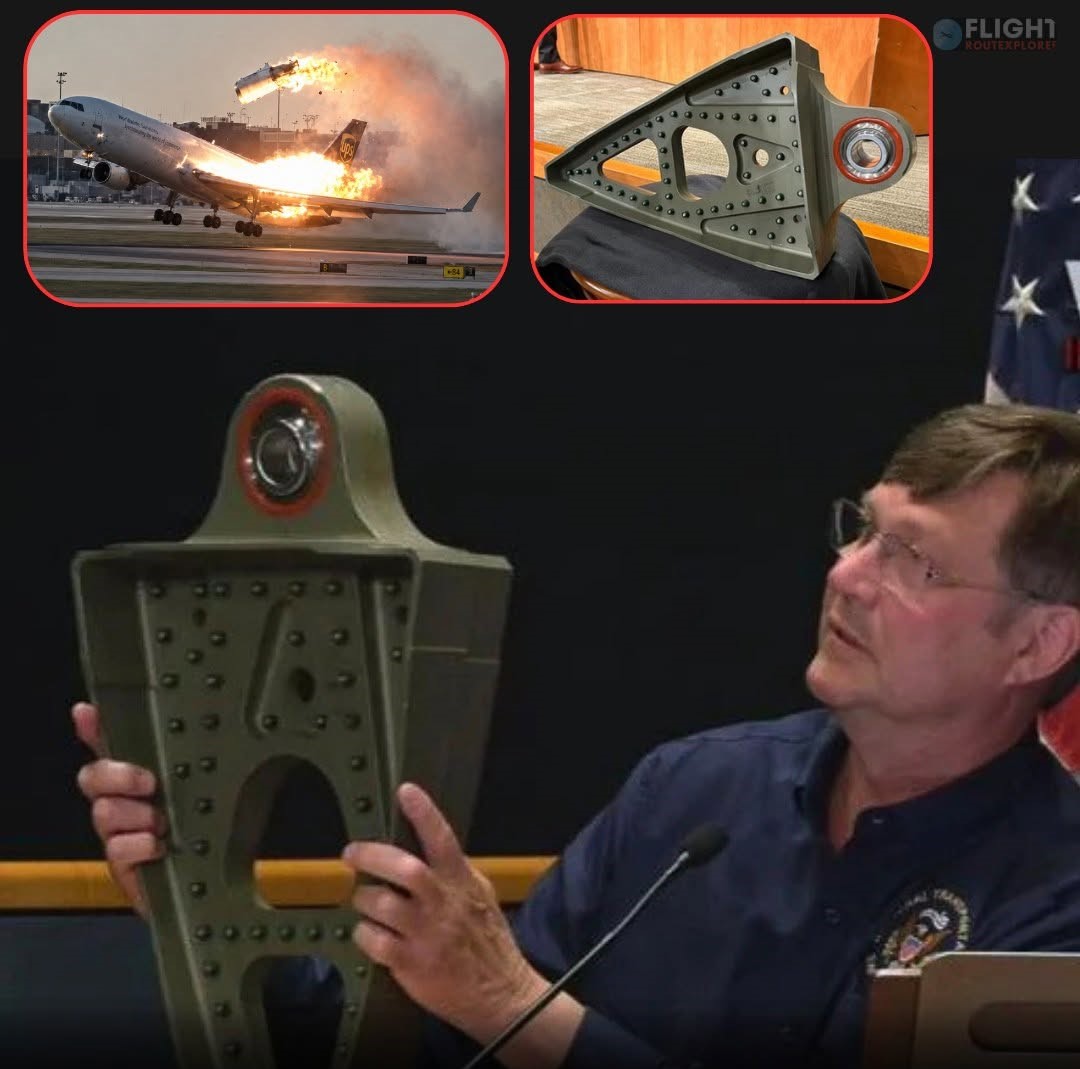
Before the deadly crash of UPS Flight 2976 in Louisville, there were warnings. Not just days or months before, but decades.
The McDonnell Douglas MD-11 cargo plane, built in 1991, went down around 5:15 p.m. Nov. 4, 2025, after its left wing caught fire, killing all three pilots on board. The plane slammed into Grade A Auto Parts, killing 12 employees and customers on the ground. Twenty-three other people were injured.
In May, the National Transportation Safety Board held a two-day investigative hearing in Washington as part of its investigation into the crash.
The NTSB says the left engine and pylon of the plane separated after the takeoff rotation. The pylon is the structure that connects the engine to the wing of the plane. Investigators examining the wreckage after the crash found cracks in some parts of the pylon.
Since 2002, operators caught 10 fractures before takeoff on the same part that broke in the UPS crash. Only four were reported to the Federal Aviation Administration.
“Don’t you think the FAA should have had the information that you had fractured races one, two, three, four times?” NTSB Chair Jennifer Homendy asked Boeing representatives during the agency’s investigative hearing in Washington.
In 2008, Boeing wrote a service letter about the part that failed but did not require replacement and said it did not impact the “safety of flight condition.” But another document from one month later shows Boeing told a maintenance company the pylon must be removed and replaced before the plane flew again.
UPS says it was kept in the dark.
“If we would’ve known that at UPS, we would’ve asked a lot of different questions at UPS,” said David Springer, senior director of engineering at United Parcel Service.
The first day of the NTSB’s investigative hearings revealed the UPS crew switched planes before taking off in the MD-11 that would eventually crash just after takeoff. The plane was fully loaded with fuel for the nine-hour flight to Honolulu from UPS Worldport at the Louisville Muhammad Ali International Airport.
The ill-fated plane was cleared for flight after a fuel leak sidelined the crew’s original plane. Among the hundreds of pages of interview transcripts released by the NTSB, one said that during the second plane’s pre-flight inspection, the flight crew shared good-natured banter with the maintenance team about “meeting again” so soon.
Dramatic images the NTSB released after the crash showed the engine detaching as flames erupted on the wing. The plane was already ablaze as it briefly got airborne, leaving behind trails of smoke.
Examining the wreckage, investigators found cracks in some of the parts that held the engine to the wing, the NTSB said. Those cracks hadn’t been caught in regular maintenance, which raised questions about the adequacy of the maintenance schedule. The last time those key engine mount parts were examined closely was in October 2021, and the plane wasn’t due for another detailed inspection for roughly 7,000 more takeoffs and landings.
The warnings stretch back further. In 1979, the engine detached from another McDonnell Douglas plane in Chicago, killing 273 people. It remains the deadliest plane crash in U.S. history.
The MD-11 was supposed to be an improvement to the DC-10, the type of plane that went down in the Chicago crash.
“How similar is the DC-10 design to the MD-11 in terms of the engine pylon design?” NTSB board member Chapman asked Justin Konopaske, director of airframe service engineering at Boeing.
“Very similar,” Konopaske said.
Nearly 50 years ago, the NTSB held a hearing in the Chicago crash and made recommendations to improve safety that it says the FAA declined to follow.
“Is it still the FAA’s position the NTSB’s recommendations would not be worth it despite loss of 15 lives?” NTSB vice chairman Michael Graham asked.
“I think we would look at that recommendation differently in 2026 than in 1990 in regards to the cost benefit analysis,” FAA manager Brian Knaup said.