
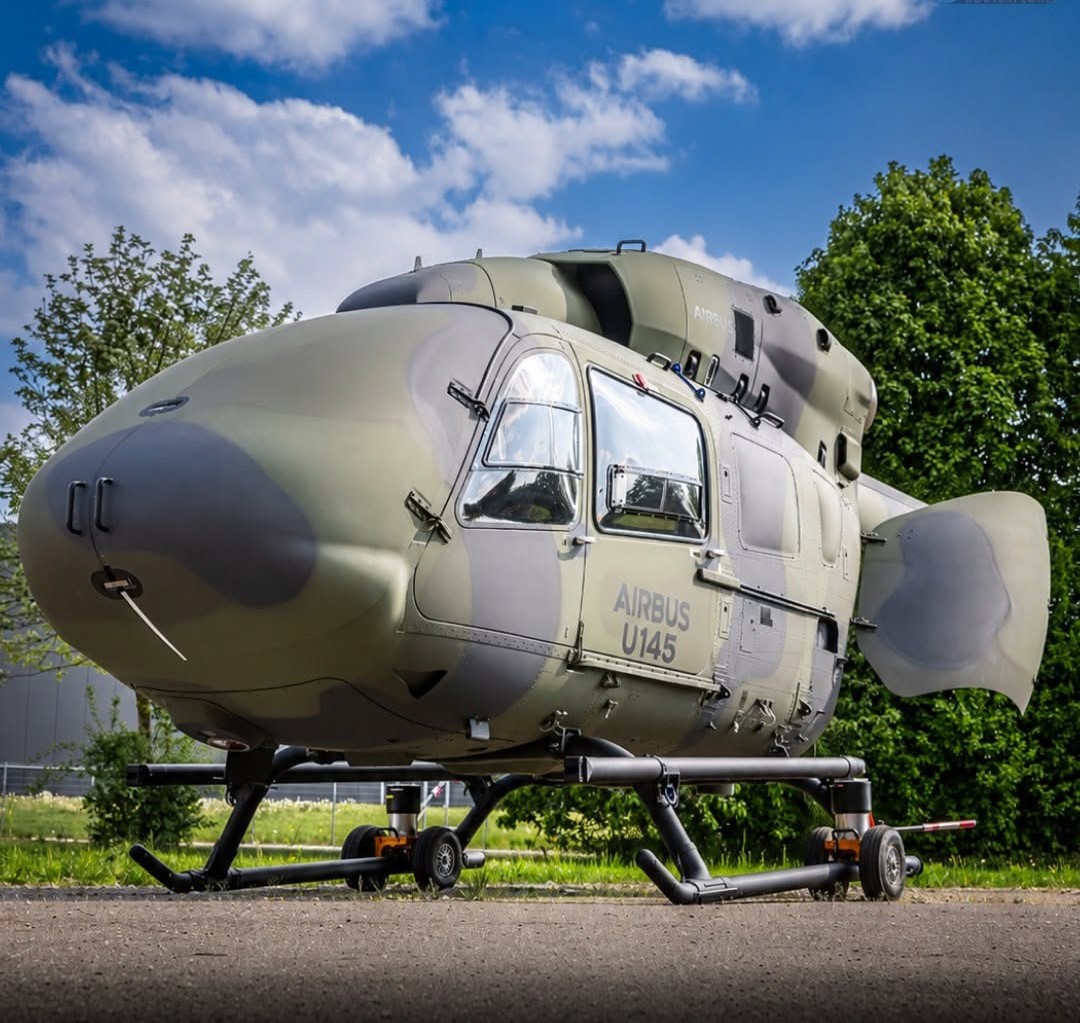
The Airbus U145 autonomous helicopter marks a significant step in the evolution of rotary-wing unmanned aviation. Revealed by Airbus Helicopters during the ILA Berlin Air Show, the new platform transforms the proven H145 helicopter into an uncrewed aircraft system capable of conducting autonomous missions across military and civilian sectors.
Airbus displayed a full-scale mock-up of the U145 at the event and announced plans for a maiden flight by the end of 2026 with a safety pilot onboard. Entry into operational service is expected in the early 2030s.
According to Airbus Helicopters CEO Matthieu Louvot, the U145 combines the payload capacity, airframe maturity, and operational experience of the H145 with the autonomy capabilities typically associated with advanced unmanned aerial systems.
Unlike the conventional H145, the U145 removes the physical cockpit entirely and replaces it with a dedicated sensor suite and artificial intelligence-driven autonomy system. Airbus says the aircraft is being optimized primarily for high-volume cargo transportation, particularly in environments where crewed operations may be risky or inefficient.
The aircraft incorporates several structural modifications, including:
– Integrated nose cargo door
– Foldable loading table
– Dedicated cargo floor
– Autonomous navigation and mission management systems
These changes are intended to streamline logistics operations while maximizing payload flexibility.
With a maximum takeoff weight of 3,800 kilograms, the U145 offers significantly greater lift capacity than many conventional unmanned aircraft currently in service.
Although logistics support is the primary focus, Airbus is positioning the U145 as a modular platform capable of supporting a wide range of future missions.
Airbus confirmed it is working with MBDA on concepts involving air-launched effects and drone mothership capabilities, reflecting growing interest among Western militaries in distributed and networked battlefield operations.