
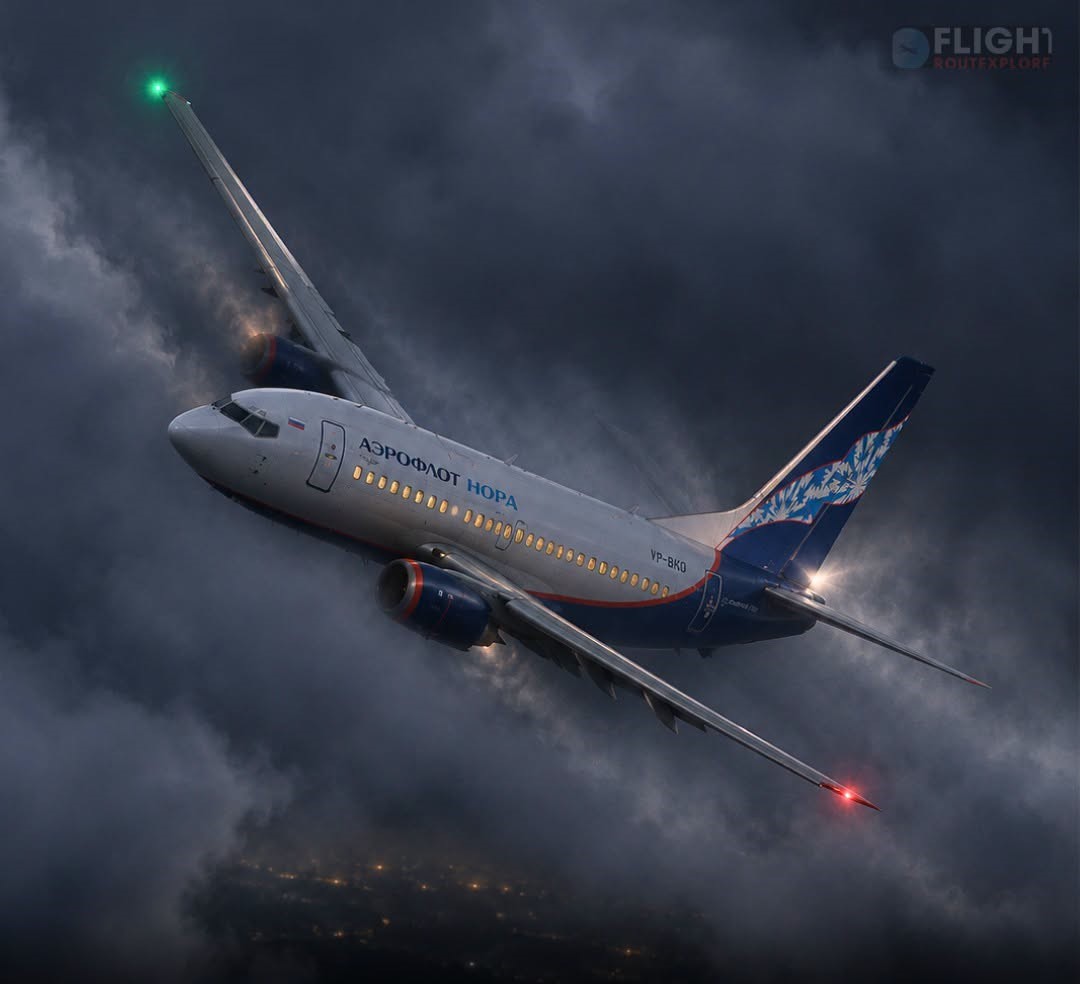
On September 14, 2008, Aeroflot-Nord Flight 821 was approaching Perm International Airport after a night flight from Moscow’s Sheremetyevo Airport. The Boeing 737-505, registration VP-BKO, carried 82 passengers and six crew members.
At about 5:10 a.m. local time, the aircraft disappeared from radar and crashed on the outskirts of Perm, near the Trans-Siberian Railway. There were no survivors. All 88 people aboard were killed, making it the deadliest accident involving a Boeing 737-500 at the time.
The approach initially appeared routine, but the crew soon encountered a rapidly developing loss-of-control situation. The aircraft was operating at night and in cloud, with the autopilot and autothrottle eventually disengaged.
A persistent difference in engine thrust created additional control difficulties, while the pilots were required to manage the throttles manually.
As the aircraft maneuvered toward the runway, it began rolling to the left. The crew attempted to correct the increasing bank, but the situation deteriorated.
Investigators later determined that the pilots had lost their spatial orientation and were no longer accurately perceiving the aircraft’s attitude. The Boeing climbed unexpectedly, rolled through an extreme bank and ultimately overturned into a steep descent.
The aircraft struck the ground at high speed and was destroyed. Wreckage was scattered across the area, with the crash also damaging tracks of the Trans-Siberian Railway. Rail traffic was temporarily diverted while rescue teams searched the wreckage. Emergency crews found no survivors.
The investigation initially faced confusion because early reports suggested that an engine fire or engine failure might have caused the disaster. Investigators ultimately rejected that explanation. Examination of the engines and flight-recording data showed that an engine failure was not the primary cause.
The final investigation identified loss of spatial orientation as the immediate cause, particularly involving the captain during the landing phase. A significant factor was the crew’s unfamiliarity with the Western-style attitude indicators installed in the Boeing.
The pilots had extensive experience on Soviet-built aircraft such as the Tu-134 and An-2, whose attitude indicators presented aircraft attitude differently. That difference became critical when the crew was already under pressure and flying without the autopilot.
Investigators also identified inadequate crew resource management, insufficient Boeing 737 training, fatigue and weaknesses in Aeroflot-Nord’s operational and maintenance practices. The aircraft had also been operated with a known throttle-control problem that increased pilot workload.
One of the most disturbing revelations came from the captain’s post-mortem examination: alcohol was detected in his body. Investigators also concluded that he had not received adequate rest before the flight. These factors were considered contributors rather than the single direct cause of the crash.
The tragedy exposed how unfamiliar cockpit systems, inadequate training, fatigue, workload and impaired performance could combine into a catastrophic loss of control.
It became a major warning about the dangers of transitioning crews from Soviet-era aircraft to Western jets without sufficiently robust training and operational oversight. Aeroflot-Nord subsequently rebranded as Nordavia in 2009, while Flight 821 remained one of Russia’s most significant modern aviation disasters.