
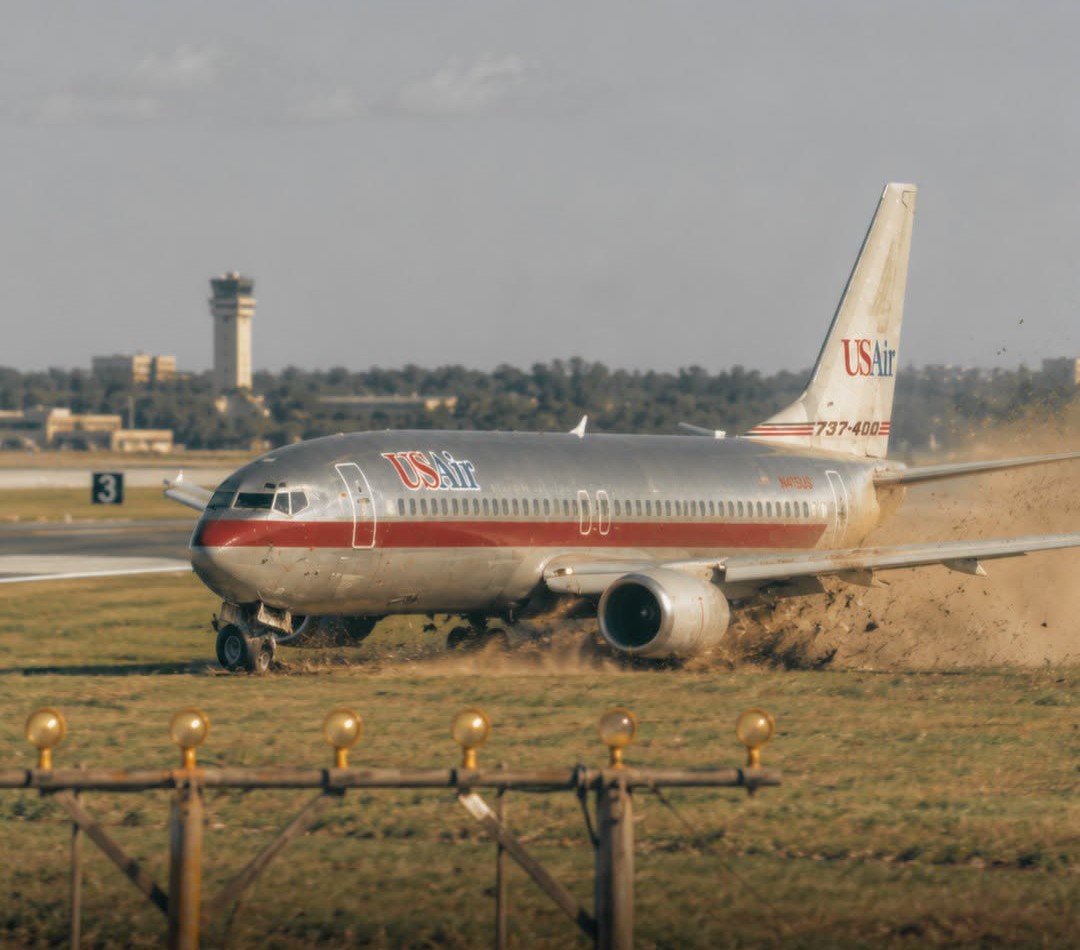
On September 20, 1989, USAir Flight 5050 was preparing to fly from New York’s LaGuardia Airport to Charlotte, North Carolina.
The Boeing 737-400, registered N416US, was carrying 57 passengers and six crew members. It was operating as a replacement for a canceled scheduled flight.
The accident unfolded within seconds of the takeoff roll. Flight 5050 was cleared to depart from Runway 31, which was wet and bordered at its departure end by an elevated approach-lighting structure over Bowery Bay.
As first officer Constantine Kleissas advanced the throttles, the aircraft began drifting to the left. Captain Michael Martin attempted to correct the movement using the nosewheel steering tiller.
The aircraft continued accelerating while the pilots struggled with directional control. A loud bang followed by a rumbling noise was heard in the cockpit. Investigators later determined that the aircraft’s left nose tire had been damaged and pulled from its wheel after excessive use of the nosewheel steering tiller.
The captain then took control and rejected the takeoff. However, the decision came after the aircraft had passed its calculated V1 speed of 125 knots; the rejection began at approximately 130 knots.
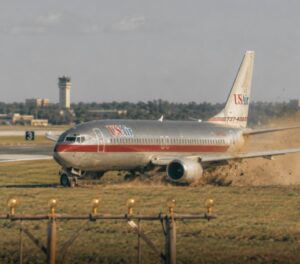
Instead of immediately achieving maximum braking, the captain initially used differential braking to steer the aircraft, delaying effective braking. The Boeing 737-400 crossed the end of the runway at about 34 knots.
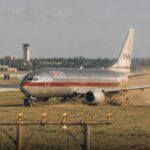
The aircraft struck a wooden approach-lighting stanchion and broke into three sections. The forward portion came to rest on the structure while sections of the fuselage were left partly submerged in Bowery Bay.
The impact created a chaotic evacuation as passengers escaped through overwing exits and other usable doors into the dark, cold water.
Around 20 passengers gathered on the aircraft’s wings while others entered the water and clung to flotation cushions, debris and runway structures. Some passengers were pulled beneath the runway deck by the current.
Rescue crews, boats, firefighters and helicopters responded rapidly, but the operation remained difficult because of the partially submerged wreckage, darkness, fuel on the water and strong movement from rescue craft. The last trapped passengers were removed roughly 90 minutes after the crash.
Two passengers were killed and 15 others were injured. The other occupants survived, many because of the rapid emergency response and successful evacuation through the overwing exits.
The subsequent NTSB investigation revealed that the aircraft had departed with its rudder trim at the extreme left position. Investigators determined that the mistrimmed rudder had created the initial directional-control problem. The crew had failed to identify the abnormal trim during preflight checks, taxiing or the takeoff preparation.
Investigators could not determine exactly how the rudder trim had moved to the full-left position while the aircraft was parked. One possibility considered was inadvertent activation of the trim control by someone seated in the jumpseat, although this could not be conclusively established.
The investigation also uncovered serious cockpit coordination problems. The captain had not conducted a detailed rejected-takeoff or emergency briefing, the first officer failed to properly engage the autothrottles at the start of the takeoff, and communication about who was controlling the aircraft became confused.
The captain also initiated the rejected takeoff above V1 and did not immediately use maximum braking.
The NTSB concluded that the primary cause was the captain’s failure to exercise command authority in time either to reject the takeoff or to take sufficient control to continue it, after the takeoff had been initiated with the rudder mistrimmed. The captain’s failure to detect the mistrimmed rudder before departure was also identified as causal.
The accident prompted safety recommendations involving rudder-trim control design, cockpit coordination, pilot training, crew pairing and water-survival procedures. Boeing 737 rudder-trim controls were subsequently modified to reduce the possibility of inadvertent movement.