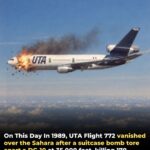

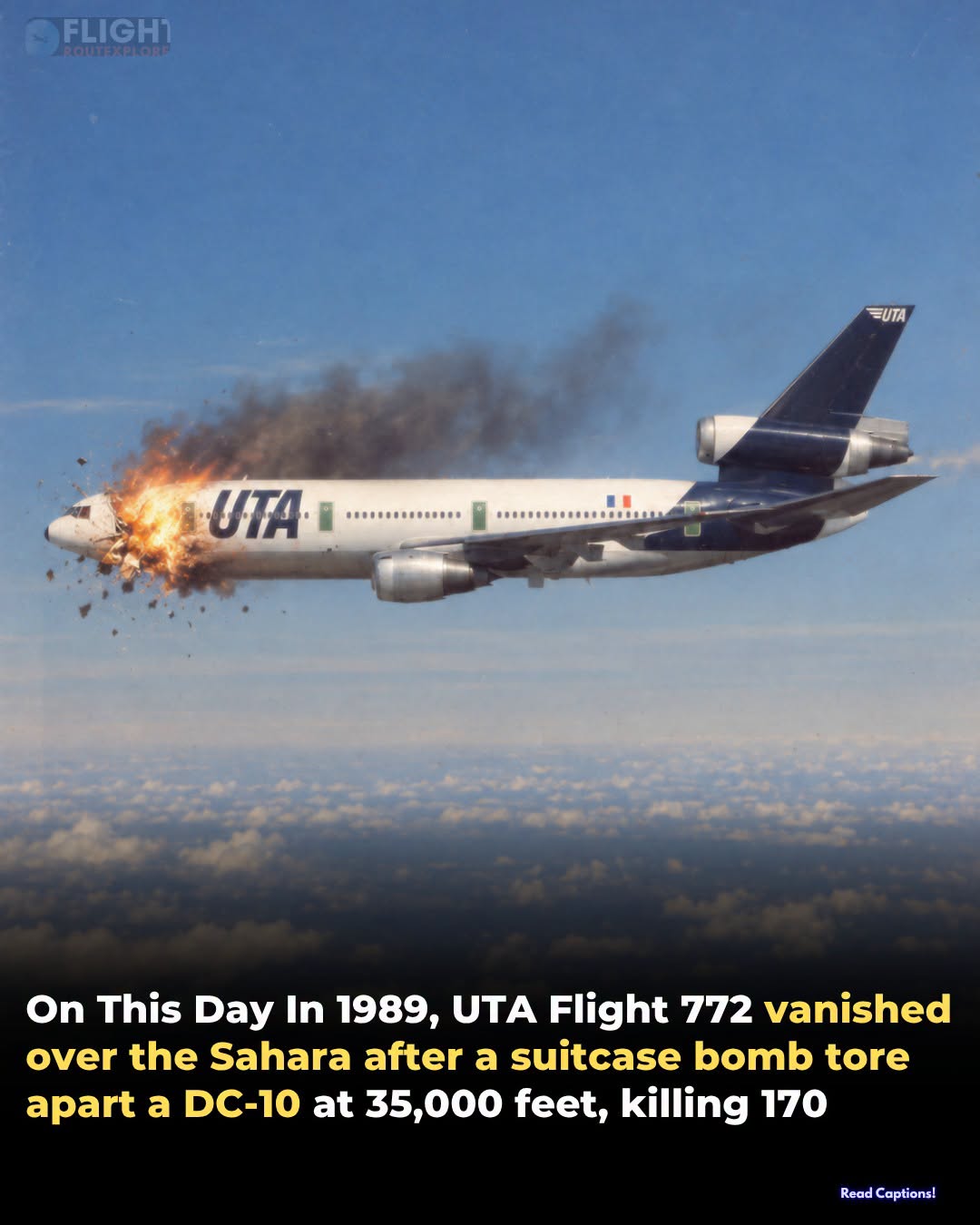
On September 19, 1989, UTA Flight 772 was operating from Brazzaville in the Republic of the Congo to Paris, with a scheduled stop at N’Djamena, Chad.
The aircraft was a McDonnell Douglas DC-10-30, registration N54629, carrying 156 passengers and 14 crew members.
After completing its stop at N’Djamena, the aircraft departed at about 13:13 local time and climbed toward its planned cruising altitude of approximately 35,000 feet.
The flight initially appeared completely normal. About 20 minutes after departure, Captain Georges Raveneau made routine contact indicating that everything was normal. There would be no further communication from the crew.
Approximately 46 minutes after leaving N’Djamena, the aircraft was cruising over the remote Ténéré Desert in Niger when a powerful explosion occurred inside the forward cargo compartment.
The blast violently damaged the aircraft, causing the DC-10 to break apart in midair. With the aircraft suddenly disintegrating at cruising altitude, there was no opportunity for the crew to issue a distress call or attempt an emergency landing.
The wreckage came down across a vast area of desert near the Termit Massif, roughly 450 kilometers east of Agadez. French and Nigerien teams reaching the site found debris and victims scattered across the harsh desert terrain.
All 170 people aboard were killed, making the bombing the deadliest aviation disaster in Niger.
Investigators initially had to determine whether a catastrophic mechanical failure could have caused the sudden breakup. The absence of a distress call, the extensive fragmentation of the aircraft and evidence recovered from the wreckage quickly pointed toward an explosion.
Examination of the wreckage and flight-recording evidence established that a bomb had detonated in the forward cargo hold.
Investigators concluded that the explosive device had been concealed inside luggage loaded before the aircraft departed Africa. Evidence eventually linked the bomb to a suitcase placed aboard the aircraft at Brazzaville.
French investigators spent years reconstructing how the device had been prepared, transported and placed on the aircraft.
The investigation ultimately focused on Libyan intelligence personnel. French authorities identified six Libyan nationals whom investigators accused of organizing the bombing, including Abdallah Senoussi, a senior Libyan intelligence official and brother-in-law of Muammar Gaddafi. In 1999, a French court convicted all six in absentia and sentenced them to life imprisonment.
Because the defendants were not present, the proceedings could not provide victims’ families with direct testimony from the accused.
The case also became intertwined with the political tensions between Libya, France and Chad during the 1980s. French investigators examined evidence suggesting the bombing was connected to Libyan state security operations, although the precise political motivation remained disputed.
The tragedy remained a painful issue for victims’ families for years. In 2004, Libya agreed to provide $170 million in compensation, equivalent to $1 million for each person killed. The settlement was reached without Libya formally admitting responsibility in the compensation agreement.
UTA Flight 772 therefore became more than a devastating aviation disaster. The investigation transformed it into a major international terrorism case, with investigators painstakingly reconstructing an attack that had destroyed a wide-body airliner thousands of feet above one of the world’s most remote regions.