
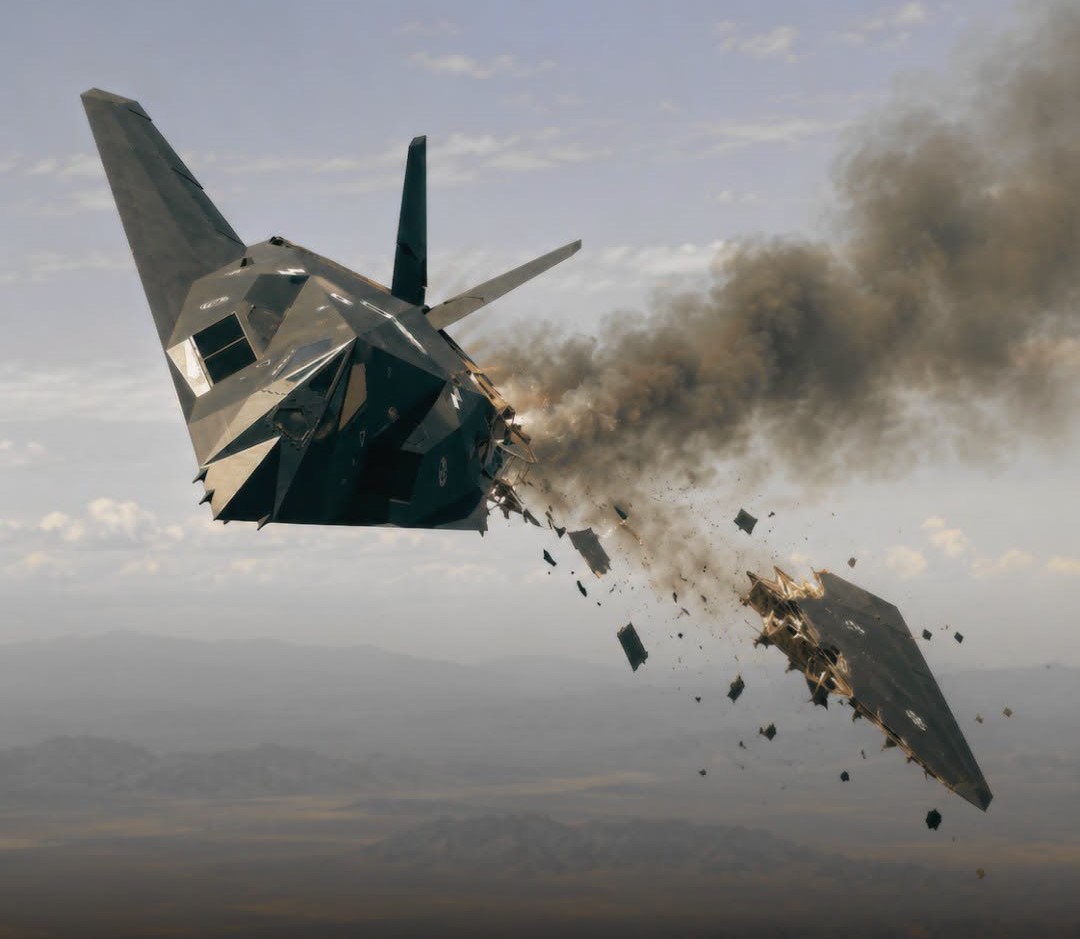
On September 14, 1997, a U.S. Air Force F-117A Nighthawk was performing at the Chesapeake Air Show at Martin State Airport near Baltimore, Maryland, when a seemingly small maintenance error caused one of the world’s most secretive aircraft to suddenly break apart.
The aircraft, serial number 81-10793, was being flown by Major Bryan “B.K.” Knight, an experienced F-117 pilot. More than 10,000 spectators had gathered for the show as the stealth fighter completed a series of passes over the airport.
During its third and final pass, the aircraft was preparing to climb away when Knight felt a violent shudder. The left wing structure failed, and the wing separated from the aircraft.
With the F-117 suddenly uncontrollable, Knight ejected safely. The aircraft plunged toward the nearby Bowleys Quarters residential area and crashed into a house, erupting into flames.
The house was destroyed, while other homes, vehicles and property were also damaged or burned. Several people on the ground suffered minor injuries, but remarkably, there were no fatalities. Knight survived with minor injuries.
The crash immediately triggered a major security and safety response. The wreckage was secured because the F-117 contained classified technology, while officials also examined possible hazards from the burning aircraft.
Residents were temporarily displaced as investigators recovered debris and examined the crash site. The Air Force grounded its F-117 fleet while the cause was investigated.
The eventual findings revealed that the spectacular failure had been caused not by pilot error, enemy action or an aerodynamic maneuver, but by a maintenance mistake dating back more than a year.
Investigators discovered that a structural support assembly inside the left wing, nicknamed the “Brooklyn Bridge,” had been improperly reinstalled during scheduled maintenance in January 1996.
The assembly required numerous fasteners, but four of the critical fasteners were missing. Over time, the improperly secured structure became increasingly flexible.
During flight, this allowed damaging vibration and movement to develop in the wing and elevon system. The problem ultimately progressed until the structure could no longer withstand the aerodynamic loads.
Even more troubling, investigators determined that later maintenance inspections had failed to identify the missing fasteners. The defective installation therefore remained undetected for roughly 20 months before the aircraft disintegrated during the airshow.
The Air Force described the accident as an unintentional maintenance oversight. Following the crash, the entire F-117 fleet was inspected, and no other aircraft was found to have the same defect.
The disaster destroyed a $40-million-plus stealth fighter, but the most extraordinary outcome was that nobody was killed. Major Knight escaped through his ejection seat, while people on the ground survived an aircraft falling directly into a residential neighborhood.
The accident became a stark reminder that even the most technologically advanced aircraft can ultimately depend on something as simple—and as critical—as correctly installed fasteners.