
On September 1, 1983, Korean Air Lines Flight 007 was flying from Anchorage, Alaska, to Seoul, South Korea, when a routine overnight passenger flight became one of the most controversial tragedies of the Cold War.
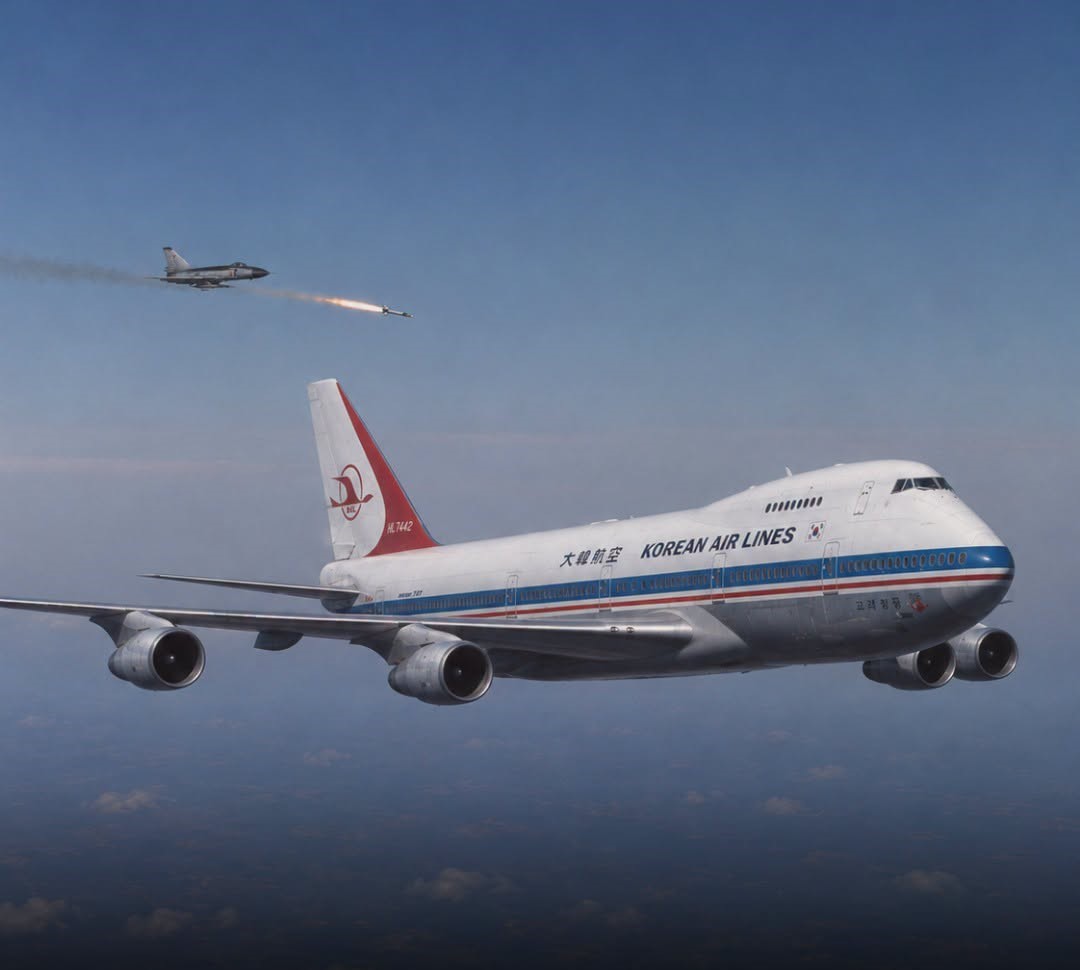
The Boeing 747-230B, registered HL7442, was carrying 246 passengers and 23 crew members. None would survive. What made the disaster especially shocking was that the aircraft had wandered hundreds of kilometres from its intended route and deep into one of the most heavily defended areas of the Soviet Union before being intercepted by a fighter and destroyed by air-to-air missiles.
Flight 007 had begun its journey in New York, departing John F. Kennedy International Airport on August 31 before stopping in Anchorage. At approximately 4:00 a.m. local time, the Boeing 747 departed Anchorage for the final leg to Seoul.
At the controls were Captain Chun Byung-in, First Officer Son Dong-hui and Flight Engineer Kim Eui-dong, all highly experienced aviators. The captain alone had more than 10,000 hours of flight experience, including over 6,600 hours on the Boeing 747. There was little reason to suspect that the flight would become anything other than a routine trans-Pacific journey.
But shortly after departure, something went wrong with the aircraft’s navigation. The flight was supposed to intercept the North Pacific airway R-20 near Bethel, Alaska, and then follow a carefully defined route toward Japan and South Korea.
Instead, KAL 007 gradually moved farther and farther north of its intended track. The deviation was not a sudden dramatic turn. That was one of the most dangerous aspects of the incident: the aircraft continued flying smoothly while slowly drifting into the wrong part of the world.
The Boeing 747’s navigation system could automatically follow a programmed route using its inertial navigation system, or INS. After takeoff, however, the aircraft initially had to fly using a selected heading before intercepting the INS route.
Investigators eventually concluded that the autopilot probably remained in HEADING mode instead of successfully transitioning to INS. Another possibility considered was that INS had been selected but could not capture the programmed route because the aircraft was already too far away from it.
The critical problem was that the crew did not recognize the growing discrepancy. Navigation checks that could have revealed the error apparently failed to expose it. The aircraft therefore continued almost perfectly along the wrong heading. By the time anyone outside the aircraft fully appreciated what was happening, KAL 007 had entered Soviet-controlled airspace.
The timing could hardly have been worse. The Cold War was extremely tense, and Soviet leaders were deeply suspicious of American military intentions. A U.S. Air
Force RC-135 reconnaissance aircraft was operating in the broader region, monitoring a Soviet missile test, while Soviet forces around Kamchatka were already on heightened alert. Against that background, an unidentified large aircraft approaching sensitive military territory looked far more threatening than an ordinary passenger flight.
When KAL 007 approached the Kamchatka Peninsula, Soviet air-defense forces scrambled fighters to intercept it. Several MiG-23s were sent after the Boeing, but command-and-control difficulties made interception difficult. The Boeing eventually crossed back into international airspace over the Sea of Okhotsk before approaching Sakhalin.
The aircraft was still being tracked. When it re-entered Soviet airspace near Sakhalin, Soviet air-defense commanders treated it as a hostile target. Su-15 interceptors were dispatched. Major Gennadiy Osipovich eventually closed in on the Boeing 747.
This is where the tragedy took an irreversible turn.
Osipovich later said that he could see the aircraft’s windows and knew it was a Boeing. In a later interview, he acknowledged that he understood it was a civilian-type aircraft, but believed that a civilian aircraft could potentially be modified for military intelligence purposes. At the same time, Soviet commanders on the ground were debating what exactly the aircraft was. Some wanted positive identification, while others argued that its penetration of Soviet territory was enough to justify destruction.
Osipovich fired cannon bursts as warning shots, but the ammunition was not tracer ammunition, meaning the crew of KAL 007 may not have been able to see them. Crucially, later evidence showed that there was no effective radio communication between the interceptor and the airliner establishing that KAL 007 had been ordered to land. The situation became even more confusing when KAL 007 requested permission from Tokyo Area Control to climb to a higher altitude for fuel economy. The request was approved.
The climb slowed the Boeing and caused the pursuing Su-15 to overshoot. To the Soviet pilot, the manoeuvre appeared potentially evasive. Ground controllers were also concerned that the aircraft was about to escape Soviet airspace. At approximately 18:26 UTC, Osipovich fired two missiles at the Boeing.
The first missile exploded approximately 50 metres behind the aircraft. Its fragments tore through the rear fuselage and damaged critical systems. The explosion caused rapid decompression of the passenger cabin and damaged hydraulic systems, including systems associated with the elevator and autopilot. The second missile also inflicted damage, but later analysis determined that the interceptor’s description of catastrophic wing damage was inaccurate.
And then came one of the strangest parts of the disaster.
The Boeing did not immediately fall from the sky.
Despite the missile strike, its engines continued operating. The aircraft actually climbed from about 35,000 feet to approximately 38,250 feet. The damaged control systems and autopilot behaviour complicated the crew’s attempts to control the aircraft. About 20 seconds after the explosion, the autopilot disconnect warning was heard. The crew then attempted to regain control manually, but the damaged hydraulic systems delayed the response.
For several minutes, KAL 007 remained airborne. One of the final radio transmissions to Tokyo indicated that the crew was dealing with rapid decompression and requested a descent to 10,000 feet. Soviet controllers, meanwhile, initially believed that the target had been destroyed, only to discover that it was still flying. The damaged aircraft eventually descended in a spiral toward the sea near Moneron Island, west of Sakhalin. Radar tracking ended as the aircraft disappeared from view.
All 269 people aboard were killed.
The aftermath was almost as extraordinary as the shoot-down itself. Search operations immediately became entangled in Cold War confrontation. Soviet, American, Japanese and South Korean forces searched the region, but they did not operate as a unified rescue effort. Naval forces from opposing sides maneuvered around one another while simultaneously searching for the aircraft’s wreckage and its flight recorders.
The Soviet Union initially refused to acknowledge that it had shot down the airliner. Its first public statements said that Soviet fighters had intercepted an unidentified aircraft that had violated Soviet airspace. Only after the United States publicly released intercepted Soviet communications did Moscow admit that the aircraft had been destroyed. The Soviet government nevertheless insisted that the aircraft could have been conducting an intelligence mission.
The United States responded by releasing an extraordinary amount of previously classified intelligence, including recordings of Soviet military communications. The evidence was presented at the United Nations, dramatically exposing what had happened and increasing international condemnation of Moscow. President Ronald Reagan described the incident as a horrific act and a major international outrage.
The first ICAO investigation, completed in December 1983, concluded that KAL 007 had entered Soviet airspace accidentally. Investigators identified the likely cause as a navigation error involving the autopilot and INS. The crew apparently failed to recognize that the aircraft was diverging from its planned route, a failure later characterized as a lack of situational awareness and flight-deck coordination.
But the investigation was severely limited because some of the most important evidence was unavailable. The Soviet Union claimed that it had not recovered the flight recorders. Years later, that claim proved false.
After the collapse of the Soviet Union, Russian President Boris Yeltsin revealed that Soviet authorities had actually recovered the cockpit voice recorder and flight data recorder. In 1992, he released the recorder containers and related documents, and the tapes were subsequently provided to ICAO. Soviet memoranda revealed that officials had known about the recorders and had deliberately kept their existence secret. One memo indicated concern that the recordings might fail to support the Soviet claim that KAL 007’s penetration of Soviet territory had been deliberate.
The reopened ICAO investigation in 1993 was therefore able to examine the cockpit recordings and Soviet air-defense communications. The new evidence continued to support the conclusion that the aircraft’s route deviation was accidental. The cockpit conversations were consistent with the possibility that the Boeing had remained on a constant magnetic heading instead of following the programmed INS route, or that the INS had been engaged after the aircraft had already moved beyond the system’s ability to capture the intended track.
The newly released Soviet communications also revealed an uncomfortable truth about the interception. The evidence did not establish that KAL 007 had received an effective radio warning before the missile attack. A later Soviet memorandum acknowledged that the recovered recordings showed no attempt by the interceptor to establish radio contact with the airliner on the international emergency frequency and no visible tracer warning shots.
The disaster permanently changed aviation safety and international politics. The United States expanded radar coverage for aircraft departing Alaska and established additional monitoring systems over the North Pacific. In 1986, the United States, Japan and the Soviet Union established a joint air-traffic-control arrangement for the region, including direct communication links between controllers.
The tragedy also accelerated the civilian adoption of satellite navigation. President Reagan directed that GPS technology eventually be made available for civilian use, helping lay the groundwork for the satellite-navigation systems that would later become fundamental to modern aviation.
Perhaps the most important lesson from KAL 007 was that there was no single mistake that fully explains the disaster. A navigation error put the aircraft where it should never have been. The crew failed to recognize the growing deviation. Soviet radar and command systems struggled to intercept and identify the aircraft. Cold War paranoia transformed an unidentified passenger jet into a perceived military threat. The interceptor pilot knew he was looking at a Boeing but did not establish that it was a civilian airliner before firing. And after the shooting, political secrecy delayed the full truth for years.
The Boeing 747 had not set out to enter Soviet airspace. It had been carrying ordinary passengers toward Seoul. Yet a small navigation error, left undetected for hours, carried it into one of the most dangerous airspaces on Earth at precisely the wrong moment.
On September 1, 1983, 269 lives were lost. But the story of Flight 007 did not end when the aircraft disappeared beneath the Sea of Japan. It continued through years of political accusations, secret documents, disputed searches and unanswered questions, until the collapse of the Soviet Union finally exposed evidence that had been hidden for nearly a decade.
Even after the recorders were recovered, one mystery remained particularly haunting: why did the Soviet military choose to destroy an aircraft whose identity had never been conclusively established, despite the interceptor pilot later acknowledging that he could see it was a Boeing and that it appeared to be a civilian aircraft? The answer lay not simply in aviation error, but in the extraordinary fear and mistrust of the Cold War.