
On September 21, 2001, Aeroflot Flight 521 was approaching Dubai International Airport after an otherwise uneventful flight from Moscow’s Sheremetyevo Airport.
The aircraft, an Ilyushin Il-86 registered RA-86074, was carrying 307 passengers and 15 crew members. What happened during the final stages of the approach turned the routine arrival into a potentially catastrophic accident.
As the aircraft prepared to land, the crew used a non-standard procedure intended to reduce noise during the approach. The landing gear circuit breaker had been switched off so that the flaps could be extended before the landing gear.
The flight engineer subsequently operated the landing gear controls, but the circuit breaker was not reactivated. As a result, the landing gear did not actually extend, although the crew failed to recognize the problem.
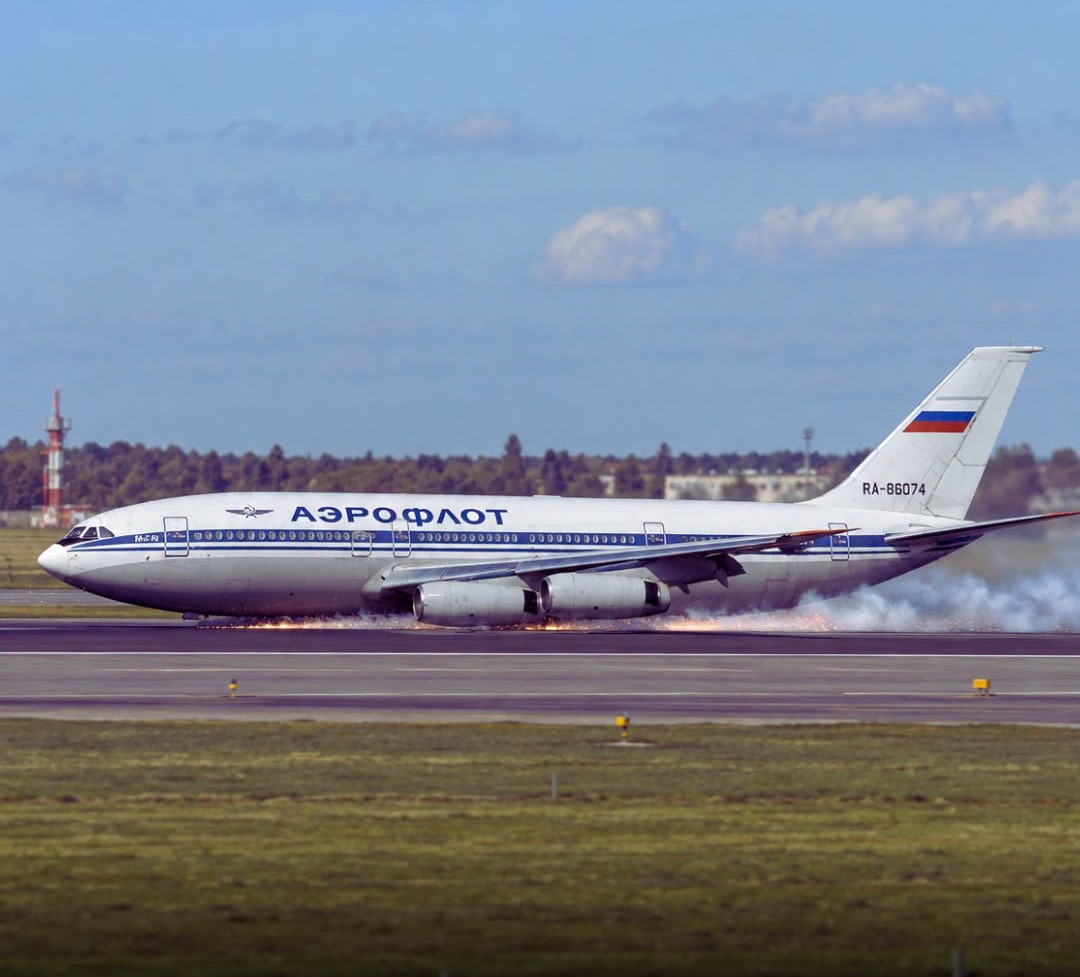
The aircraft continued its approach toward Dubai with the landing gear still retracted. At approximately 20:09 local time, Flight 521 touched down on Runway 30R on the underside of its fuselage.
The enormous Il-86 scraped along the runway and slid to a stop. The impact and friction caused fires involving engines two and three and the rear cargo compartment, creating a serious emergency for the occupants.
Airport emergency crews responded rapidly and extinguished the fires. Despite the severity of the belly landing and the subsequent fire, all 322 people aboard escaped alive.
There were no fatalities, making the accident a remarkable example of an event that could have produced a much higher death toll.
The investigation involved the Interstate Aviation Committee, Russia’s Federal Air Transport Agency, Ilyushin and Aeroflot. Investigators determined that the accident was primarily linked to crew actions during the approach.
The landing-gear circuit breaker had not been restored after the non-standard configuration, and the crew failed to recognize that the landing gear remained retracted. Investigators also identified shortcomings in crew coordination and resource management, along with violations of established procedures.
The consequences continued after the emergency. The damaged Il-86 was declared a write-off. Aeroflot compensated each passenger with an amount equivalent to about US$400 and paid Dubai International Airport approximately US$10 million because the disabled aircraft blocked Runway 30R and disrupted airport operations for about 13 hours. The pilots subsequently lost their certificates, while the captain was dismissed.
The aircraft was later stripped for parts and eventually scrapped. By 2003, the remains had been disposed of and the airframe ultimately sank in the Persian Gulf.
Aeroflot Flight 521 remains a striking aviation incident because the aircraft came down without its landing gear and suffered significant fire damage, yet every person on board survived.
The investigation highlighted how an unusual procedure, a missed switch or circuit-breaker action, inadequate cross-checking and poor crew coordination could combine during a critical phase of flight.