
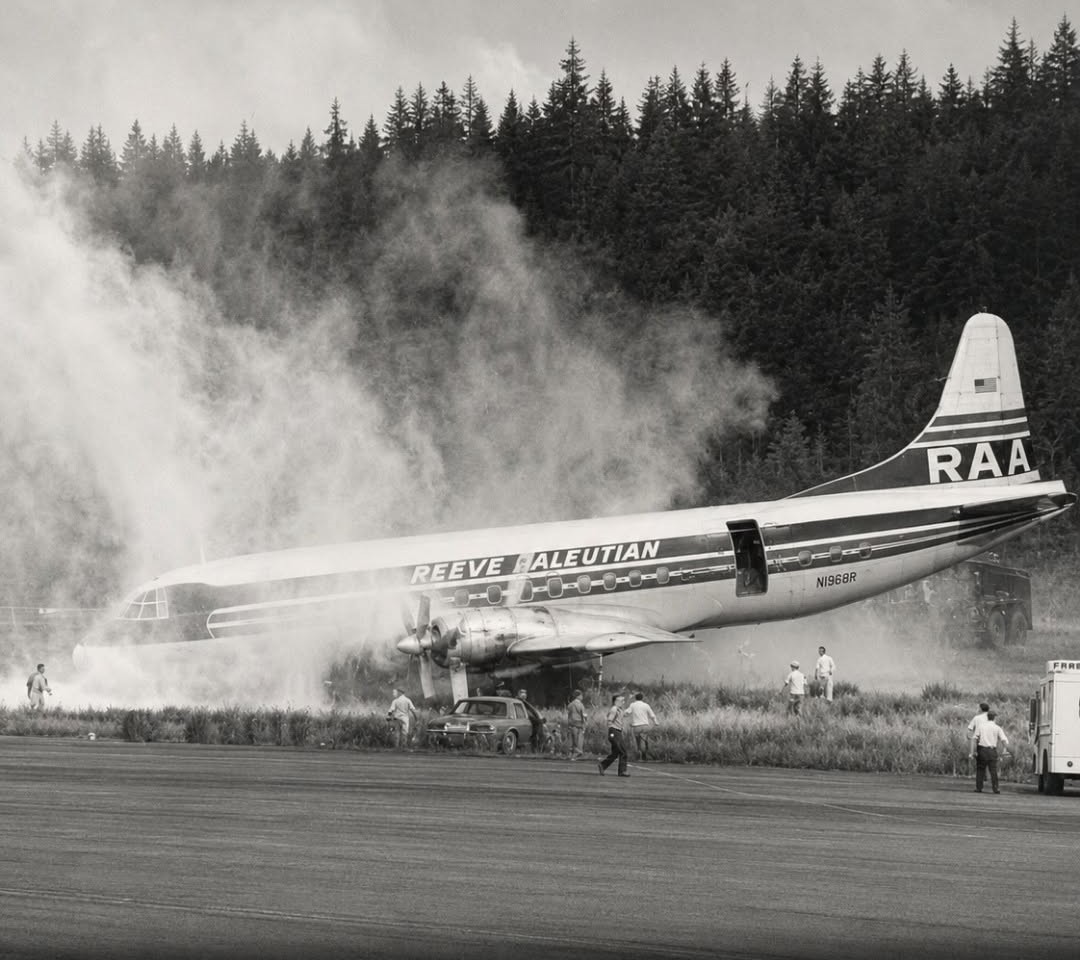
On June 8, 1983, one of the most extraordinary aviation survival stories ever recorded unfolded over the North Pacific. What began as a routine Reeve Aleutian Airways flight from Cold Bay, Alaska, to Seattle turned into a life-threatening emergency when an entire propeller separated from the aircraft in flight, tore through the fuselage, and left the crew struggling to control a severely damaged airliner. Against overwhelming odds, every person on board survived.
Reeve Aleutian Airways Flight 8 was operated by a Lockheed L-188 Electra, a four-engine turboprop airliner carrying 10 passengers and 5 crew members. Shortly after departing Cold Bay, the crew noticed an unusual vibration somewhere on the aircraft. At first, the vibration did not appear severe enough to indicate an emergency, but it was concerning enough that the flight engineer left the cockpit and walked into the passenger cabin to visually inspect the engines and propellers. Despite the vibration, he could not see anything obviously wrong.
The aircraft continued climbing from approximately 19,000 feet toward its cruising altitude of 25,000 feet. As the flight attendant entered the cockpit to discuss the unexplained vibration with the pilots, the shaking suddenly intensified. A loud bang was heard, followed by rapid decompression. When the flight attendant looked out a cabin window moments later, she was shocked to discover that the No. 4 propeller on the outer right engine was gone.
The situation immediately became catastrophic. The separated propeller did not simply fall into the ocean. It struck the aircraft itself, slicing a large hole into the underside of the fuselage. The impact caused rapid cabin decompression and extensive structural damage. More dangerously, parts of the aircraft’s control systems were damaged, leaving the crew with significantly reduced control authority and limited ability to maneuver the aircraft normally.
Inside the cockpit, the pilots quickly realized they were facing an unprecedented emergency. The damage had affected multiple systems, and normal flight characteristics had changed dramatically. Engine power controls were also affected, with the throttles becoming difficult or impossible to move from their existing settings. The aircraft remained flyable, but controlling it would require exceptional skill and improvisation.
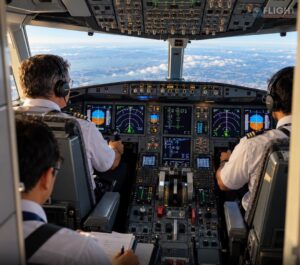
Faced with a life-threatening situation over cold ocean waters, Captain James Gibson, First Officer Gary Lintner, and Flight Engineer Gerald “Moose” Laurin began searching for any way to maintain control. They discovered that the autopilot system could still provide valuable assistance despite the extensive damage. By carefully combining autopilot inputs with the remaining flight controls, they managed to stabilize the aircraft and keep it airborne.
Returning to Cold Bay was considered impractical, so the crew elected to divert to Anchorage, where a longer runway and greater emergency support were available. During the diversion, the crew continually adapted to the aircraft’s damaged condition. Because conventional power management was limited, they used a combination of engine shutdowns, landing gear deployment, and careful flight planning to control their altitude and speed. Every phase of the flight required creative problem-solving as the crew worked to keep the damaged Electra under control.
As the aircraft approached Anchorage, the challenge became even greater. Landing an aircraft with damaged controls and limited engine management capability presented enormous risks. Nevertheless, the crew successfully lined up with the runway and brought the Electra safely to the ground.
Because the throttles remained jammed, the crew shut down the engines after touchdown to eliminate residual thrust and help stop the aircraft. During the landing roll, a tire burst and intense braking generated enough heat to ignite brake fires. The aircraft eventually departed the runway and came to rest in a ditch. Remarkably, none of the 15 people on board suffered serious injuries.
The successful landing immediately attracted attention throughout the aviation world. Pilots and investigators alike were astonished that the crew had managed to save the aircraft despite the extensive damage. Captain Gibson later received recognition from President Ronald Reagan, while the Air Line Pilots Association awarded Gibson, Lintner, and Laurin its Superior Airmanship Award for their exceptional handling of the emergency.
Investigators then turned their attention to the central mystery: why had the propeller separated in the first place? Unfortunately, the most important piece of evidence was never recovered. After striking the aircraft, the propeller fell into the Pacific Ocean and disappeared. Despite efforts to locate it, the propeller was never found.
As a result, investigators were unable to determine the precise mechanical failure that caused the separation. They concluded that the emergency began with the loss of the No. 4 propeller, but the underlying cause could not be established because the propeller itself was unavailable for examination. The exact reason for the failure therefore remains one of aviation’s enduring mysteries.
One of the most surprising aspects of the story is that the aircraft itself was not written off. Despite suffering severe structural damage and one of the most dramatic in-flight failures ever survived by a commercial airliner, the Electra was repaired and returned to service. Years later, it was converted into an aerial firefighting aircraft in Canada, continuing to fly long after the incident that nearly destroyed it.
More than four decades later, Reeve Aleutian Airways Flight 8 remains a remarkable example of crew resourcefulness, calm decision-making, and exceptional airmanship. While the mystery of the missing propeller has never been solved, the actions of the flight crew transformed what could have become a major tragedy into one of aviation history’s greatest survival stories.