
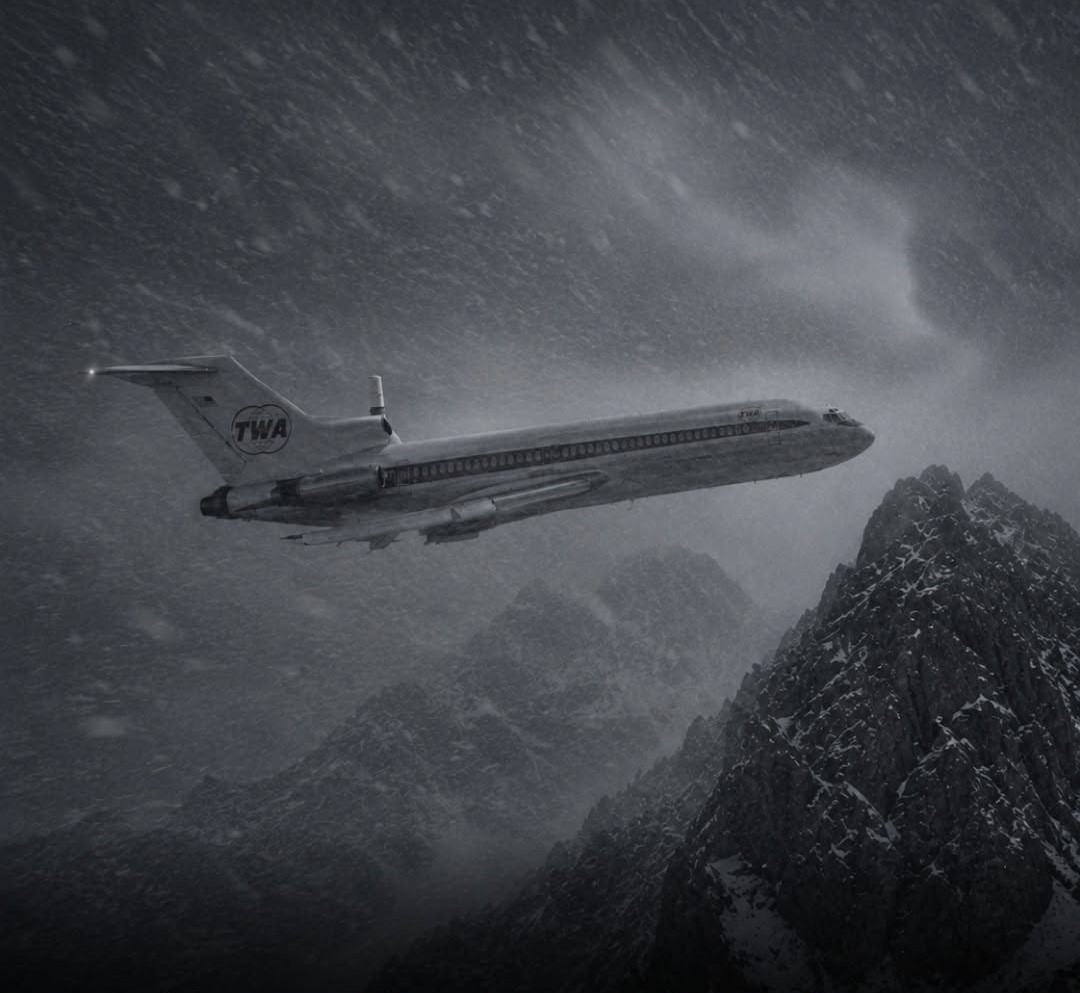
On December 1, 1974, Trans World Airlines Flight 514, a Boeing 727-231, departed Indianapolis with a stop in Columbus before continuing toward the Washington, D.C. area. On board were 85 passengers and 7 crew members. None of them knew they were about to become part of one of the most influential aviation accidents in history.
The flight was originally destined for Washington National Airport, but poor weather, strong crosswinds, snow showers, turbulence, and low visibility forced air traffic controllers to divert the aircraft to Washington Dulles International Airport. The crew began preparing for a non-precision instrument approach to Runway 12 at Dulles while flying through deteriorating weather conditions.
Controllers vectored the aircraft toward the approach course and instructed the crew to descend to 7,000 feet. Later, they issued the phrase “cleared for the approach,” a common instruction at the time. The problem was that pilots and controllers often interpreted that phrase differently. Many pilots believed it authorized them to descend to the minimum altitude associated with the approach, while controllers believed previously assigned altitude restrictions remained in effect until the aircraft reached a published segment of the procedure.
Believing they could continue descending, the crew left 7,000 feet and descended toward 1,800 feet, the altitude shown at the first approach fix on the chart. However, they had not yet reached the point where that altitude was safe. The Boeing 727 was still many miles away from the protected approach segment and was flying toward mountainous terrain hidden by clouds, snow, and poor visibility.
Inside the cockpit, the crew discussed turbulence, downdrafts, and the challenging weather. The aircraft remained fully under control, its engines were operating normally, and its navigation systems were functioning correctly. This was not a mechanical failure. Instead, it became one of aviation’s most notable Controlled Flight Into Terrain (CFIT) accidents — a situation where a fully functional aircraft is inadvertently flown into the ground.
At approximately 11:09 a.m. local time, while traveling at roughly 230 knots, the Boeing 727 slammed into the western slope of Mount Weather, Virginia. The impact destroyed the aircraft instantly, killing all 92 people on board.
An unusual detail emerged in the aftermath. Mount Weather was home to a secret U.S. government emergency operations facility designed to maintain government continuity during a national crisis or nuclear war. The crash unexpectedly brought public attention to the existence of the highly classified site. Although the underground complex was unharmed, a major communications line serving the facility was severed during the accident.
Investigators quickly determined that the aircraft had been following the correct general route toward Dulles but had descended too early. The National Transportation Safety Board concluded that the primary cause was a dangerous misunderstanding between pilots and air traffic controllers regarding approach clearances and altitude restrictions. The wording used by controllers was technically correct under the procedures of the day, but many pilots interpreted it differently, creating a hidden hazard within the aviation system.
One of the most shocking revelations during the investigation was that another airliner had nearly crashed in an almost identical situation on the same approach route only six weeks earlier. That incident had not been properly reported or shared throughout the aviation community. The discovery highlighted the need for a system that would allow pilots and controllers to confidentially report safety concerns and near misses without fear of punishment.
The tragedy directly contributed to the creation of the Aviation Safety Reporting System (ASRS), which remains one of the most important aviation safety programs in the world today. It also led to major changes in air traffic control phraseology, ensuring that altitude restrictions were communicated far more clearly. In addition, the accident accelerated the widespread adoption of Ground Proximity Warning Systems (GPWS), technology that alerts crews when an aircraft is dangerously close to terrain.
The legacy of TWA Flight 514 extends far beyond the mountainside where it crashed. The accident demonstrated how a simple misunderstanding, rather than a mechanical failure, could bring down a modern airliner. The lessons learned transformed pilot-controller communication, improved terrain awareness technology, and helped prevent countless future accidents.
More than five decades later, TWA Flight 514 remains a powerful reminder that in aviation, even a few misunderstood words can have catastrophic consequences. The loss of 92 lives led to safety improvements that continue to protect millions of passengers around the world every year.