
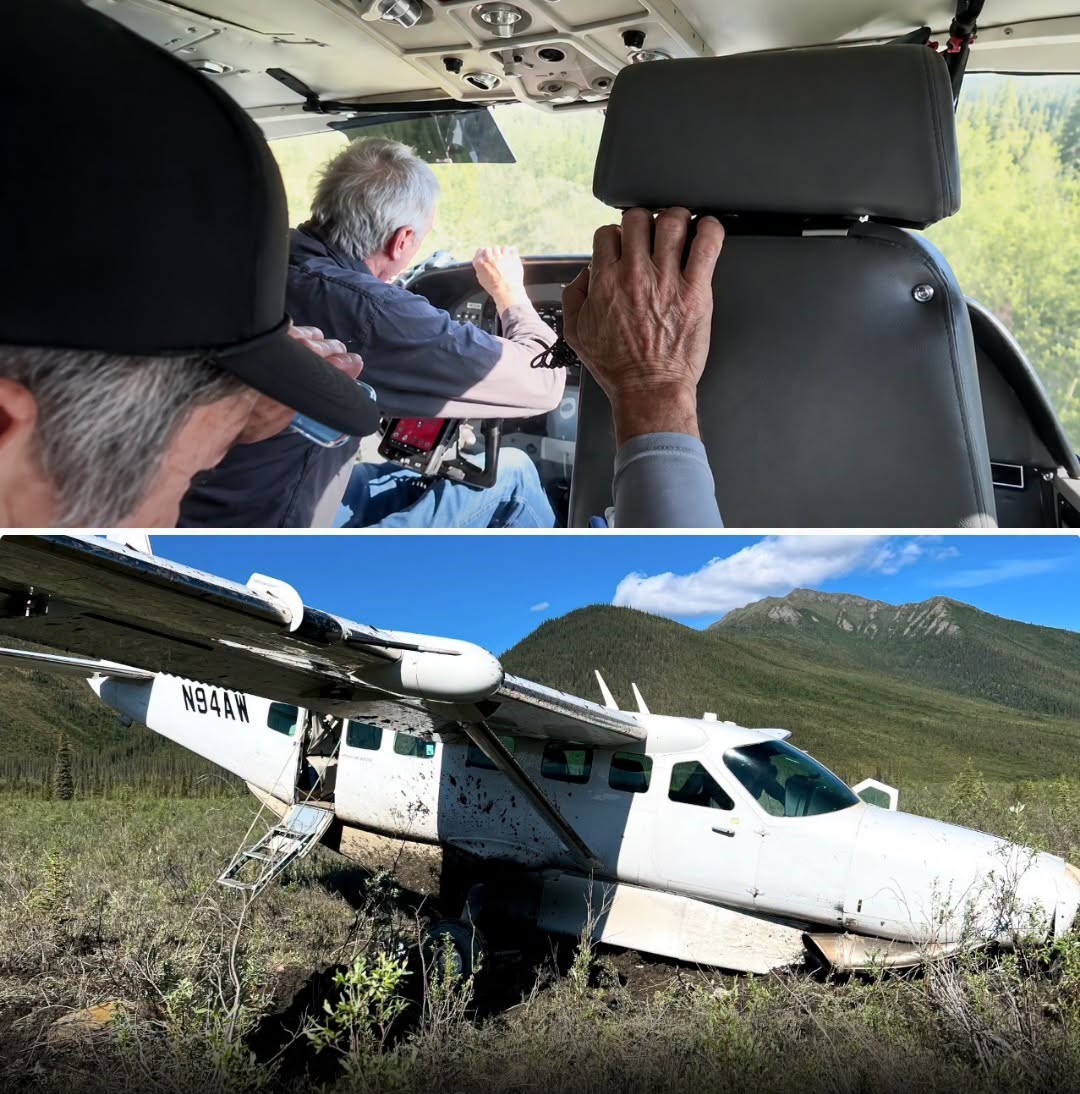
A routine commuter flight through Alaska’s remote Brooks Range turned into a terrifying survival story after a Wright Air Service Cessna 208 Caravan experienced a serious engine problem just minutes after takeoff from Coldfoot.
The aircraft, carrying a pilot and nine passengers on its way to Anaktuvuk Pass, reportedly began suffering engine surges accompanied by an unusual whining and groaning noise. Unable to maintain altitude, the experienced pilot made the critical decision to perform an emergency off-airport landing on a remote stretch of glacial terrain about 20 miles north-northwest of Coldfoot.
Despite the challenging conditions, the pilot successfully brought the aircraft down on a gravel-covered area surrounded by trees. The pilot suffered only a minor injury, while all nine passengers escaped without injury.
One of the passengers captured the dramatic ordeal on video, documenting both the emergency landing and the helicopter rescue that followed. The group remained at the crash site for around 30 minutes before another aircraft spotted them. Helicopters operating in the area later rescued everyone and transported them safely back to Coldfoot.
According to the U.S. National Transportation Safety Board (NTSB), initial information points toward a possible engine malfunction. Investigators say the aircraft’s engine reportedly began surging five to ten minutes after departure and produced abnormal sounds consistent with the pilot’s account.
The aircraft’s emergency locator transmitter (406 ELT) activated immediately after the landing, while the operator’s SpiderTracks flight monitoring system helped rescuers quickly locate the aircraft in the remote wilderness.
Investigators do not believe weather played a role in the incident. Recovery of the damaged aircraft is now underway, although the remote location requires a heavy-lift helicopter. The investigation will examine the engine, maintenance records, pilot experience, and environmental conditions.
The pilot, described by investigators as one of Wright Air Service’s most experienced Caravan captains with thousands of flight hours, has been praised for selecting an excellent forced landing site that likely prevented a far more serious accident.
Because the Cessna Caravan and its Pratt & Whitney Canada engine are widely used across Alaska’s air taxi fleet, investigators are working quickly to determine whether this was an isolated failure or something that could affect other aircraft.
A preliminary NTSB report is expected within approximately 15 days, while the final investigation could take up to 18 months.