
On June 26, 1988, one of the most controversial accidents in aviation history unfolded during what was meant to be a celebration of the revolutionary Airbus A320. Air France Flight 296Q, operated by Air Charter International on behalf of Air France, was conducting a demonstration flight at the Habsheim Air Show in eastern France.
The aircraft had been delivered only three days earlier and was making its very first passenger flight. On board were 136 people, including journalists, aviation enthusiasts, invited guests, and competition winners who had boarded for a sightseeing flight.
The Airbus A320 was being promoted as the future of commercial aviation. It featured an advanced digital fly-by-wire flight control system and computerized flight protections unlike anything previously seen on a commercial airliner.
The demonstration was intended to showcase these capabilities before thousands of spectators gathered along the runway.
The flight departed Paris Charles de Gaulle Airport and arrived at Basel-Mulhouse Airport before continuing to the small Habsheim Airfield for the scheduled flypast. The display plan called for the aircraft to fly along the runway with its landing gear extended and flaps configured for landing at approximately 100 feet above the ground while maintaining a very slow speed.
After passing the spectators, the pilots would apply full power, climb away, turn around, and repeat the maneuver in the opposite direction before continuing on a sightseeing flight toward Mont Blanc.
Captain Michel Asseline, an experienced Air France captain and one of the airline’s A320 instructors, was flying the aircraft. Because Habsheim was too small to be included in the aircraft’s flight management computer database, the approach had to be conducted visually. The crew had received only limited information about the airfield and had never flown there before.
As the aircraft approached the runway, everything initially appeared normal. The landing gear was down, the flaps were fully extended, and the engines were operating at idle thrust to maintain the slow demonstration speed.
However, instead of stabilizing at the planned altitude of around 100 feet, the aircraft gradually descended much lower. Witnesses and flight recorder data later showed the Airbus leveling off at roughly 30 feet above the ground while flying at approximately 122 knots with a very high nose-up attitude.
From the cockpit, the runway and surrounding terrain appeared different than expected. At the far end of the runway stood a dense forest that had not been prominently highlighted during planning. Flying at only around 30 feet left virtually no safety margin.
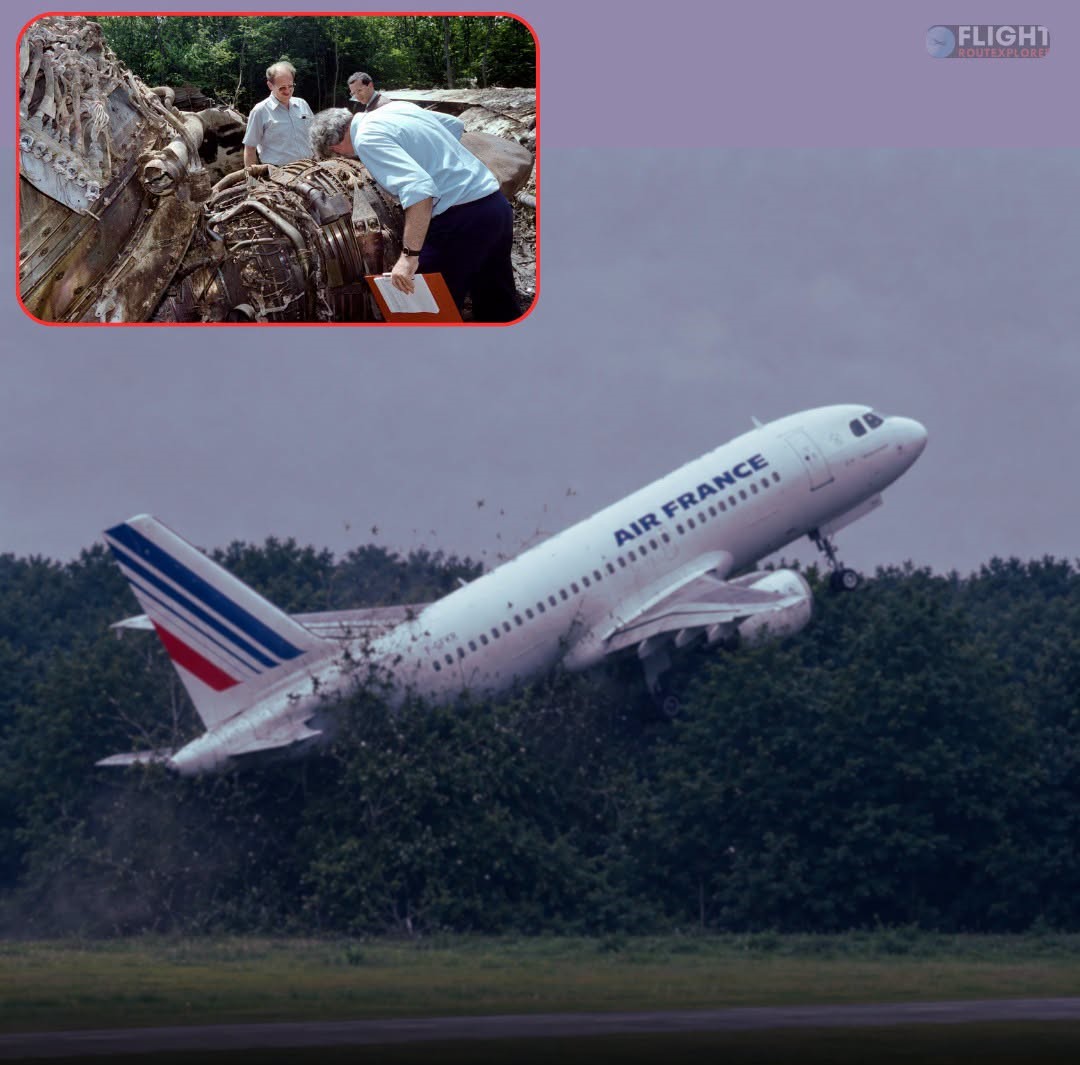
As the aircraft continued its low pass, the captain realized the danger and commanded a go-around. The throttles were advanced to full takeoff power, but modern turbofan engines require several seconds to accelerate from idle to maximum thrust. At such a low altitude, there simply was not enough time or distance for the engines to develop the necessary power. While the engines were still spooling up, the Airbus struck the tops of the trees beyond the runway.
The impact tore away branches before the aircraft plunged into the forest. It slid through the trees, broke apart, and burst into flames. The violent crash occurred directly in front of thousands of horrified spectators, many of whom captured the accident on video cameras. The footage quickly spread around the world and became one of the most widely analyzed aviation accident recordings ever made.
Remarkably, everyone initially survived the impact itself. Emergency responders rushed to the burning wreckage as passengers and crew attempted to evacuate through smoke and flames. Many escaped with injuries, but three passengers later died from smoke inhalation. Among the victims were two children. Around fifty people suffered injuries of varying severity, while 133 survived the accident.
The crash immediately raised difficult questions because it involved one of the world’s newest commercial aircraft and the first fatal accident involving the Airbus A320. Investigators from France’s Bureau of Enquiry and Analysis (BEA), assisted by Airbus and Air France, launched a comprehensive investigation.
The flight data recorder and cockpit voice recorder were recovered from the relatively intact tail section. Their data showed that the aircraft itself was functioning normally before the collision. Investigators found no evidence of engine failure, flight control malfunction, or fly-by-wire system defects.
The investigation reconstructed the final seconds of the flight in detail. It determined that the aircraft had descended to approximately 30 feet instead of the planned 100 feet, while maintaining engines at idle and an extremely slow airspeed. When the pilots finally selected maximum thrust for the go-around, the engines responded exactly as designed, but they required several seconds to accelerate from idle power. Those few seconds proved fatal because the aircraft reached the trees before sufficient thrust became available.
The official report concluded that several factors combined to produce the accident. The crew flew significantly lower than intended, they underestimated the proximity of the forest beyond the runway, they delayed initiation of the go-around, and they relied on visual judgment at an unfamiliar airfield. Investigators stated that the aircraft’s systems, including its fly-by-wire protections, performed correctly throughout the event and were not responsible for the crash.
Captain Asseline strongly disputed these conclusions. He argued that the aircraft’s computerized flight control system had prevented an immediate climb and that engine response had been delayed by software logic. He also questioned aspects of the flight recorder evidence and maintained his innocence for the rest of his life. These claims fueled years of debate among aviation enthusiasts and generated numerous conspiracy theories suggesting recorder tampering or system failures.
Independent reviews and documentaries examined these allegations extensively, but no official investigation found evidence supporting claims of black box substitution or intentional manipulation of evidence. Airbus also published detailed technical responses explaining why the aircraft behaved according to its certified design.
The legal aftermath was equally controversial. Several individuals, including Captain Asseline, the first officer, Air France officials, and organizers connected with the demonstration, were convicted of involuntary manslaughter. Captain Asseline ultimately served ten months in prison followed by probation, although he continued to insist that the aircraft’s automation contributed significantly to the tragedy.
The accident prompted important changes in aviation demonstration procedures. Demonstration flights carrying passengers became far more restricted, greater emphasis was placed on detailed airfield familiarization, and display routines involving large transport aircraft received stricter planning and oversight. The accident also highlighted the importance of understanding engine spool-up time during low-energy maneuvers and reinforced that even the most advanced flight control computers cannot overcome the basic laws of aerodynamics when an aircraft is flown too low with insufficient energy.
More than three decades later, Air France Flight 296Q remains one of the most studied accidents involving fly-by-wire technology. While the Airbus A320 family went on to become one of the safest and most successful commercial aircraft ever built, the Habsheim crash serves as a lasting reminder that advanced technology cannot eliminate the consequences of operating with minimal margins during low-altitude flight.