
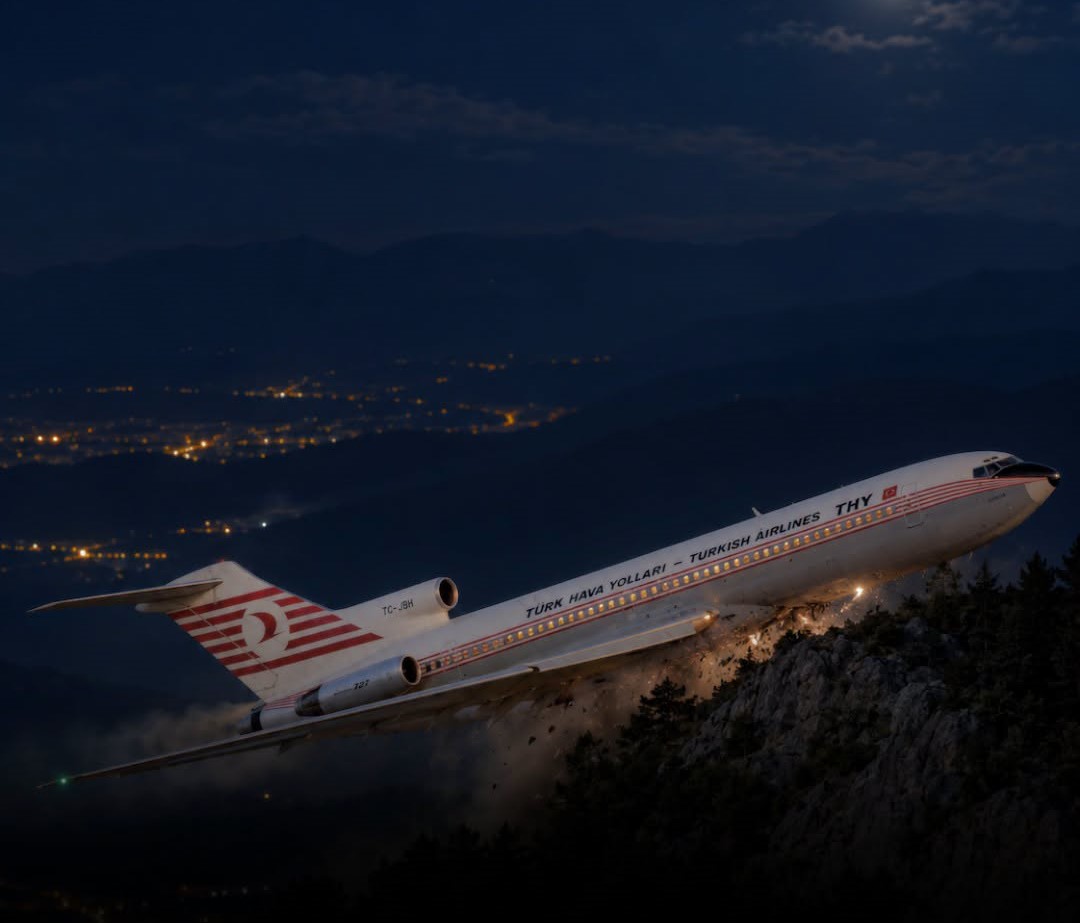
On September 19, 1976, Turkish Airlines Flight 452 was operating from Milan, Italy, to Antalya, Turkey, via Istanbul when a fatal navigation error turned a routine nighttime approach into one of the country’s worst aviation disasters.
The Boeing 727-200, registered TC-JBH and named Antalya, carried 146 passengers and eight crew members. All 154 people aboard were killed.
The aircraft arrived at Istanbul Atatürk Airport from Milan at about 21:30 local time. After passengers boarded, the Boeing 727 departed for Antalya at 22:45, carrying many passengers traveling for vacations. About 30 minutes after takeoff, the crew began preparing for the descent toward Antalya.
At approximately 23:11, the pilots reported that they could see what they believed were the lights of Antalya. The aircraft, however, was still about 100 kilometers north of its destination, near Isparta. The crew also believed they had identified the airport runway and began descending.
The Antalya controller warned the crew that the aircraft was not visible to him, but the first officer continued with the visual approach. A crucial exchange followed when the first officer questioned whether he should trust the controller or what he was seeing. The captain, who had been in the passenger cabin, returned to the cockpit after realizing something was wrong.
By then, the aircraft was dangerously low. The crew had mistaken the lights of Isparta for Antalya and the dark mountainous terrain ahead for the Mediterranean Sea. The Boeing passed close to Isparta and subsequently began climbing. At around 23:20, it struck Karatepe Hill near Isparta.
The impact destroyed the aircraft and scattered wreckage across an area of roughly two kilometers. One wing was found near the top of the hill while the engines came to rest farther down the terrain. The crash site was illuminated during the night while military personnel attempted to control the scene and extinguish fires.
The aftermath was chaotic. Thousands of people reached the crash site despite efforts to restrict access. Many victims were badly burned, making identification difficult. Most of the Italian victims were eventually repatriated, while 18 Italian passengers and unidentified victims were buried locally.
Investigators initially examined reports that the aircraft might have exploded in flight or been struck by lightning. Weather information quickly ruled out lightning. The cockpit voice recorder was recovered and examined, while the flight data recorder was found several days later.
The investigation revealed that the central problem was a navigational and judgment error during the nighttime descent. The crew had relied on visual references when instrument navigation was required. They misidentified Isparta’s lights as Antalya and descended prematurely toward terrain.
Investigators also discovered a significant equipment issue: Antalya Airport’s distance-measuring equipment had failed three days before the accident. This deprived the crew of an important navigational reference that could have helped expose their actual position.
Turkish Airlines Flight 452 was therefore classified as a controlled flight into terrain, with the aircraft still under the pilots’ control when it struck the mountain. The disaster killed all 154 occupants and remains the deadliest aviation accident in Turkey.