
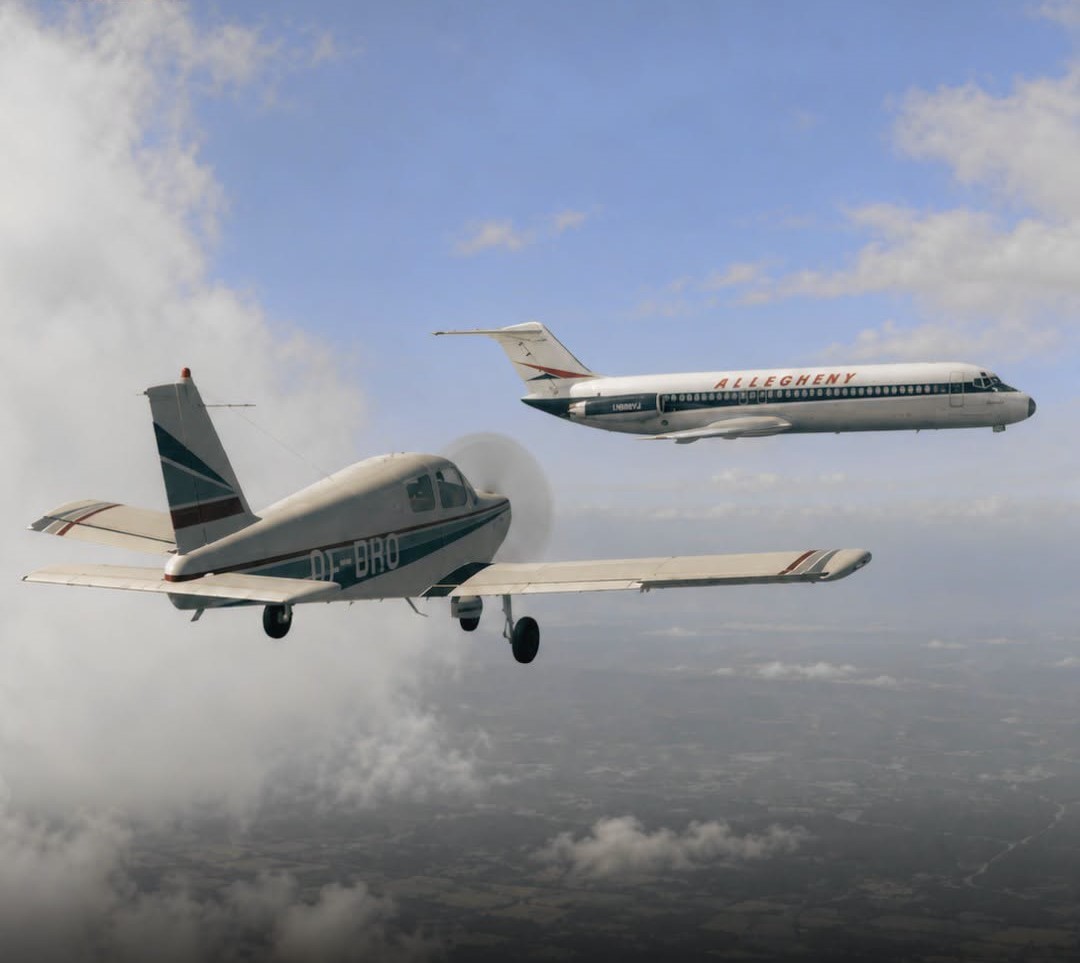
On September 9, 1969, Allegheny Airlines Flight 853 was flying from Boston to St. Louis with scheduled stops in Baltimore, Cincinnati and Indianapolis. The McDonnell Douglas DC-9-31, registered N988VJ, had 78 passengers and four crew members aboard.
At the controls was Captain James Elrod, an experienced pilot with more than 23,800 flight hours, accompanied by 26-year-old First Officer William Heckendorn.
After departing Cincinnati at about 3:15 p.m., Flight 853 was operating under instrument flight rules. Air traffic control instructed the crew to descend from 10,000 feet to 6,000 feet and then to 2,500 feet after passing the Shelbyville VOR.
The DC-9 was subsequently vectored onto a heading of 280 degrees. That was the final recorded communication between the aircraft and controllers.
At almost exactly the same time, a privately owned Piper PA-28-140, registered N7374J, had departed Brookside Airpark on a solo cross-country flight. Its pilot, 34-year-old Robert Carey, was flying under visual flight rules at a planned altitude of 3,500 feet.
Unlike the airliner, the Piper was not communicating with air traffic control and did not have a transponder. Investigators found no evidence that it appeared as a primary radar target.
Although visibility was about 15 miles, clouds obstructed the view between the two aircraft. They converged near Fairland, Indiana, at approximately 3,550 feet with a relative speed of roughly 350 mph.
The crews and controller had only about 14 seconds in which the developing collision could potentially have been detected and avoided.
The aircraft collided with devastating force. The Piper’s left wing struck the DC-9’s rear tail assembly, severing the airliner’s tail. The DC-9 immediately became uncontrollable, rolled left, inverted and plunged nose-first into a soybean field at an estimated 400 mph.
The Piper broke apart in mid-air and crashed about 4,500 feet away. There were no survivors. All 82 people aboard the DC-9 and the lone occupant of the Piper were killed, bringing the death toll to 83.
The investigation ultimately revealed that the tragedy was not simply a case of two pilots failing to see each other. In its report adopted on July 15, 1970, the National Transportation Safety Board determined that the probable cause was deficiencies in the FAA’s air traffic control collision-avoidance system in an area where IFR and VFR traffic mixed.
Investigators specifically cited limitations of the “see-and-avoid” concept, radar’s inability to detect every aircraft and the absence of regulations providing adequate separation between VFR and IFR traffic in terminal areas.
The disaster became a major lesson in aviation safety. In the years that followed, transponders became standard equipment on commercial aircraft and increasingly common in general aviation.
Controlled airspace around major airports was strengthened, airborne collision-avoidance systems such as TCAS became widespread, and ground-based conflict-alert systems gave controllers automated warnings of potentially dangerous traffic conflicts.
More than five decades later, Flight 853 remains Indiana’s deadliest commercial airline disaster—a tragedy in which a fast airliner and a small general-aviation aircraft came together with almost no time left to react, exposing dangerous gaps in the airspace system of the era.