
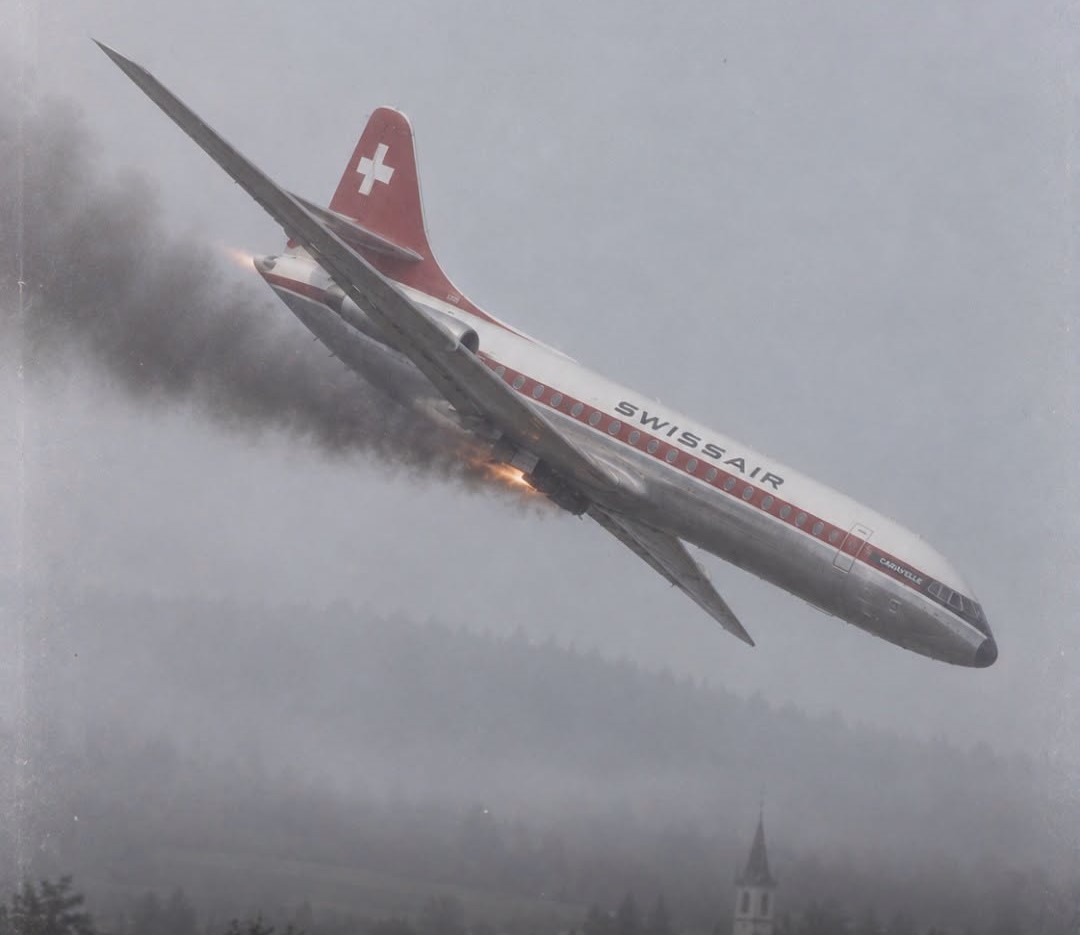
On September 4, 1963, Swissair Flight 306, a Sud Aviation SE-210 Caravelle III named Schaffhausen, departed Zurich Airport for Rome via Geneva. There were 74 passengers and six crew members aboard.
What began as a routine morning flight quickly became a disaster after a chain of events that started before the aircraft even left the ground.
Zurich was covered by dense fog when the flight prepared for departure. At about 06:05 UTC, the crew taxied partway down the runway using high engine power to disperse the fog and assess visibility.
The aircraft then returned to the takeoff position and was cleared for departure at approximately 06:13.
The decision proved crucial. The intense braking and high-power taxiing caused the aircraft’s brakes to overheat severely. The Caravelle’s magnesium wheel components were exposed to extreme heat, and one wheel reportedly burst before takeoff.
After the landing gear was retracted during the climb, investigators determined that the damaged wheels or subsequent wheel failures likely damaged hydraulic lines in the landing-gear bay.
Hydraulic fluid then escaped and came into contact with overheated wheel components, igniting a fire inside the landing-gear area. At about 06:17, witnesses on the ground saw a white smoke trail coming from the aircraft’s left side. Moments later, a long flame was visible beneath the left wing.
The aircraft continued climbing, reaching roughly 2,700 metres (8,900 feet), but the fire was rapidly damaging vital systems. Flight-recorder data showed abnormalities beginning around 06:18, while investigators later found evidence that electrical systems were being affected and aircraft components were separating with increasing frequency.
The crew apparently struggled to control the rapidly deteriorating aircraft. The left engine eventually shut down, although investigators could not establish conclusively whether this resulted from crew action or damage caused by the fire.
At about 06:20, the aircraft began descending and entered a gentle left turn before rapidly losing altitude. A Mayday call was transmitted at approximately 06:21.
Only about a minute later, Flight 306 crashed near Dürrenäsch, roughly 35 kilometres from Zurich Airport. The Caravelle was destroyed and all 80 people aboard were killed.
The investigation concluded that the initial chain was linked to overheated brakes and wheel failure during the fog-clearing taxi procedure, followed by damage to hydraulic lines and ignition of leaking hydraulic fluid.
However, investigators could not conclusively determine exactly what caused the final catastrophic loss of control. Possible factors included fire damage to the left wing and rear fuselage, failure of hydraulic flight controls, and damage to the elevator control system.
The tragedy had an extraordinary impact on Humlikon, a small Swiss village. Forty-three of its 217 residents—around one-fifth of the entire population—were aboard the flight. The dead included the village’s entire local council, all members of its school board and its post-office clerk.
The crash also prompted a significant safety change. Following the accident, Caravelle aircraft were modified to use non-flammable hydraulic fluids, addressing one of the critical links in the chain that had turned a wheel and brake problem into a fatal in-flight fire.