
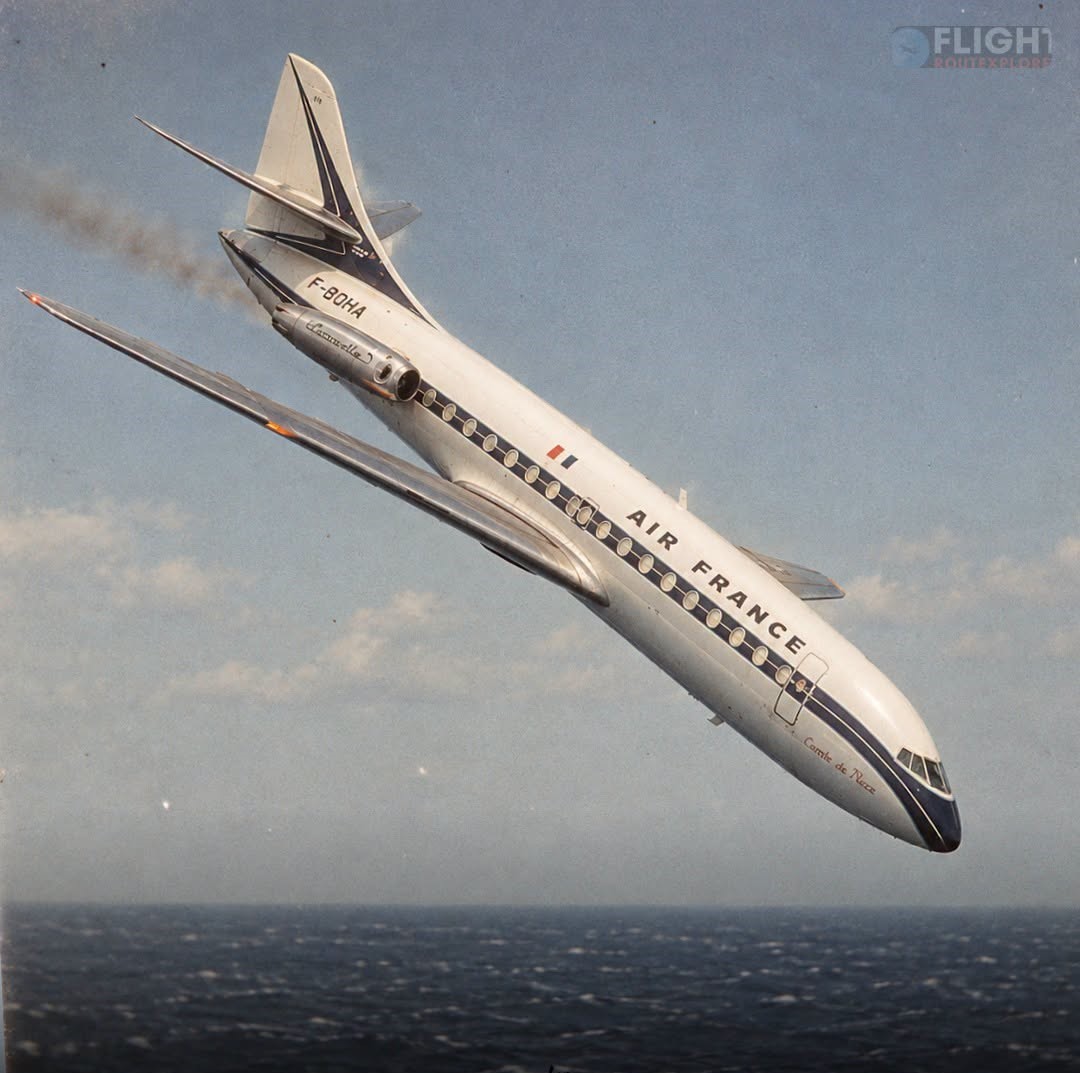
On September 11, 1968, Air France Flight 1611, a Sud Aviation SE-210 Caravelle III named Béarn, departed Ajaccio in Corsica for Nice with 89 passengers and six crew members aboard. The flight initially appeared routine, with clear weather and no reported problems.
At about 10:28 local time, while the aircraft was descending through roughly 9,000 feet, the crew became concerned about a problem in the cabin. At 10:30, they alerted air traffic control that there was a fire on board. Controllers immediately cleared the Caravelle for a direct approach to Nice and gave it landing priority.
For a few minutes, there was still hope that the aircraft could reach the airport. At about 10:32, the crew reported having the ground in sight and good visibility. But the situation deteriorated rapidly. At 10:33, radio and radar contact disappeared while the aircraft was still approximately 40–45 kilometres from Nice.
Rescuers searching the Mediterranean soon discovered a large kerosene slick and floating wreckage. The Caravelle had crashed into the sea, killing everyone aboard. There were no survivors. Among the victims were senior French military officer Lieutenant General René Cogny, Polish physicist Jerzy Sawicki and Irish banker Arthur O’Connor.
The investigation became extraordinarily difficult because the wreckage lay about 2,300 metres underwater. Several recovery campaigns eventually brought substantial quantities of aircraft material to the surface. Investigators also recovered the flight recorder, but the portion containing the final moments of Flight 1611 was unreadable.
The official investigation concluded that a fire had probably started in the rear passenger toilet. Investigators considered two possible sources: a defective water heater or a cigarette discarded in a waste bin. The fire apparently spread through the rear of the aircraft until the crew lost control. However, investigators could not determine exactly how the crew lost control, with toxic smoke or gases and attempts by passengers to reach the cockpit among the possibilities considered.
But another explanation refused to disappear. The crash occurred relatively close to a French military missile-testing area, and allegations soon emerged that Flight 1611 had been struck by a missile during military exercises. The official inquiry rejected that theory, citing the available wreckage evidence, radar information and military assurances that no missile had been fired into the aircraft’s flight path.
Yet doubts persisted for decades. Critics pointed to disputed evidence, classified military records, the damaged flight recorder and questions about the handling of recovered wreckage. Relatives of victims continued pressing for a fuller explanation, while French authorities gradually released previously classified archival material.
The missile theory gained renewed attention decades later, with officials examining whether previously inaccessible military records could shed new light on the disaster. The possibility that Flight 1611 was accidentally hit during a military exercise has never completely disappeared from public debate.
The wreckage remains at the heart of the mystery. Although the official conclusion points toward an onboard fire, the missing final flight-recorder information and continuing questions about military activity have ensured that Air France Flight 1611 remains one of aviation’s most controversial unresolved disasters.
The crash killed all 95 people aboard and transformed what began as an ordinary Mediterranean flight into a tragedy whose final moments remain disputed more than half a century later.