
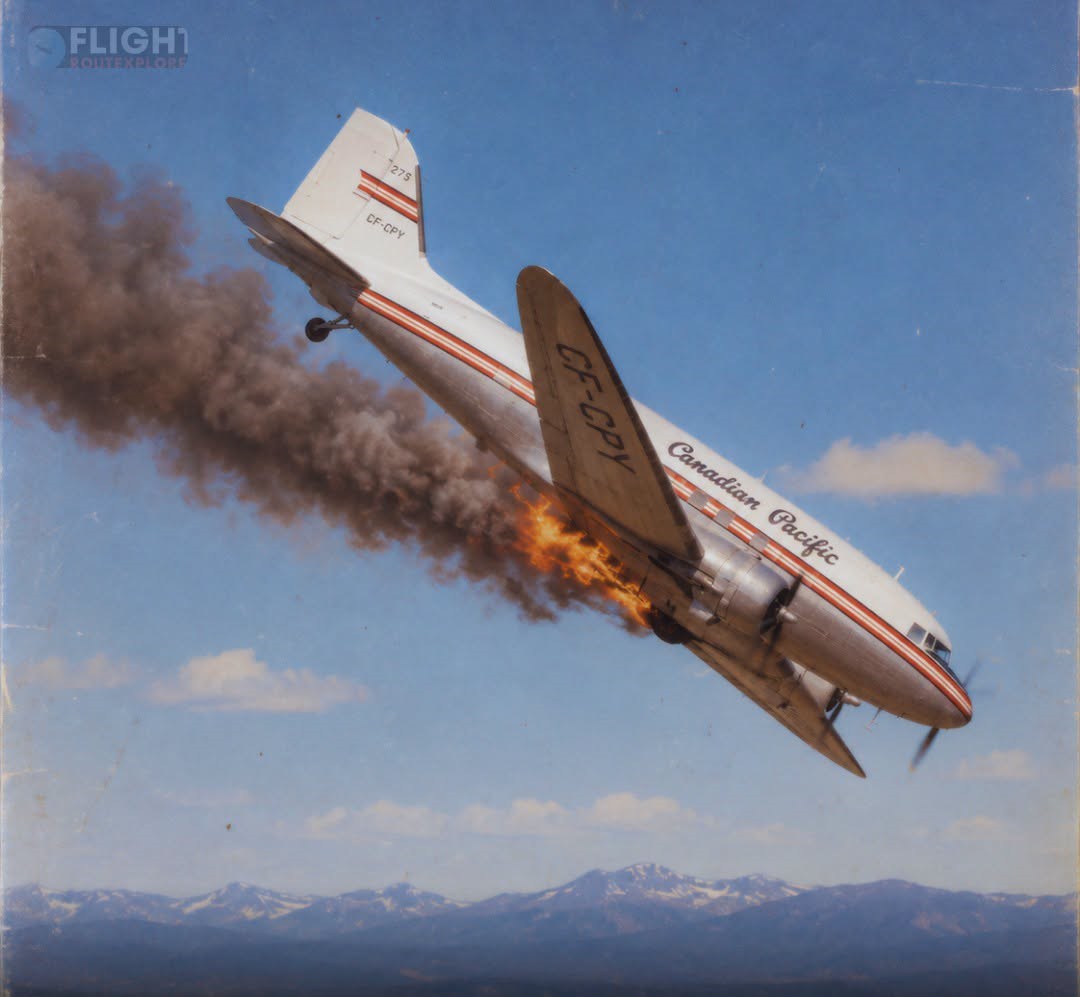
On September 9, 1949, Canadian Pacific Air Lines Flight 108 departed Montreal for Baie-Comeau, Quebec, with a scheduled stop at Quebec City. The Douglas DC-3, registered CF-CUA, carried 19 passengers and four crew members.
Among the passengers was Rita Morel, the wife of Quebec jeweller Joseph-Albert Guay. Unknown to the other passengers, Guay had arranged for a deadly package to be placed aboard the aircraft.
The aircraft left Quebec City five minutes later than planned. That seemingly insignificant delay would become one of the most important details in the investigation. Guay had calculated that the bomb would explode while the aircraft was over the St. Lawrence River, sending the wreckage into the water and making investigators’ work extremely difficult.
Instead, because of the delay, the DC-3 was still over land when the explosion occurred. The aircraft was destroyed over Cap Tourmente near Sault-au-Cochon, and all 23 people aboard were killed, including four children.
Investigators initially faced what appeared to be a catastrophic aircraft accident. But examination of the wreckage soon revealed evidence of an explosion. A forensic analysis concluded that a dynamite time bomb had been placed in the aircraft’s forward baggage compartment.
Because the wreckage was accessible on land rather than lying underwater, investigators were able to recover crucial evidence that might otherwise have been lost.
The investigation eventually uncovered a shocking motive. Guay was having an affair with Marie-Ange Robitaille and wanted to marry her, but his marriage prevented him from doing so.
He had previously attempted to find someone willing to kill his wife. Eventually, he recruited watchmaker Généreux Ruest and Ruest’s sister, Marguerite Pitre, into a plot involving dynamite. Guay also arranged a $10,000 life-insurance policy on his wife on the very day of the flight.
A conspiracy theory surrounding the disaster might suggest that the aircraft was deliberately targeted for reasons involving its prominent passengers or some wider political or corporate plot.
However, the investigation produced no credible evidence of such a conspiracy. Instead, the evidence pointed toward a deeply personal murder-for-insurance scheme. Three senior executives of Kennecott Copper Corporation were aboard, but investigators concluded that they were not the intended targets.
The breakthrough came when police traced an unusual package delivered to the airport. Pitre eventually admitted taking the package to the airport for Guay. Ruest later admitted constructing the bomb mechanism, although he claimed he believed it was intended for blasting tree stumps.
Guay was arrested and convicted of murder in March 1950. Before his execution, he sent Quebec Premier Maurice Duplessis a detailed 40-page confession implicating Ruest and Pitre.
Guay was hanged on January 12, 1951. Ruest was executed in July 1952, and Pitre was hanged in January 1953, becoming the thirteenth and last woman executed in Canada. The Sault-au-Cochon tragedy became one of Canada’s most notorious murder cases and was the first airliner bombing to be conclusively solved.
The tragedy also had a disturbing legacy. Six years later, United Air Lines Flight 629 was destroyed by another dynamite bomb in a case that bore striking similarities to the Guay affair. All 44 people aboard were killed. Investigators later linked that bombing to Jack Gilbert Graham, who had also used life insurance as part of his motive.