
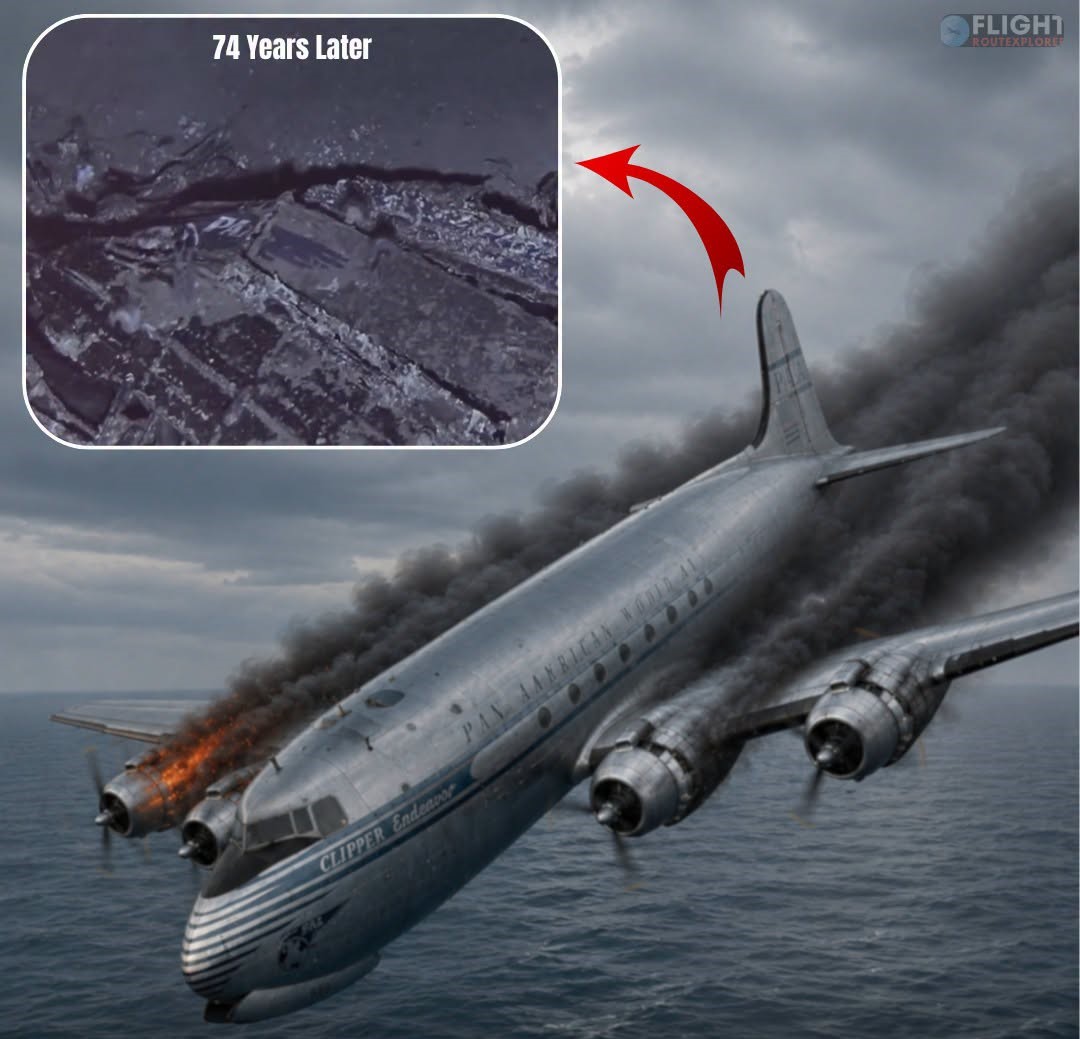
For 74 years, the final resting place of Pan American World Airways Flight 526A remained one of aviation’s greatest unsolved mysteries. The Douglas DC-4, named Clipper Endeavor, vanished beneath the Atlantic Ocean off Puerto Rico on Good Friday, April 11, 1952.
While the tragedy forever changed commercial aviation safety, the wreck itself remained hidden until June 2026, when a deep-sea expedition located it nearly 2,000 feet beneath the Atlantic Ocean. The discovery has revived interest in one of the most significant aviation accidents in history and has finally provided long-awaited answers to families and historians.
On April 11, 1952, Clipper Endeavor departed San Juan’s Isla Grande Airport at 12:11 p.m. local time on a scheduled flight to New York’s Idlewild Airport, now known as John F. Kennedy International Airport. On board were 64 passengers and five crew members. The weather around San Juan was generally good, although rough seas were present north of Puerto Rico because of strong winds.
The takeoff appeared completely normal. The four-engine Douglas DC-4 climbed steadily after leaving the runway. However, just seconds later, at an altitude of around 350 feet, disaster struck. The No. 3 engine, located on the aircraft’s right wing, suddenly failed. The crew quickly feathered the propeller to reduce drag and immediately decided to abandon the flight and return to San Juan.
Despite losing one engine, the aircraft initially continued climbing as the pilots carefully turned back toward the airport. But within moments, the situation became catastrophic when the No. 4 engine, also on the right wing, failed. Losing both engines on the same side left the aircraft without enough thrust to remain airborne.
Captain John C. Burn declared an emergency and informed air traffic control that he would attempt a ditching in the Atlantic Ocean approximately seven miles northwest of the airport. With the aircraft rapidly losing altitude, there was no longer any possibility of reaching land safely.
Only nine minutes after takeoff, at approximately 12:20 p.m., Clipper Endeavor struck the ocean. The captain managed a remarkably controlled water landing despite the impossible circumstances. Investigators later concluded that virtually everyone aboard survived the impact itself.
Unfortunately, survival after the ditching proved far more difficult than surviving the crash. The rear portion of the fuselage separated during impact, allowing seawater to flood the cabin almost immediately. Within less than three minutes, the aircraft disappeared beneath the surface.
Panic quickly spread among passengers. At the time, airlines did not provide pre-flight safety demonstrations explaining where life jackets were stored or how to use them. Many passengers were unable to locate flotation devices, while others hesitated to leave the sinking aircraft because they feared the rough seas and possible sharks. Crew members struggled to deploy life rafts before the aircraft sank beneath them.
The United States Coast Guard responded almost immediately after receiving the emergency transmission. Rescue aircraft, amphibious flying boats and rescue vessels raced toward the crash site. Despite dangerous sea conditions, Coast Guard crews landed directly on the ocean to recover survivors. One rescue aircraft even became disabled after taking on large amounts of seawater because maintenance had temporarily removed part of its pumping system. The crew eventually transferred survivors to a Coast Guard vessel before carefully taxiing the damaged flying boat back to San Juan Harbor, where crowds gathered to cheer the rescuers.
Although everyone initially survived the ditching, only 17 people were ultimately rescued alive. Fifty-two passengers lost their lives, most of them drowning after the aircraft sank. Thirty-nine victims were never recovered, making it one of the deadliest ditching accidents in commercial aviation history.
The Civil Aeronautics Board launched an extensive investigation to determine what had caused the accident. Investigators discovered that the No. 3 engine should have been removed from service before the flight because of known mechanical deficiencies, but inadequate maintenance allowed it to continue operating. Faulty engine components contributed to the engine’s failure shortly after takeoff.
When the second engine on the same wing failed moments later, the aircraft simply could not maintain altitude. Investigators also noted that after the second engine failure, the pilots attempted to regain altitude without using maximum available power, causing the aircraft’s speed to decrease rapidly. However, later legal proceedings ultimately cleared Captain Burn of responsibility, concluding that poor maintenance and defective engine parts were the true causes of the disaster.
The accident permanently changed commercial aviation. Investigators realized that many passengers died because they had never been instructed about emergency exits, life jackets or evacuation procedures. The tragedy led directly to recommendations that airlines provide mandatory pre-flight safety demonstrations on flights over water, improve flotation equipment and standardize emergency procedures.
Today, every commercial airline safety briefing instructing passengers how to fasten seat belts, locate emergency exits and use life jackets traces part of its origin to lessons learned from Flight 526A. The procedures that millions of travelers now watch before takeoff were developed in response to tragedies like Clipper Endeavor.
For decades, however, one mystery remained unsolved. The aircraft itself had never been found. Beginning in 2019, the Air/Sea Heritage Foundation launched a dedicated search using historical documents, survivor testimony, old navigation records and modern mapping technology. The effort later partnered with Deep Sea Vision and Discovery Channel’s Expedition Unknown.
On June 2, 2026, an autonomous underwater sonar vehicle detected the wreckage resting almost 2,000 feet below the Atlantic Ocean north of Puerto Rico. The aircraft was found split into two major sections, matching survivor accounts recorded more than seven decades earlier. The discovery was announced publicly in July 2026, finally ending a 74-year search.
Finding Clipper Endeavor is about far more than locating a lost airplane. It confirms historical accounts of the accident, provides closure to families who never knew where their loved ones’ final resting place was, and demonstrates how modern underwater exploration technology can solve aviation mysteries once considered impossible. More importantly, it serves as a reminder that one of the darkest moments in aviation history ultimately led to safety procedures that continue to save lives on every commercial flight today.