
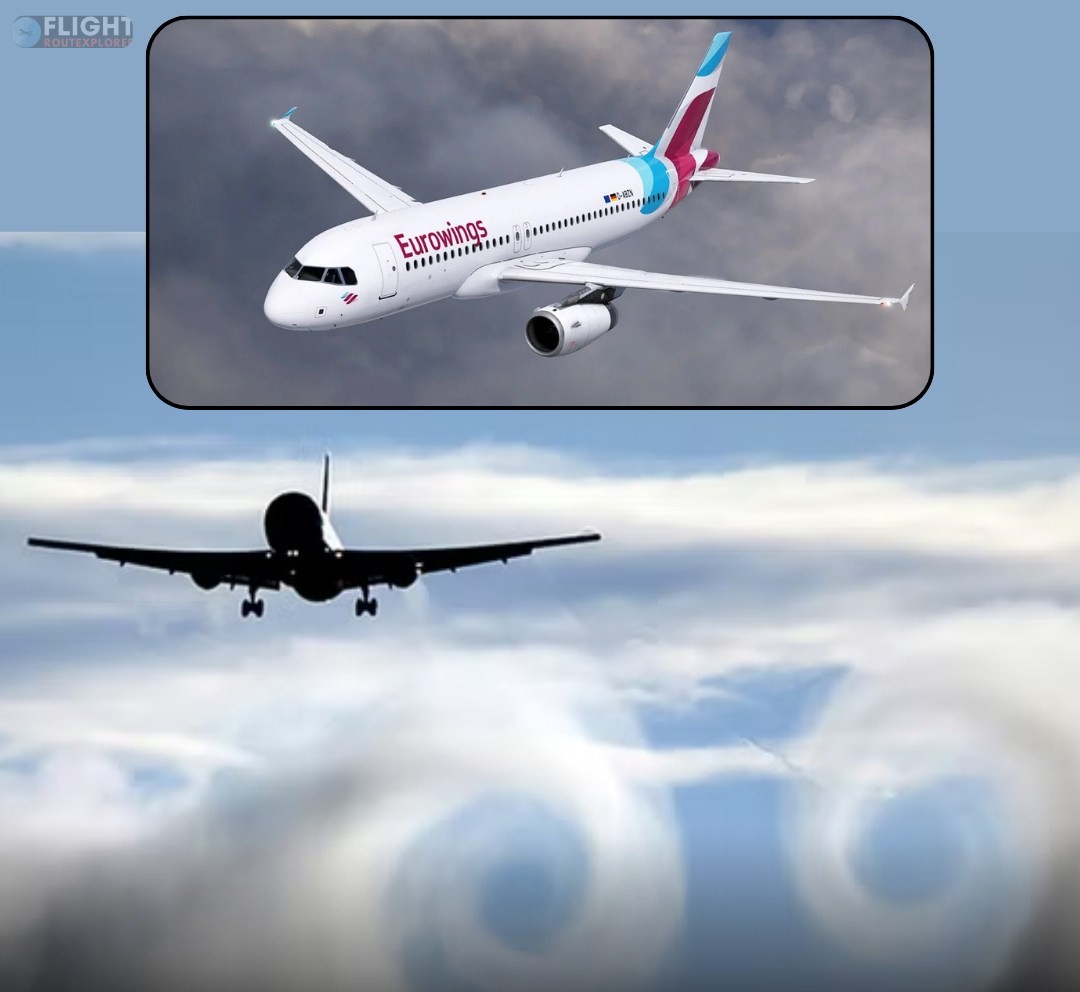
A routine climb over Bosnia and Herzegovina suddenly turned violent when a Eurowings Airbus A320-200 operating flight EW635 from Rhodes  to Cologne
  encountered severe turbulence and wake turbulence from an Emirates Airbus A380 flying ahead on May 30, 2026.
The incident occurred about 20 nautical miles east of Sarajevo while the A320, registered D-AEWS, was climbing from FL360 to FL380. Ahead of it, Emirates flight EK1 from Dubai  to London Heathrow
  was cruising at FL380 in an Airbus A380-800, approximately 7.6 nautical miles in front of the Eurowings jet.
As the A320 climbed through FL376, the aircraft was suddenly hit by turbulence believed to be generated by the massive wake vortices of the A380. The pilots immediately stopped the climb and descended back to FL360 at rates reaching 3,000 feet per minute.
Inside the cabin, the turbulence caused chaos. Four passengers suffered minor injuries, while a flight attendant was reportedly thrown into the cabin ceiling during the violent upset. Despite the frightening encounter, the crew maintained control of the aircraft and continued safely to Cologne, where emergency medical services were waiting upon arrival.
The injured passengers and crew member were treated onboard before being transported to a hospital for further evaluation. Investigators secured both the Cockpit Voice Recorder (CVR) and Flight Data Recorder (FDR) to analyze the sequence of events.
Meanwhile, the Emirates A380 continued its journey to London Heathrow without incident.
Interestingly, ICAO wake turbulence separation recommendations require a minimum spacing of 7 nautical miles between a “Super” category aircraft like the A380 and a trailing “Medium” category aircraft such as the A320 at the same altitude or 1,000 feet below. Reports indicate the aircraft were separated by approximately 7.6 nautical miles, highlighting how powerful A380 wake vortices can remain even within standard separation limits.
The Eurowings aircraft stayed on the ground in Cologne for about 4.5 hours before returning to service with a delay of roughly 3.5 hours.