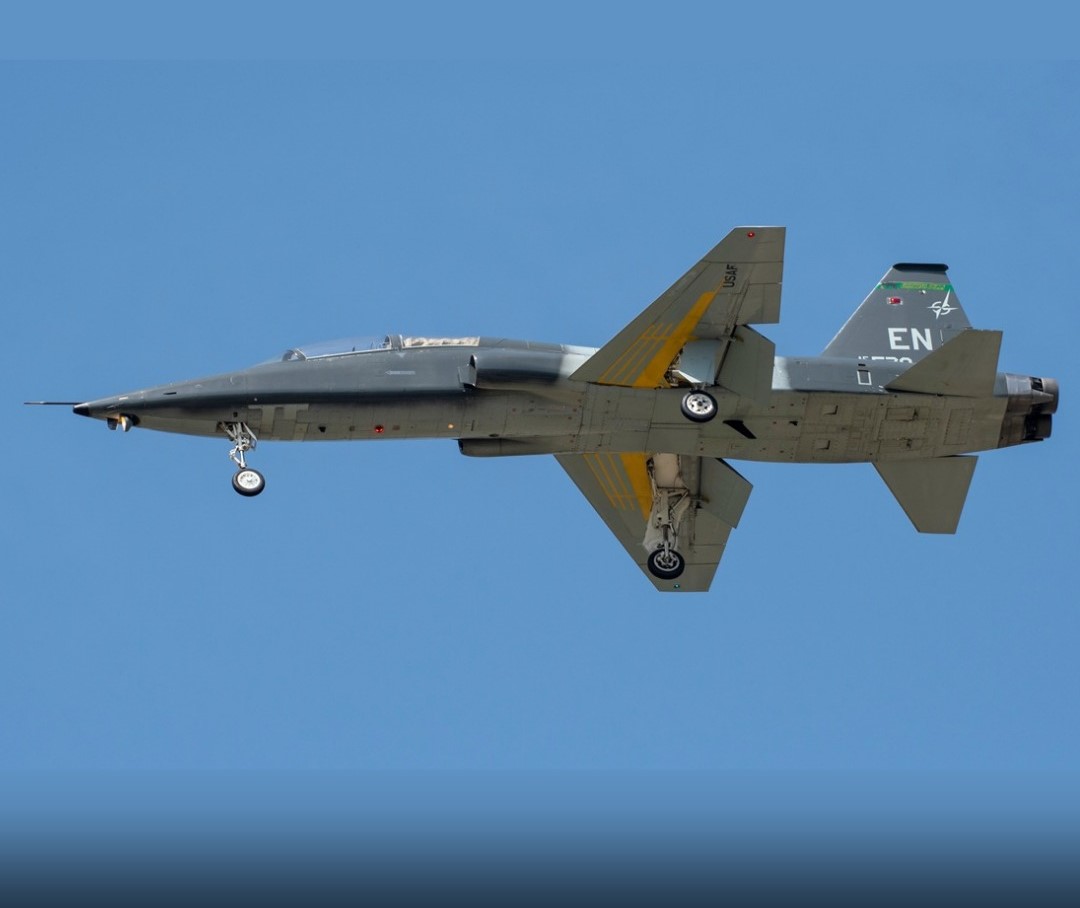
Following the crash of a T-38 Talon II trainer at Columbus Air Force Base (AFB), Mississippi, involving a Japanese trainee aviator, the United States Air Force announced a fleet-wide operational pause for all of the aircraft “out of an abundance of caution.”
According to reports, the crash in Mississippi occurred during a routine training flight conducted by the 14th Flying Training Wing. The Japanese pilot, who suffered a broken leg in the crash but no more serious injuries, was a trainee in the Japan Air Self-Defense Force (JASDF) and was learning to fly the T-38 alongside approximately 20 other Japanese personnel, according to Japan’s Mainichi Shimbun newspaper.
The grounding of the T-38 will impact units across Air Education and Training Command, Air Combat Command, Air Force Materiel Command, and Air Force Global Strike Command. It will allow an investigation as to what caused the mishap on May 12, 2026.
“The duration of the pause remains undetermined pending further engineering analysis and development of an inspection process to clear aircraft for a safe return to flight. Inspections are anticipated to begin as early as this week. Individual aircraft may resume flying operations once the inspection process and, if necessary, any corresponding maintenance actions are complete,” the Air Force wrote in its announcement.
The service further announced that affected major commands were “actively working to mitigate impacts to operations, training and readiness,” and that will include a greater emphasis on simulator training while the T-38 Talons are grounded.
Columbus AFB’s stated mission is to “Train World Class Pilots.” It focuses on specialized undergraduate pilot training in the T-38C Talon, T-6 Texan II, and T-1A Jayhawk trainer aircraft, conducting roughly 260 training sorties per day.
The T-38 Talon II is the US Air Force’s primary advanced jet trainer. It is a modernized version of the T-38 Talon that was first adopted in 1961. It shares the same airframe design and basic functionality. Introduced in 2001, it also features modernized avionics, a “glass cockpit,” and upgraded engine components.
The twin-engine, high-altitude aircraft serves as the primary supersonic jet trainer for undergraduate pilot training, and it is among the aircraft that are used to train pilots who will eventually fly the F-22 Raptor and F-35 Lightning II.
Current plans call for the Talon II to be replaced by the Boeing/Saab T-7A Red Hawk, which is set to enter service in 2028. However, as it will take nearly a decade to fully transition to the Red Hawk, the US Air Force began last fall to modernize around 190 of its newest T-38s.