
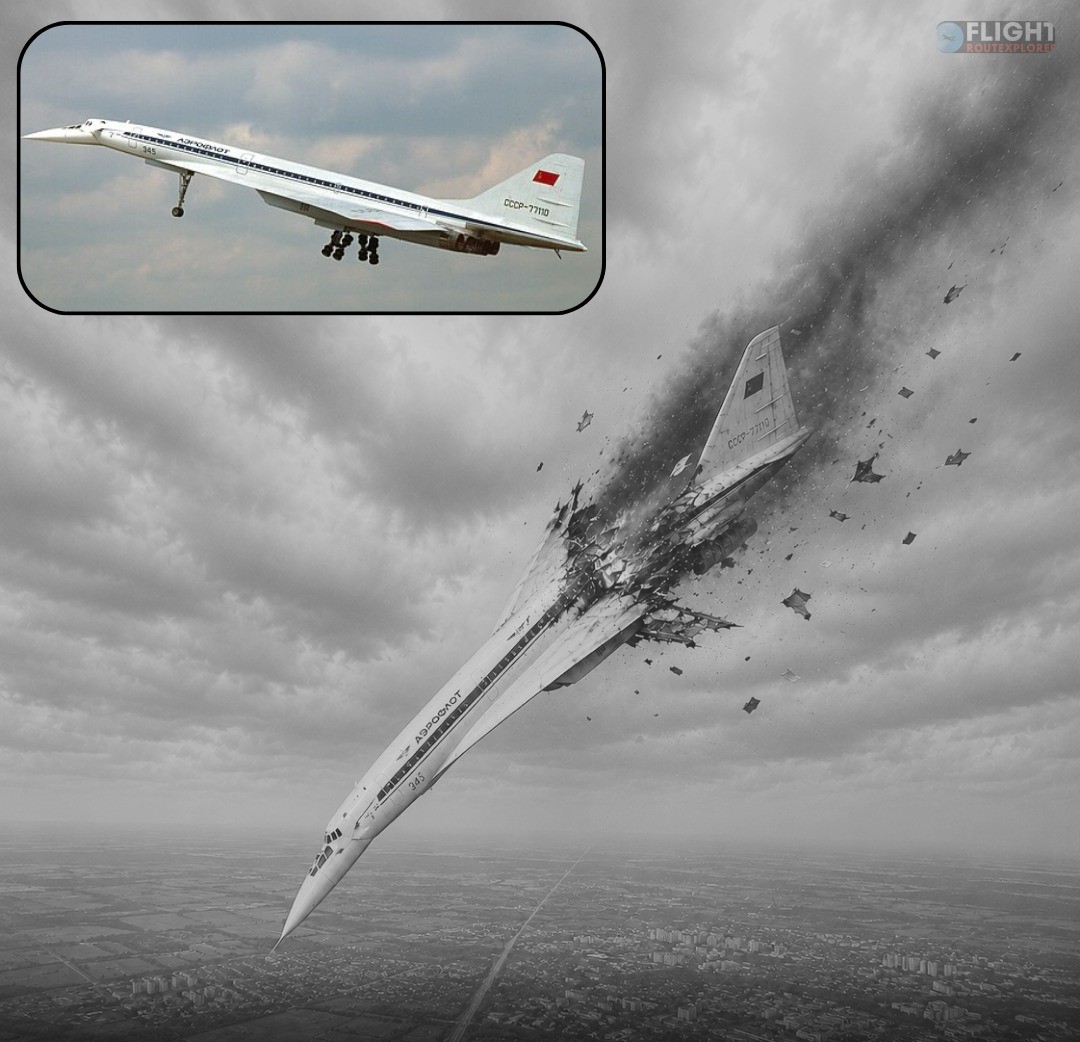
On 3 June 1973, thousands of spectators gathered at the Paris Air Show at Le Bourget Airport expecting to witness one of the greatest technological rivalries of the Cold War. The Soviet Union had brought its brand-new Tupolev Tu-144, the world’s first supersonic passenger airliner to fly, while the West proudly showcased the Concorde. What was meant to be a demonstration of Soviet aerospace achievement instead became one of the most shocking air show disasters ever recorded.
The aircraft involved was Tupolev Tu-144S registration CCCP-77102. The jet had already performed successfully during the previous day’s display and was scheduled to conduct another demonstration flight on 3 June. The Soviet delegation was under immense pressure to impress the international audience and to outperform the Concorde, which had already delivered an elegant and highly praised display. Multiple accounts suggest that the Tu-144 crew wanted to demonstrate the aircraft’s superior climb and maneuvering performance.
The demonstration initially appeared normal. The Tu-144 made several high-speed passes over the airfield and climbed steeply into the sky. Witnesses described the aircraft as performing aggressively, far more dramatically than a typical airliner demonstration. As the aircraft reached altitude, it suddenly pitched upward even more sharply before unexpectedly transitioning into a violent nose-down dive. Spectators watched in horror as the giant supersonic transport plunged toward the ground.
As the crew attempted to recover from the dive, enormous aerodynamic forces acted on the airframe. The aircraft exceeded its structural limits. The left wing suffered catastrophic failure, and the Tu-144 began to break apart in mid-air. Large sections of the aircraft separated from the fuselage, debris scattered across the sky, and the airliner disintegrated before crashing into the town of Goussainville, several kilometers from the airfield. The impact destroyed homes and triggered fires across the neighborhood.
All six crew members aboard the aircraft were killed instantly. The crash also killed eight people on the ground and injured many others. Approximately fifteen houses were destroyed or severely damaged by the falling wreckage. For many spectators, the event unfolded in mere seconds, transforming an air show celebration into a mass-casualty disaster.
In the immediate aftermath, French authorities secured the crash site while investigators recovered wreckage from both the residential area and surrounding fields. The remains of the aircraft were transported to Le Bourget for examination, while some components were later returned to the Soviet Union. Because the accident involved one of the Soviet Union’s most prestigious aviation projects and occurred during the height of the Cold War, the investigation quickly became politically sensitive.
Investigators determined that the aircraft had entered a steep dive and subsequently suffered structural breakup during the attempted recovery. However, determining exactly why the dive occurred proved far more difficult. The official French-Soviet investigation ultimately concluded that no definitive cause could be established. Importantly, the commission stated that there was no evidence of a fundamental design flaw in the aircraft’s structure or systems and officially declared the exact cause undetermined.
One of the most persistent theories involves a French Mirage fighter jet that had been secretly assigned to photograph the Tu-144’s advanced retractable canards. According to this theory, the Tu-144 crew unexpectedly encountered the Mirage during the display. Believing the fighter was dangerously close, the pilots may have initiated an abrupt evasive maneuver, pushing the aircraft into a steep dive. While later reports confirmed that a Mirage was indeed operating nearby, investigators found no evidence of an imminent collision. Nevertheless, the possibility that the Soviet crew reacted to the fighter’s presence remains one of the leading explanations.
Another theory suggests that the crew was attempting to outperform Concorde’s display. Experienced air show pilot Bob Hoover later stated that the Tu-144 appeared to be pulled into an exceptionally steep climb from which recovery would have been extremely difficult. According to this view, the aircraft may have stalled or entered an uncontrollable attitude before the crew attempted a desperate recovery that overstressed the structure.
Additional theories emerged over the years. Some researchers suggested that a film camera in the cockpit may have interfered with controls during the maneuver. Others pointed to possible issues within the aircraft’s flight-control system, including changes made before the demonstration that may have allowed greater control-surface movement than originally intended. These possibilities were never conclusively proven, but they remain part of the ongoing debate surrounding the accident.
More than fifty years later, the 1973 Paris Air Show Tu-144 crash remains one of aviation’s greatest mysteries. Investigators successfully determined how the aircraft broke apart, but they never established with certainty what triggered the fatal sequence. The combination of Cold War politics, conflicting witness accounts, classified military activity, and incomplete evidence ensured that the final answer was never found. What is certain is that the crash severely damaged the reputation of the Tu-144 program. Although the aircraft would later enter limited passenger service, confidence in the project never fully recovered. The disaster became a defining moment in the history of supersonic transport and remains one of the most dramatic air show accidents ever captured on film.