
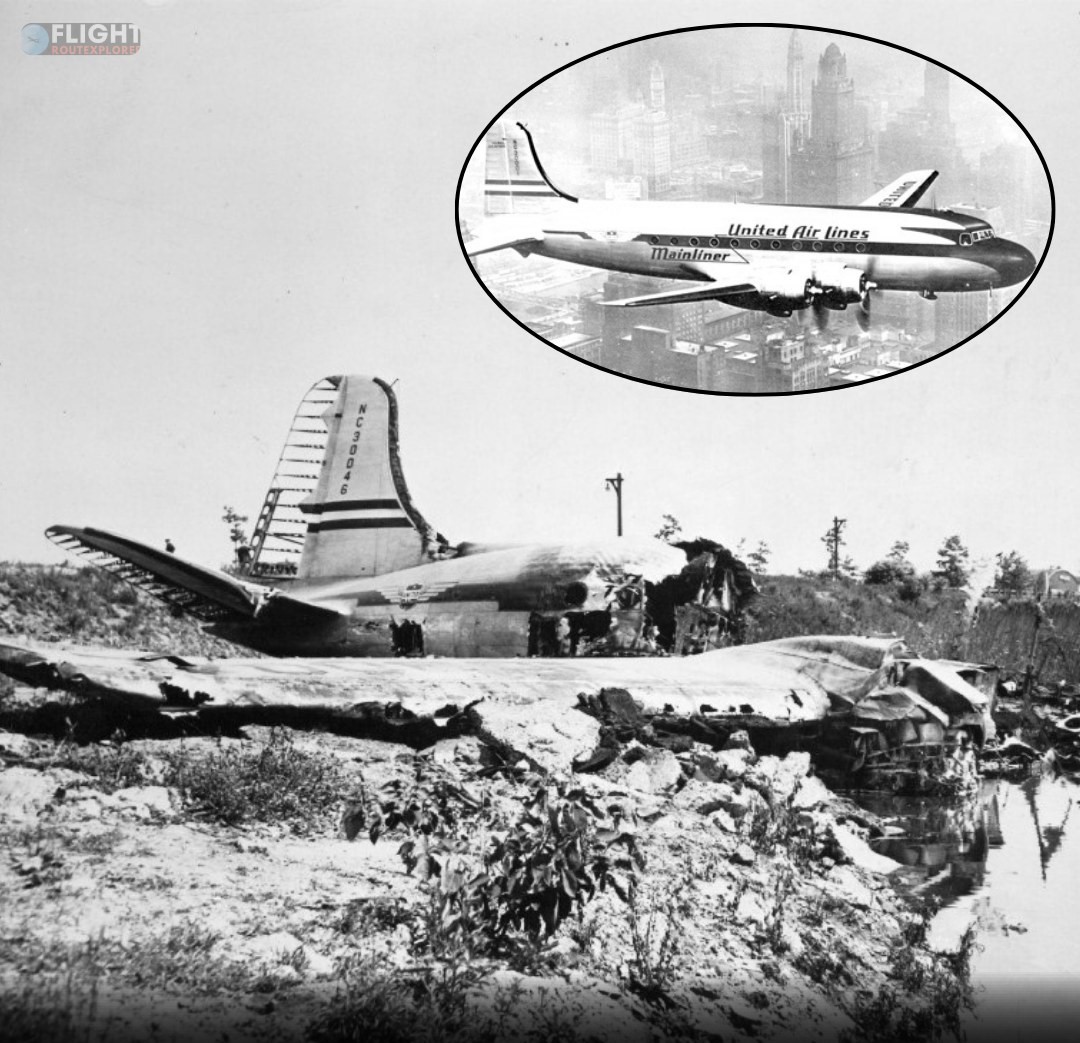
On May 29, 1947, what should have been a routine evening departure from New York’s LaGuardia Airport turned into one of the most horrifying disasters in early aviation history. United Air Lines Flight 521 crash claimed 43 lives after a Douglas DC-4 failed to take off, tore through an airport fence, crossed a busy highway, and exploded in flames beside a pond.
At the time, it was the deadliest commercial airline disaster in United States history.
United Air Lines Flight 521 was operating a scheduled service from New York to Cleveland using a Douglas DC-4 named “Mainliner Lake Tahoe.” On board were 44 passengers and 4 crew members. The aircraft was commanded by Captain Benton Baldwin, an experienced pilot flying during increasingly unstable weather conditions over New York.
As evening thunderstorms approached LaGuardia, the crew prepared for departure from Runway 18 — a shorter runway compared to the airport’s other available departure strip. Witnesses later described dark clouds, lightning, and rapidly shifting winds around the airfield. Despite the worsening weather, the aircraft taxied into position and began its takeoff roll.
Almost immediately, something appeared wrong.
The DC-4 accelerated down the runway but failed to rotate normally. According to investigators and eyewitness accounts, Captain Baldwin suddenly decided to abort the takeoff after much of the runway had already been used. The crew slammed on the brakes and attempted a desperate ground loop maneuver to stop the aircraft before the runway ended.
But the heavy four-engine aircraft could not stop in time.
The plane thundered off the end of Runway 18, smashed through the airport perimeter fence, crossed the Grand Central Parkway, narrowly missing vehicles, and slammed into an embankment near the Casey Jones School of Aeronautics. The impact ripped the aircraft apart before it plunged into a marshy pond area and burst into flames.
The crash scene quickly became an inferno.
Fuel ignited instantly, trapping many passengers inside the wreckage. Rescue crews and bystanders rushed toward the burning aircraft, but the heat was so intense that many victims could not be reached in time. Ten people initially escaped the wreckage alive, though several later died from severe burns and injuries. Only five ultimately survived the disaster.
The tragedy stunned the nation.
Newspapers across America carried graphic images of the smoking wreckage beside LaGuardia Airport. The crash became front-page news because of both the massive death toll and the terrifying fact that the aircraft never became airborne. For less than 24 hours, Flight 521 held the grim distinction of being the worst commercial aviation disaster in U.S. history before another DC-4 crash involving Eastern Air Lines near Baltimore surpassed it the following day.
Investigators from the Civil Aeronautics Board launched a major inquiry into the accident. Early theories focused on sudden wind shifts and dangerous weather conditions near the runway. Some reports suggested that a powerful change in wind direction may have convinced the captain to abort the takeoff too late.
However, the official investigation eventually pointed toward pilot error.
The Civil Aeronautics Board concluded that the probable cause was either the crew’s failure to release the aircraft’s gust lock before takeoff or the captain’s decision to abort because of apprehension caused by the short runway and changing wind conditions. Investigators believed the aircraft may not have been able to pitch upward properly if the gust locks remained engaged.
The investigation also revealed how critical runway selection and weather judgment were becoming during the rapid expansion of post-war commercial aviation. Flight 521 became one of several late-1940s disasters that pushed airlines and regulators to improve pilot procedures, cockpit checklists, runway safety standards, and takeoff decision training.
Today, the disaster is remembered as one of the defining tragedies of early airline travel — a horrifying reminder of how dangerous commercial flying could be during aviation’s formative years. What began as a routine evening flight ended in catastrophe before the aircraft ever left the ground.