

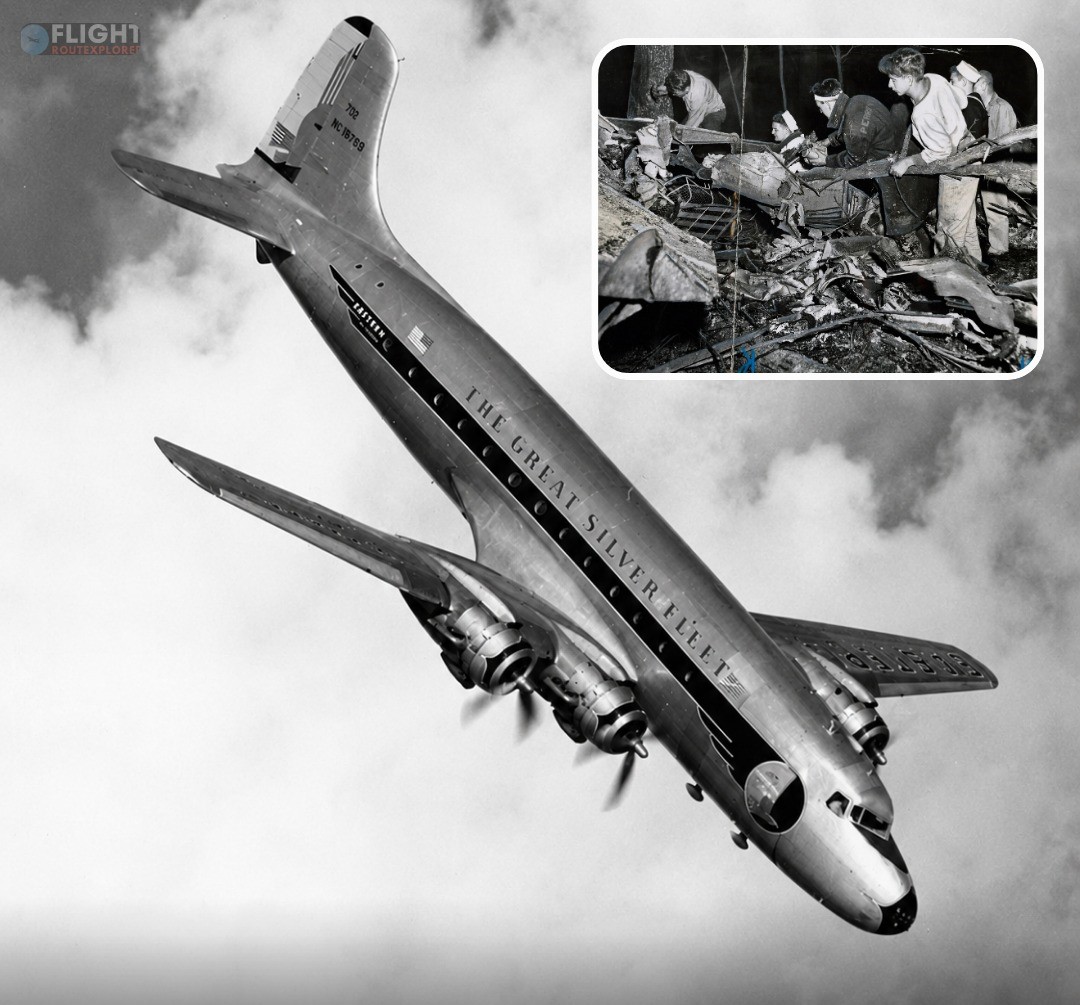
On May 30, 1947, a routine passenger flight from Newark to Miami suddenly turned into one of the most baffling aviation disasters in American history. Eastern Air Lines Flight 605, a Douglas C-54B Skymaster carrying 53 people, plunged from the sky near Bainbridge, Maryland, killing everyone on board. Nearly eight decades later, investigators’ inability to determine the exact cause still fuels debate among aviation historians.
Flight 605 departed Newark International Airport at 5:04 PM on a scheduled southbound route to Miami. The four-engine Douglas aircraft climbed normally to its assigned cruising altitude of 4,000 feet. Weather conditions along the route were considered acceptable, and nothing appeared unusual during the early part of the flight.
As the aircraft passed over Philadelphia, the crew transmitted a calm routine message reporting that “all is well.” It would be the final communication from the cockpit.
Only minutes later, witnesses on the ground saw the large airliner suddenly pitch downward. The descent rapidly steepened into what observers described as a terrifying near-vertical dive. Some reported hearing engines screaming at high power before the aircraft slammed into wooded terrain about two miles east of Bainbridge, Maryland.
The impact was catastrophic. The airplane exploded and scattered wreckage across the area, igniting fires that could be seen from miles away. Rescue crews rushed to the scene, including personnel from nearby military facilities, but there were no survivors. All 49 passengers and four crew members perished instantly.
At the time, the tragedy became the deadliest commercial aviation disaster in United States history.
Investigators from the Civil Aeronautics Board immediately launched a major inquiry. They examined wreckage, reviewed maintenance records, interviewed witnesses, and searched for any evidence of sabotage, weather problems, or mechanical failure. However, aviation investigations in the 1940s lacked modern tools such as flight data recorders and cockpit voice recorders, making the probe far more difficult.
The investigation revealed no evidence of an onboard explosion or mid-air collision. Engines appeared to have been producing power at impact, suggesting the crew may have still been attempting to regain control during the dive.
One theory focused on a possible structural or control system malfunction. Aviation author and pilot Ernest K. Gann later suggested in his book *Fate Is the Hunter* that a missing elevator hinge bolt may have caused the aircraft to become uncontrollable. Gann claimed he narrowly avoided a similar incident himself on another aircraft. However, investigators could never conclusively prove this theory because much of the wreckage had been destroyed in the violent crash and post-impact fire.
Ultimately, the Civil Aeronautics Board concluded that the aircraft suffered a sudden loss of control for reasons unknown. The official cause was listed as undetermined — a haunting outcome that left many unanswered questions.
The aftermath of Flight 605 deeply affected public confidence in postwar commercial aviation. The crash intensified calls for stronger aircraft inspections, better maintenance procedures, and improved accident investigation techniques. In the years that followed, aviation safety standards evolved dramatically, eventually leading to the introduction of flight recorders and more advanced structural testing.
For decades, the victims of Flight 605 were largely forgotten outside aviation circles. But in 2011, a memorial was finally dedicated near the crash site in Maryland, honoring those who lost their lives on that tragic evening in 1947.
Even today, Eastern Air Lines Flight 605 remains one of aviation’s enduring mysteries — a disaster where a modern airliner of its era simply fell out of the sky without warning, taking its secrets with it.