

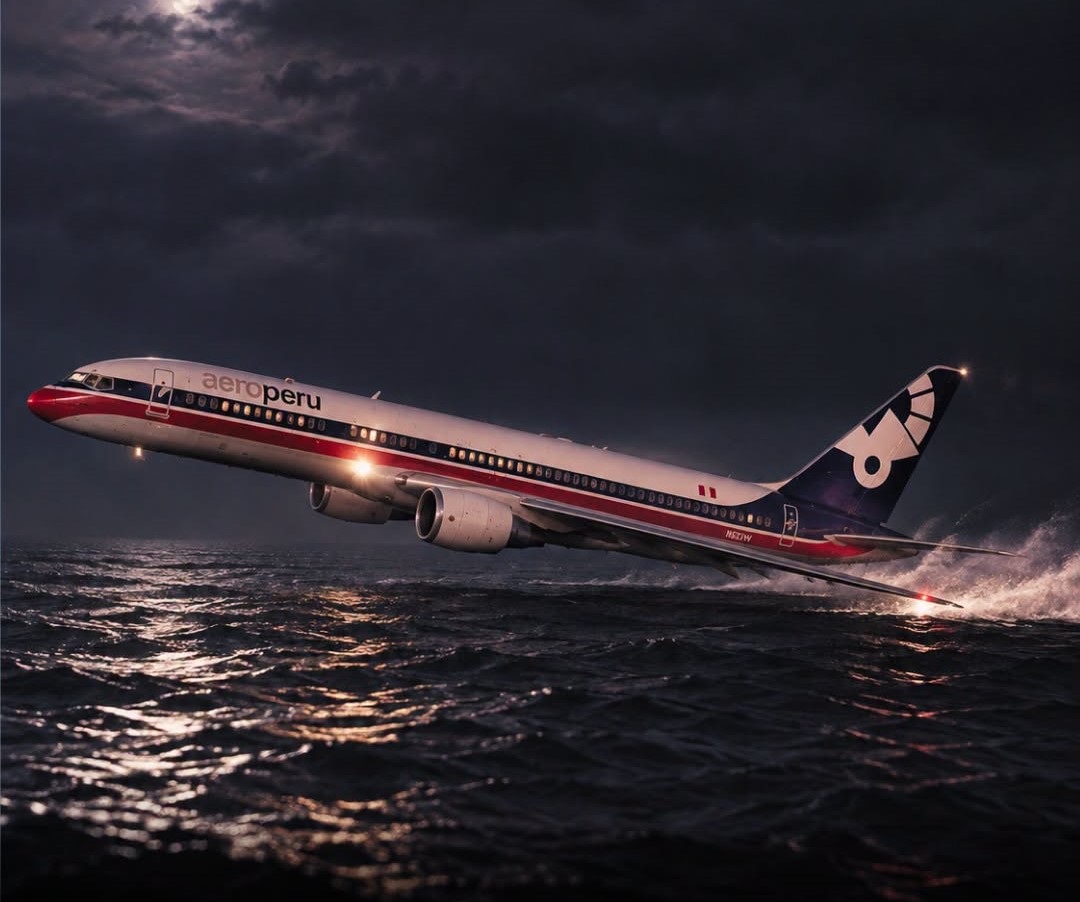
On October 2, 1996, Aeroperú Flight 603, a Boeing 757-200 registered as N52AW, departed Lima, Peru, for Santiago, Chile, carrying 61 passengers and nine crew members.
The aircraft took off at night in poor visibility, unaware of a dangerous maintenance error that would soon turn the flight into a desperate struggle for survival.
Shortly after takeoff, the pilots noticed that their flight instruments were displaying contradictory information. The altimeters, airspeed indicators and vertical speed instruments were malfunctioning.
The aircraft’s warning systems began sounding multiple alarms, including alerts for altitude, overspeed and other potentially dangerous conditions.
Captain Erik Schreiber and First Officer David Fernández declared an emergency and requested assistance from Lima air traffic control.
The pilots asked controllers to determine their altitude using radar, hoping to establish a reliable reference. However, the aircraft’s transponder was also transmitting erroneous altitude information, adding to the confusion.
As the crew attempted to return to Lima, the situation deteriorated. Flying over the dark Pacific Ocean, they had no visible horizon or reliable external reference.
Conflicting cockpit alerts and misleading instrument readings made it increasingly difficult to understand the aircraft’s actual flight condition.
During the emergency, the pilots struggled to establish their true altitude and speed. Despite repeated attempts to obtain accurate information from air traffic control, the aircraft descended dangerously close to the ocean.
Just 29 minutes after departure, the Boeing 757 struck the Pacific Ocean off the coast of Peru, killing all 70 people aboard.
The subsequent investigation uncovered a shocking cause. Adhesive tape used to protect the aircraft’s static ports during cleaning and maintenance had not been removed.
These ports measure atmospheric pressure and provide essential information for calculating altitude, airspeed and vertical speed. With the ports blocked, the flight instruments received incorrect pressure data, creating a cascade of misleading readings and alarms.
Investigators concluded that the maintenance error, combined with failures to detect the obstruction during subsequent inspections and difficulties interpreting the instrument failures, led to the disaster.
The accident exposed serious weaknesses in maintenance procedures, preflight inspections and the aircraft’s warning systems.
Aeroperú Flight 603 became a defining example of how a seemingly minor maintenance oversight could disable multiple critical flight instruments and lead to a catastrophic accident.










