

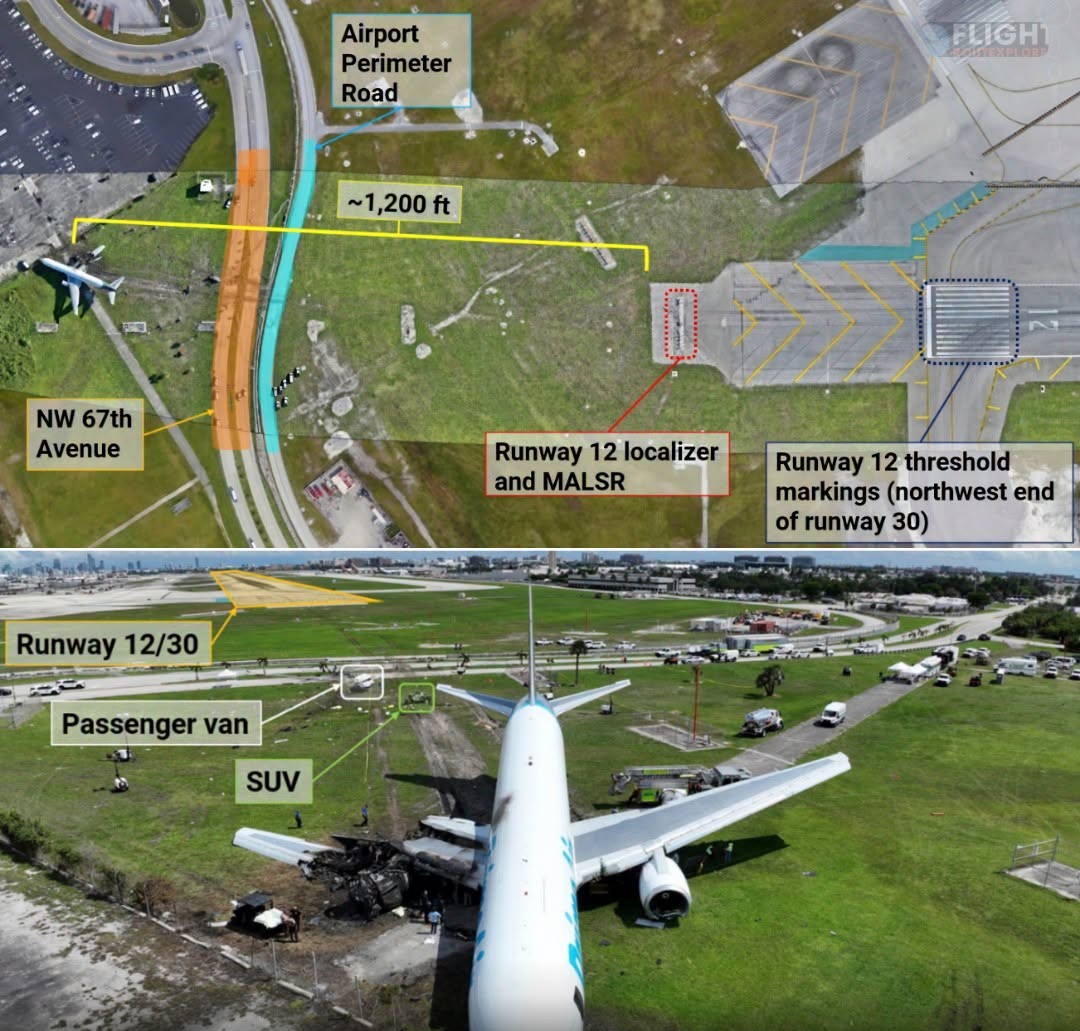
The National Transportation Safety Board (NTSB) has released its preliminary investigation report into the September 6, 2026, accident involving 21 Air Flight 7598, a Boeing 767-33A (N1997A), operating a cargo flight on behalf of Amazon from San Juan, Puerto Rico, to Miami International Airport (MIA).
The aircraft overran Runway 30 after landing, struck airport infrastructure, crossed a perimeter road and collided with two vehicles. Five people in a passenger van were killed, while three people on the ground sustained serious injuries.
Both pilots escaped with minor injuries. The aircraft suffered substantial damage and a post-crash fire broke out on its right wing.
The preliminary report reveals several critical details about the final approach and landing.
The Boeing 767 crossed the runway threshold at 177 knots and touched down approximately 3,750 feet beyond the threshold at 160 knots, leaving a significantly reduced distance for the landing rollout.
The cockpit voice recorder revealed that the first officer repeatedly warned the captain about the aircraft’s excessive speed during the approach. The aircraft also generated multiple automated warnings, including repeated “Sink Rate” and “Too Low Terrain” alerts.
Just 15 seconds after touchdown, the captain called for a go-around. However, the aircraft was already running out of runway.
Flight data recorder information shows that the speed brakes remained stowed and the thrust reversers were not deployed during the landing rollout. The wheel brakes were initially applied at 146 knots but released about eight seconds later at 120 knots as both engines were advanced to go-around thrust.
The aircraft then slowed to idle thrust, and the brakes were reapplied. But with only about 415 feet of runway remaining, the aircraft departed the paved surface at 113 knots.
It struck the runway localizer and approach lighting system before crossing the airport perimeter fence and hitting a Ford Econoline passenger van. It subsequently struck a Toyota Corolla Cross SUV while traversing NW 67th Avenue.
Another important detail concerns the weather. Winds were reported from 190 degrees at 17 knots, gusting to 26 knots, while the aircraft was landing on Runway 30.
The report notes that the air traffic controller issued landing clearance without providing wind information, despite FAA procedures requiring wind direction and velocity to be stated when a tailwind component exists.
The NTSB also confirmed that Miami’s Runway 30 did not have an Engineered Materials Arresting System (EMAS) installed at its end.
The investigation is ongoing. Investigators will conduct a detailed aircraft performance study using flight data and other engineering evidence to better understand the approach, landing, braking sequence and runway excursion.
The preliminary report documents the sequence of events but does not establish the probable cause of the accident. Further findings are awaited.










