
On 3 September 1978, Air Rhodesia Flight 825 was flying from Victoria Falls to Salisbury, with a scheduled stop at Kariba.
The Vickers Viscount 782D, named Hunyani and registered VP-WAS, had just departed Kariba Airport carrying 52 passengers and four crew members. Most of the passengers were holidaymakers returning to Salisbury after spending the weekend at Lake Kariba.
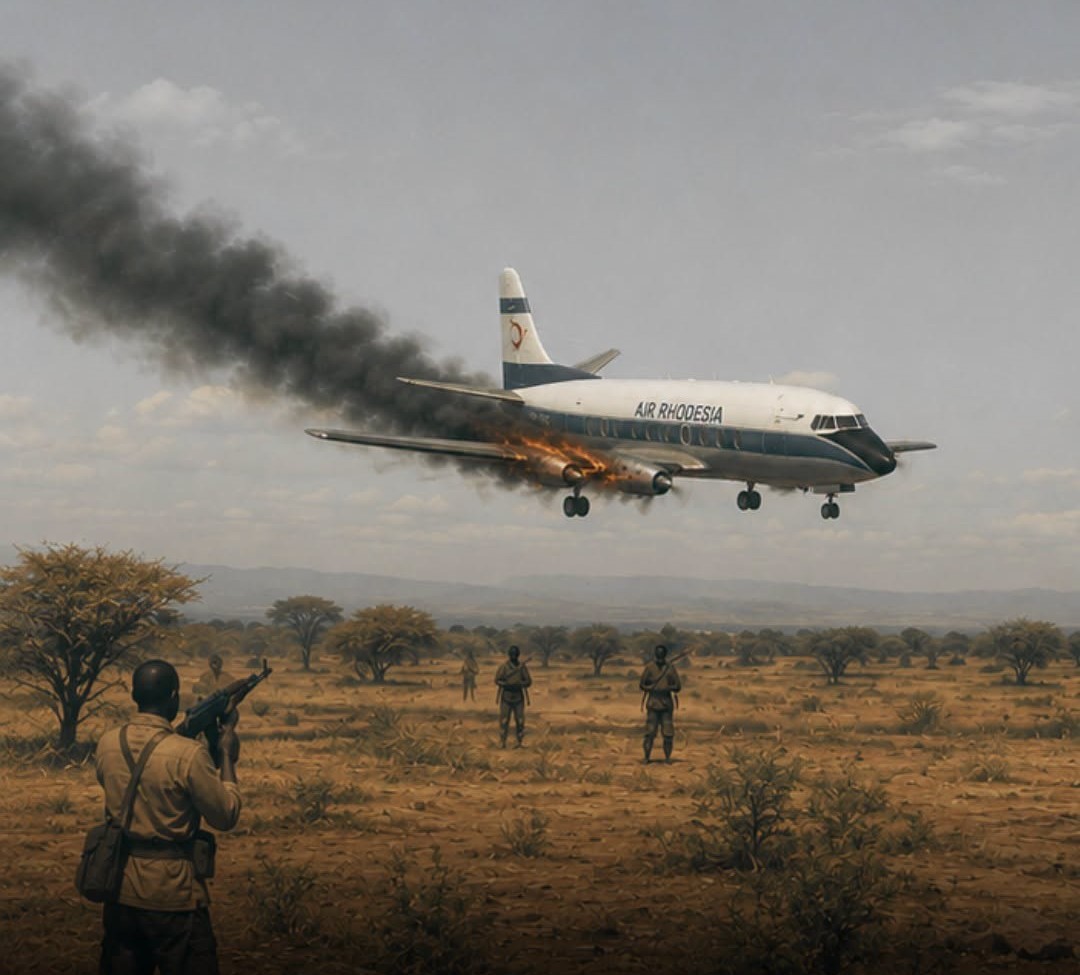
The flight had been airborne for only about five minutes when tragedy struck. ZIPRA (Zimbabwe People’s Revolutionary Army) guerrillas were positioned beneath the aircraft’s flight path and fired a Soviet-made Strela-2 shoulder-launched, heat-seeking missile.
The missile struck the aircraft’s starboard wing and exploded near the inner engine. The blast ruptured a fuel tank and hydraulic lines and caused a fire that could not be extinguished. The second starboard engine failed almost immediately, leaving Captain John Hood with only the two engines on the opposite wing.
The crippled Viscount began losing altitude rapidly. At about 17:10, Hood radioed air traffic control that he had lost both starboard engines and was going to crash.
He instructed the passengers to brace for an emergency landing and searched for somewhere suitable to put the aircraft down. He chose an open cotton field in the Whamira Hills, west of Karoi, and attempted a wheels-up belly landing.
For a moment, the landing appeared relatively stable. But the aircraft struck an unseen ditch. The Viscount was thrown into a cartwheel, broke apart and caught fire as its remaining fuel tanks ruptured.
The cabin was engulfed in flames, killing 38 people, including both pilots and the two flight attendants. Eighteen passengers initially survived the crash, although many were badly injured.
What happened next transformed the crash into one of the most notorious incidents of the Rhodesian Bush War. Five survivors, led by passenger Cecil MacLaren, left the wreckage to search for water at a nearby village.
Three others hid in the surrounding bush as armed men approached. That left ten injured survivors visible near the wreckage, including women and children.
About nine ZIPRA guerrillas reached the crash site at approximately 17:45. According to survivor accounts, they initially presented themselves as friendly and said they would bring assistance and water. Instead, they gathered the ten survivors together.
The guerrillas then opened fire with automatic weapons. Those who survived the shooting were attacked with bayonets. Ten people who had survived the crash were killed, including a mother and her three-week-old baby.
MacLaren and the four people accompanying him were returning with water when they heard the gunfire. Believing the sound might have been ammunition or luggage exploding in the burning wreckage, they initially continued toward the site.
When the guerrillas noticed them, they opened fire again, forcing the group to flee. The three survivors who had hidden in the bush also managed to escape. Later that evening, the attackers returned to the wreckage and looted passengers’ belongings before leaving.
The final death toll was 48: 38 people died in the crash itself and another 10 were massacred after surviving the impact. Only eight of the 56 people aboard ultimately survived. The surviving passengers were located by Rhodesian soldiers and police over the following days and taken for medical treatment.
The subsequent revelations established that the aircraft had not crashed because of an ordinary mechanical failure. It had been deliberately targeted by a Strela-2 missile, a weapon that had made attacks on aircraft increasingly feasible for ZIPRA. Before Flight 825, Rhodesian military aircraft had already been targeted with such missiles, but no civilian airliner had previously been successfully attacked.
ZIPRA leader Joshua Nkomo publicly accepted responsibility for the shootdown in a BBC interview the following day, claiming intelligence had indicated that the aircraft was being used for military purposes. He denied that ZIPRA fighters had massacred the survivors. However, accounts from the surviving passengers described the killings in detail.
The attack had enormous political consequences. Secret negotiations between Nkomo and Rhodesian Prime Minister Ian Smith had been progressing shortly before the shootdown, but the talks were immediately suspended. Rhodesia subsequently launched retaliatory military operations against guerrilla bases in Mozambique and Zambia, while martial law was expanded across large parts of the country.
Flight 825 also changed aviation security in Rhodesia. Air Rhodesia began developing measures to make its Viscounts harder for heat-seeking missiles to detect, including shielding, low-radiation paint and exhaust modifications. Before those measures could be fully implemented, ZIPRA shot down another Air Rhodesia Viscount, Flight 827, on 12 February 1979, killing all 59 people aboard.
The destruction of Flight 825 therefore became more than an aviation disaster. It was a deliberate attack on a civilian airliner followed by the killing of survivors, leaving 48 dead and eight alive—and triggering a chain of retaliation and political consequences that further intensified an already brutal war.