
A mysterious vibration. A strange humming noise. Then one warning after another. Minutes later, both engines were dead and a private jet was gliding through the darkness toward a busy Texas highway.
The NTSB’s preliminary investigation into the June 16, 2026, NetJets crash in Laredo, Texas, is now revealing a disturbing chain of mechanical events that may have started much earlier in the flight.
The aircraft, a Textron Aviation 680A registered N523QS and operated by NetJets, was flying from Los Cabos, Mexico, to Austin, Texas. Early in the flight, the pilots noticed something they had never experienced before: an unusual low-frequency vibration accompanied by a humming noise.
The crew contacted the NetJets Flight Operations Duty Manager by telephone. They described the vibration as feeling as though “a fan is on,” adding that it could actually be felt through the dashboard. It had remained steady during the climb before disappearing, then later began cycling on and off.
Maintenance control joined the discussion.
At almost the same time, the cockpit displayed a “BOTH ON ADC 1” Crew Alerting System message related to the Air Data Computer. One theory discussed during the call was that an avionics cooling fan inside the forward instrument panel might be responsible for the vibration.
The pilots completed the appropriate Quick Reference Handbook procedure. The warning cleared. With no abnormal indications visible on the aircraft’s synopsis pages, the crew, maintenance controller and operations duty manager determined that the flight could continue to Austin and the vibration could be written up after landing.
But the vibration may have been the first clue that something far more serious was developing.
As N523QS approached the US-Mexico border, the cockpit suddenly displayed “FUEL BST PUMP ON R,” indicating low pressure in the right fuel system.
Seconds later came another warning: “FUEL PRESS LOW R.”
Around three minutes after that, two more messages appeared: “ELEC TRU FAIL R” and “WSHLD HEAT INOP R.”
Then, approximately 11 minutes later, another critical message appeared.
“FUEL LEVEL LOW R.”
What had initially appeared to be an unexplained vibration was now accompanied by fuel, electrical and system failures.
The crew declared an emergency with Monterrey Area Control Center. After being handed over to Houston Air Route Traffic Control Center, the pilots reported a generator failure, “multiple other failures” and a low fuel level indication.
They requested an immediate diversion to Laredo International Airport.
Houston controllers began vectoring the aircraft toward Laredo. Because the jet was still high, controllers instructed the crew to make a right 270-degree turn, positioning the aircraft on a 14-mile final for Runway 36L.
The runway was ahead.
Then the situation became catastrophic.
While N523QS was on final approach, the right engine flamed out.
A few seconds later, the left engine also flamed out.
The pilots were now flying a powerless business jet at night.
The first officer radioed Laredo Tower with an urgent question: “Is there a field off to our right?”
The controller replied that there were no other fields nearby.
The first officer tried again.
“Are there any open pastures or fields off to our right?”
The answer was chilling.
“It’s just going to be the main highway, and that’s just about it.”
With both engines out and the airport still out of reach, the crew maneuvered the aircraft toward the northbound lanes of Bob Bullock Loop, approximately one mile southeast of Laredo International Airport.
Security and doorbell camera footage collected by investigators showed two separate instances of fire flaring around the aircraft while it was still on final approach.
The jet touched down on the highway.
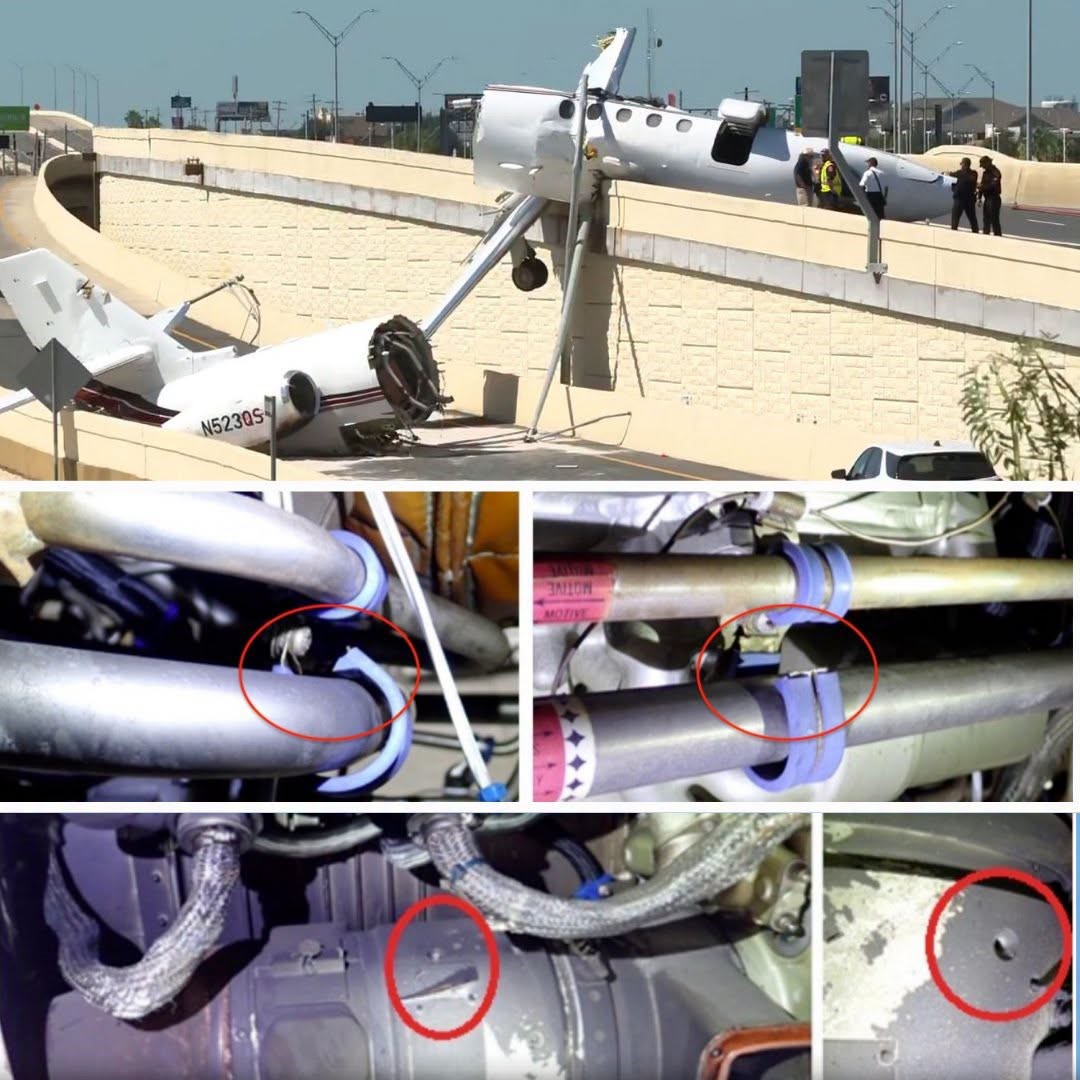
It sheared through several light poles, struck a moving vehicle and finally came to rest straddling the edge of an overpass. The fuselage rolled onto its right side, leaving the rear cabin emergency exit against the ground while the main cabin door was facing upward.
Eventually, the main cabin door was opened.
Five occupants escaped through it.
The captain suffered serious injuries. The first officer suffered minor injuries, and one passenger was killed. Three other passengers suffered minor injuries. A person inside the vehicle struck by the aircraft was also injured. The jet sustained substantial damage to its fuselage, tail and both wings.
But what investigators discovered inside the wreckage is now a crucial focus of the investigation.
The NTSB established flight control continuity for the ailerons, elevator and rudder. Investigators then examined the right engine area and discovered that the right engine fuel pressure switch had separated from the fuel tube assembly.
More significantly, the fuel tube assembly itself was fractured adjacent to a weld joint at the attachment tube leading to the fuel pressure switch.
Multiple P-clamps supporting the fuel tube assembly were also found fractured.
The preliminary investigation photographs show the right-engine fuel tube and pressure-switch area, along with several visibly damaged P-clamps. These components are now central pieces of physical evidence in the investigation.
Then investigators examined the right engine starter generator.
What they found was equally striking.
The starter generator, manufactured by Safran in October 2023, was missing multiple screws from its outer housing. According to the report, the unit had just 57.2 hours remaining before reaching the 1,200-hour interval since its last overhaul, which had been performed on April 25, 2025.
After investigators removed the generator, they discovered that its shaft was bent.
The cooling fan was fractured.
Multiple broken cooling fan blades and ball bearings were found during removal.
The cooling fan shroud displayed circumferential scoring marks.
These discoveries raise major investigative questions.
Was the mysterious vibration reported early in the flight connected to the damaged starter generator? Did the bent shaft, fractured cooling fan or internal bearing damage produce the low-frequency vibration and humming noise felt through the cockpit dashboard?
Could the vibration or another mechanical interaction have contributed to the fractured fuel tube assembly or damaged P-clamps?
How did the right-side fuel system lose pressure, and what ultimately led to the flameout of not only the right engine but also the left engine seconds later?
At this stage, the NTSB has not issued a probable cause, and the preliminary report does not establish a final causal sequence. The information remains preliminary and subject to change.
The fractured fuel tube assembly, starter generator and multiple other components have now been sent to the NTSB Materials Laboratory in Washington, DC, for detailed examination.
Investigators also recovered the aircraft’s flight data recorder and cockpit voice recorder. Both have been sent to the NTSB Recorders Laboratory for download and analysis.
Those recorders could be critical in reconstructing the final flight minute by minute: the evolution of the vibration, the sequence of cockpit warnings, engine parameters, fuel indications, electrical failures, crew actions and the exact timing of both engine flameouts.
Weather does not appear to have presented an obvious challenge at the accident site. The preliminary report lists visual meteorological conditions, clear skies, 10 miles of visibility and winds of only 2 knots. The accident occurred at night.
For investigators, the wreckage may now hold the answer to a haunting question: how did an unusual vibration that initially appeared manageable evolve into multiple system warnings, a right-side fuel pressure problem, an in-flight fire and the loss of both engines on final approach?
The pilots came within roughly a mile of the airport.
Instead, with no engine power and darkness below, their final landing surface became a Texas highway.
The investigation into N523QS is far from over, but the preliminary findings have already exposed a complex mechanical puzzle involving a fractured fuel system assembly, broken support clamps and a severely damaged starter generator.
Now, investigators must determine how those pieces connect—and whether the strange vibration heard and felt early in the flight was the first warning of the catastrophe that followed.