
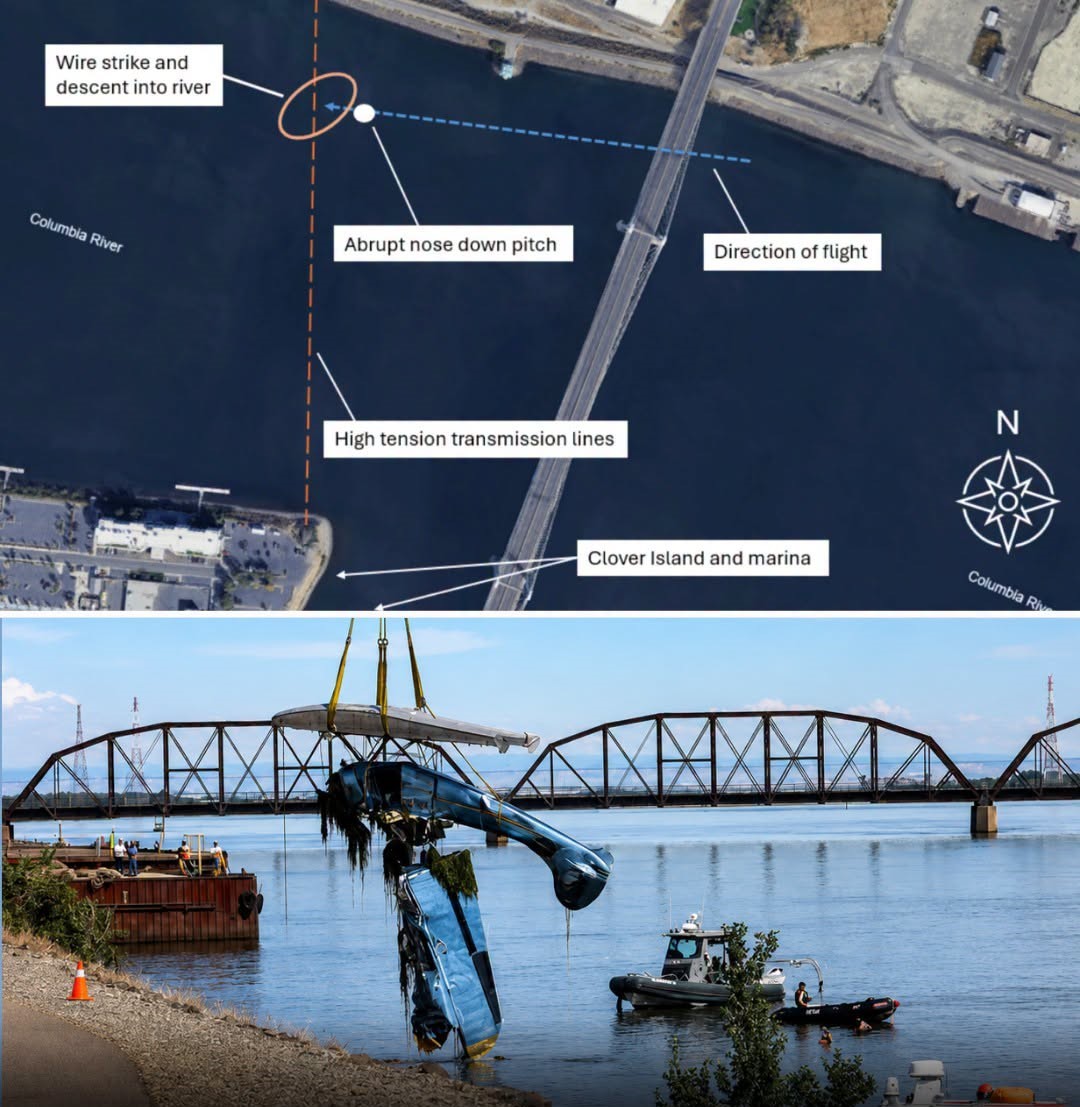
A newly released preliminary report from the National Transportation Safety Board (NTSB) has revealed new details about the tragic plane crash that claimed the lives of a pilot and passenger after a floatplane struck a high-voltage power line and plunged into the Columbia River near Kennewick, Washington, on June 24.
According to investigators, the flight was a private, non-commercial Part 91 operation involving a Cessna 195 equipped with floats. Air traffic control recordings show the pilot informed the Tri-Cities Airport tower that they intended to land on the Columbia River. The controller responded that the landing would be “at their own risk” and instructed the pilot to report once the landing was assured. The pilot acknowledged the instruction—but that would be the final radio transmission from the aircraft.
The preliminary investigation found that the floatplane flew westward over the Ed Hendler Bridge, passing between the bridge’s north tower and the eastern shoreline of the Columbia River. Witness accounts and video footage indicate the aircraft continued straight for approximately nine seconds before suddenly pitching nose-down for about one second. It then struck a high-tension transmission line located just west of the bridge before descending almost vertically into the river, coming to rest roughly 100 to 200 feet from the eastern shoreline.
The report also sheds light on the aircraft’s journey. Family members of the passenger told investigators that the flight had departed from the Napa River near Napa, California, earlier that morning and was bound for the Tanglefoot Seaplane Base in Cavanaugh Bay, Idaho. Investigators also learned that the pilot had contacted the Port of Kennewick before the trip to inquire about fuel availability at the marina, suggesting the area may have been considered as a planned stop.
Following the accident, recovery crews used a crane to lift the aircraft from the Columbia River. Investigators found that the floats, engine, propeller, and tail section remained attached to the fuselage. However, both wings had separated from the aircraft and showed extensive tearing, crushing, and scraping damage. The wing flaps were found extended, while the left aileron has not yet been recovered.
The NTSB emphasized that the document is only a preliminary report. Investigators are continuing to examine the wreckage, operational factors, and all available evidence before determining the probable cause of the crash. A final report, which could take many months to complete, will provide the agency’s official findings.