
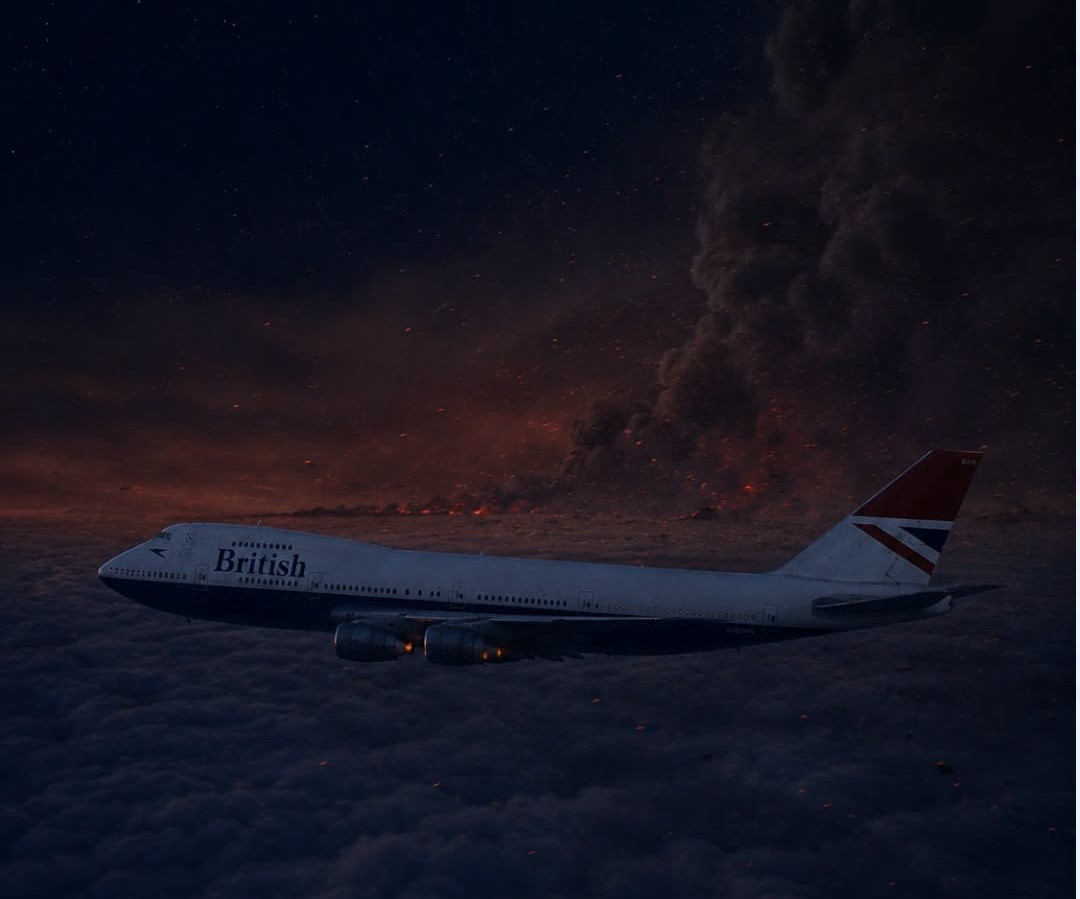
Today in 1982: The Night a Boeing 747 Lost All Four Engines at 37,000 Feet
On June 24, 1982, one of the most extraordinary survival stories in aviation history unfolded over the Indian Ocean south of Java, Indonesia. British Airways Flight 009, a Boeing 747-236B named City of Edinburgh, was operating a scheduled flight from Kuala Lumpur to Perth as part of its longer journey from London to Auckland. On board were 248 passengers and 15 crew members.
What happened that night seemed impossible. All four engines on the giant jumbo jet failed at cruising altitude, leaving the aircraft gliding silently through the darkness with no thrust. Yet against all odds, every person on board survived.
The incident began shortly after the aircraft had reached its cruising altitude of 37,000 feet. The crew noticed strange electrical discharges dancing across the windshield, resembling St. Elmo’s Fire. Weather radar showed clear skies, and there appeared to be no storm activity ahead. As a precaution, the crew switched on engine anti-ice systems and illuminated the seatbelt signs, but there was no indication of the danger that lay ahead.
Soon afterward, passengers and cabin crew noticed a sulfur-like smell and haze inside the cabin. Some passengers looking out the windows reported an eerie sight: the engines appeared to glow with a bright blue light. Unknown to everyone on board, the aircraft had entered a massive cloud of volcanic ash produced by the eruption of Mount Galunggung in Indonesia. Because the ash cloud was dry and contained little moisture, it was invisible to the aircraft’s weather radar.
At approximately 20:42 local time, engine number four began surging and failed. The crew immediately carried out emergency procedures. Before they could fully assess the situation, engine number two also failed. Within seconds, engines one and three stopped as well. In less than two minutes, all four Rolls-Royce RB211 engines had flamed out. The Boeing 747 had effectively become a giant glider.
Captain Eric Moody and his crew quickly calculated their options. A Boeing 747 has a glide ratio of approximately 15:1, meaning it can travel about 15 kilometers forward for every kilometer it descends. At 37,000 feet, they estimated they had roughly 23 minutes before reaching sea level. The crew initiated engine restart procedures while turning toward Jakarta, hoping they could either restart the engines or make an emergency landing.
During the descent, Captain Moody made what became one of the most famous passenger announcements in aviation history. Calmly informing the passengers of the emergency, he stated that all four engines had stopped and that the crew was doing its utmost to resolve the situation. His composed tone helped prevent panic among those on board.
The aircraft continued descending through the night. Inside the engines, volcanic ash had melted in the intense heat of the combustion chambers, coating internal components with a glass-like substance. As the engines cooled during the powerless glide and the aircraft descended out of the ash cloud, the hardened deposits began breaking apart. This unexpectedly created an opportunity for the engines to breathe normally again.
At around 13:56 UTC, engine number four restarted. Shortly afterward, engine number three came back to life, followed by engines one and two. The crew had regained power, but the danger was not over. One engine began surging again and had to be shut down, leaving the aircraft operating with only three reliable engines. The crew maintained a lower altitude and continued toward Jakarta.
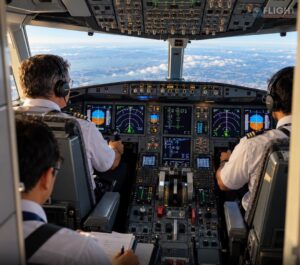
As the aircraft approached the airport, another serious problem emerged. The volcanic ash had sandblasted the windshield so severely that it had become almost opaque. Despite favorable weather conditions, the pilots could barely see outside. The approach had to be flown largely using instruments. To make matters worse, part of the airport’s instrument landing system was unavailable, forcing the crew to rely on limited guidance during the final stages of the approach.
Against all odds, the Boeing 747 landed safely at Jakarta’s Halim Perdanakusuma Airport. Every one of the 263 people aboard survived. What had begun as an apparently routine international flight had become one of the most remarkable recoveries in aviation history.
The post-flight inspection revealed extensive damage. Volcanic ash had eroded engine components, contaminated fuel systems, damaged landing light covers, and severely scratched the windshield. Three engines were replaced in Jakarta, and a fourth was replaced after the aircraft returned to the United Kingdom. Engineers found evidence that molten ash had accumulated inside the engines before cooling and solidifying.
The investigation concluded that volcanic ash from Mount Galunggung was entirely responsible for the near-disaster. At the time, aviation authorities had limited understanding of the threat volcanic ash posed to jet aircraft. The ash particles deprived the engines of sufficient airflow, melted inside the hot engine cores, and effectively shut down combustion. Because the ash cloud was invisible to weather radar, neither the crew nor air traffic controllers realized the danger until it was too late.
One of the most important revelations was that volcanic ash clouds could be just as dangerous as severe weather, despite being largely invisible to conventional detection systems. The incident led to major changes in aviation safety worldwide. Authorities established volcanic ash monitoring systems, improved reporting procedures, and developed international warning networks to keep aircraft away from volcanic ash clouds. These systems continue to protect flights around the world today.
The aftermath extended beyond regulatory changes. Less than three weeks later, another Boeing 747 from Singapore Airlines encountered ash from the same volcano and lost multiple engines, reinforcing the seriousness of the threat. Airspace around the volcano was subsequently restricted, and global aviation authorities accelerated efforts to track volcanic activity affecting flight routes.
Captain Eric Moody and his crew received numerous awards for their professionalism and skill. Their actions transformed what could have been one of the deadliest aviation disasters of the 1980s into a legendary example of cockpit resource management, teamwork, and calm decision-making under extreme pressure. The flight’s powerless descent was later recognized as one of the longest glides ever achieved by a commercial airliner.
More than four decades later, British Airways Flight 009 remains one of aviation’s most astonishing survival stories. A fully loaded Boeing 747 lost all four engines at night over the ocean, descended tens of thousands of feet without power, restarted its engines in flight, and landed safely. The event not only saved 263 lives but also fundamentally changed how the aviation industry understands and manages the threat posed by volcanic ash.