
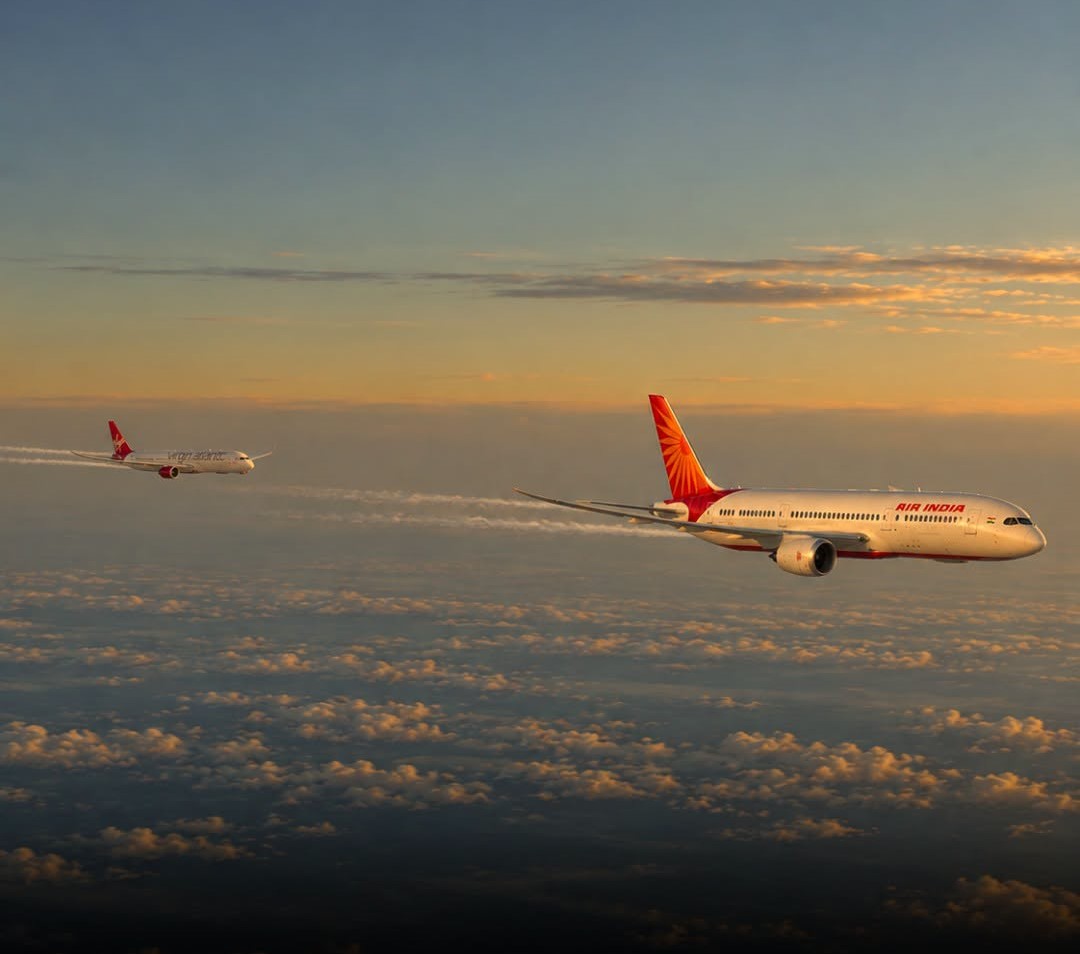
On 14 September 2022, two Boeing 787s carrying a combined 253 people came dangerously close to each other over the Arabian Sea after a routine night flight suddenly turned into a serious airprox incident.
Air India flight AIC912, a Boeing 787-8 registered VT-ANM, was flying from Dubai to Mumbai with 88 people aboard at Flight Level 390, or about 39,000 feet.
Behind it on the same airway, L301, was Virgin Atlantic flight VIR354, a Boeing 787-9 registered G-VBZZ, travelling from London Heathrow to Mumbai with 165 people. Virgin Atlantic was maintaining FL410, 2,000 feet above the Air India aircraft.
At about 02:39 UTC, the Virgin Atlantic aircraft unexpectedly began descending. Its flight data recorder showed that the crew had selected 34,000 feet at 02:38:50, and the aircraft began descending about 17 seconds later.
But Mumbai Oceanic Control had not issued a descent clearance. The investigation found that the pilot flying believed a descent clearance had been received, possibly because a broken VHF transmission was mistaken for an instruction.
The situation became increasingly dangerous. The U-5 controller saw the Virgin aircraft descending but initially could not establish radio contact. Repeated calls went unanswered.
Controllers then attempted to contact the aircraft through CPDLC, but a frequency was mistyped during the process, adding further confusion.
Virgin 354 eventually received an instruction to stop descending at FL400, but the aircraft continued downward for roughly another 10 seconds, reaching approximately FL389. It then began climbing again.
At 02:41:05, the two aircraft were both at FL390, reducing their lateral separation to just 3 nautical miles. The required separation was 1,000 feet vertically and 10 nautical miles laterally.
Remarkably, neither aircraft received a TCAS resolution advisory. The ATC system also produced no automated conflict warning because the U-5 controller had not yet acquired both aircraft. Air India maintained its assigned altitude throughout the event.
The Virgin aircraft was eventually instructed to climb back to FL410 and reached that level safely. Air India and Virgin Atlantic continued toward Mumbai and landed at 03:48 and 03:50 UTC respectively. Nobody was injured and neither aircraft was damaged.
The investigation uncovered another troubling detail after the incident. Although the occurrence required preservation of flight-recorder evidence, Virgin Atlantic’s cockpit voice recorder was not removed before the aircraft was released for its return flight to London.
The CVR data was subsequently overwritten and lost. Investigators therefore had to rely heavily on ATC recordings, Air India’s cockpit voice recorder and the Virgin aircraft’s digital flight-data recorder.
AAIB concluded that the probable cause was confirmation bias: the Virgin crew apparently expected a descent because traffic ahead was lower and they had requested a higher cruise speed.
A broken VHF transmission may then have been interpreted as descent clearance, despite CPDLC being the primary communication method in Mumbai Oceanic airspace. The report also identified poor VHF coverage, confusing communications and the absence of an automated conflict alert as important contributing factors.
The incident prompted recommendations to improve VHF coverage, emphasize communication risks in airline briefings, ensure all serious incidents are promptly reported to AAIB, and prevent aircraft from being released for another flight until required flight-recorder evidence has been preserved.