
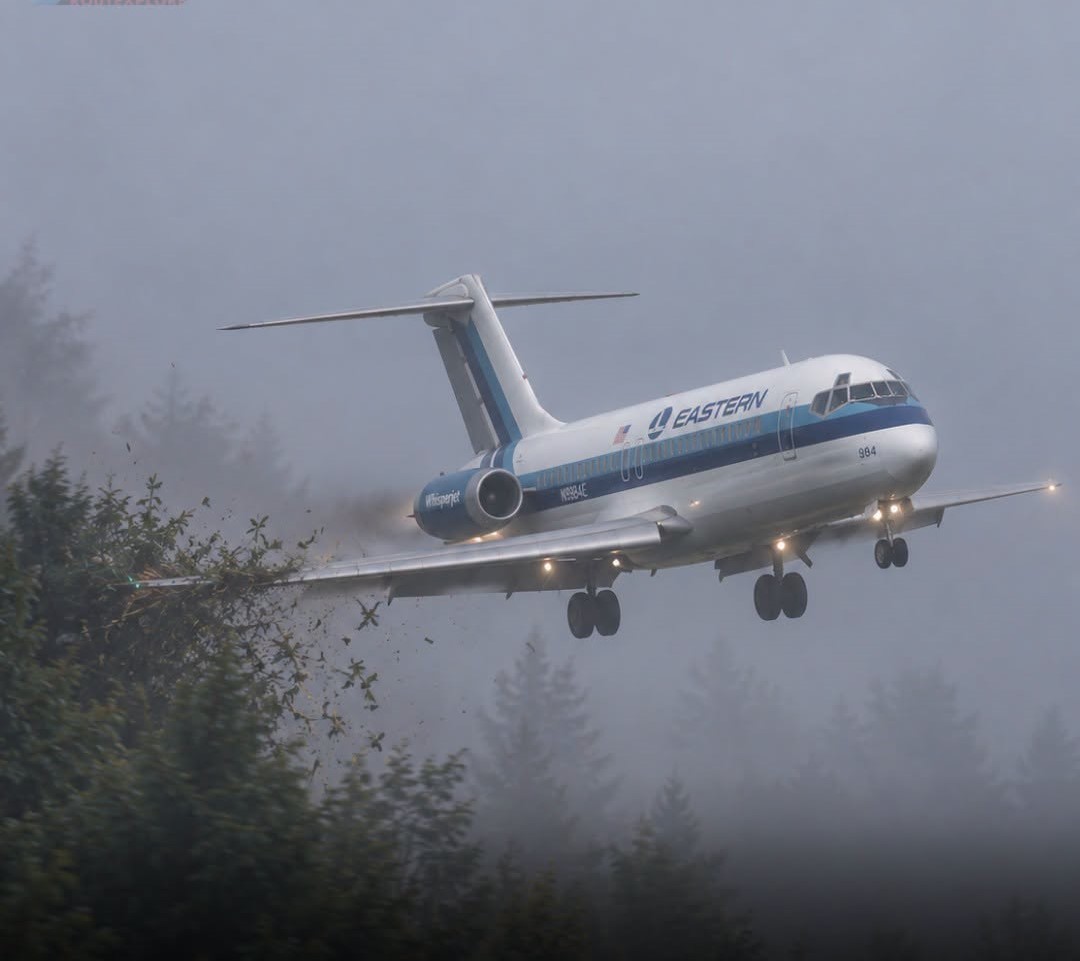
On September 11, 1974, Eastern Air Lines Flight 212 was approaching Charlotte, North Carolina, when a routine landing turned into one of the deadliest aviation accidents in the city’s history.
The McDonnell Douglas DC-9-31, registered N8984E, was carrying 78 passengers and four crew members on a scheduled flight from Charleston to Chicago via Charlotte. Only 10 people ultimately survived.
The flight departed Charleston at about 7:00 a.m., with First Officer James Daniels flying. The trip toward Charlotte was uneventful, but the airport was experiencing restricted visibility because of patchy ground fog.
The crew received the weather information and began a VOR/DME nonprecision approach to Runway 36.
As the aircraft descended toward Charlotte, the pilots became increasingly distracted by conversations unrelated to the approach.
They discussed subjects including the Watergate scandal, politics, the oil crisis and even used cars. During this period, the DC-9 continued descending through the altitudes at which the crew should have been closely monitoring its position.
The distraction became critical when Captain James Reeves spotted the Carolina Skytower, a prominent landmark near the airport.
Instead of concentrating on their instruments and prescribed approach procedures, the pilots discussed whether they were seeing the tower and attempted to establish their position visually. Meanwhile, the aircraft continued descending.
A terrain warning sounded when the DC-9 was below 1,000 feet, but the crew silenced it. Investigators later found that the warning was routinely triggered during some approaches, which reduced its perceived urgency.
The pilots also failed to make the required altitude callouts. Critically, the first officer apparently believed the aircraft was substantially higher than it actually was, an error investigators linked partly to the design of the aircraft’s drum-type altimeters.
At about 7:34 a.m., the aircraft was still descending in fog, several miles short of the runway. The crew suddenly saw trees and terrain rushing toward them. Both pilots attempted to raise the nose, but there was not enough altitude to recover.
The right wing struck a tree, followed by impacts involving the left wing. The DC-9 then crashed into a cornfield, broke apart and caught fire.
The impact killed 32 people immediately, including Captain Reeves. Many others who initially survived were trapped or seriously injured by the intense post-crash fires. Rescue crews eventually located 14 survivors, but additional victims died from their injuries, including one survivor 29 days later. The final death toll reached 72.
The National Transportation Safety Board’s investigation concluded that the aircraft itself was not the fundamental problem. Its probable cause was the flight crew’s lack of altitude awareness during critical portions of the approach, caused by poor cockpit discipline and failure to follow prescribed procedures.
Investigators emphasized that nonessential conversation had distracted the pilots from monitoring their instruments, while the attempt to identify the Skytower further diverted their attention.
The tragedy had a lasting impact on aviation safety. The investigation helped establish the importance of eliminating nonessential cockpit conversation during critical phases of flight.
The FAA eventually introduced the sterile cockpit rule in 1981, requiring flight crews to concentrate exclusively on essential operational duties during takeoff, landing and other low-altitude phases.
Flight 212 therefore became a grim example of how seemingly harmless distractions, combined with procedural failures and poor altitude awareness, can turn a normal approach into a catastrophe within minutes.