
At first, September 11, 2001, looked like an ordinary Tuesday morning in American aviation. Four scheduled passenger flights departed normally from airports in the northeastern United States, carrying hundreds of passengers and crew toward destinations thousands of miles away.
Within hours, those four Boeing aircraft would become the center of the deadliest attack ever carried out using commercial airliners.
The operation depended on something aviation had been designed to prevent: an aircraft being turned against the people and places it was supposed to connect.
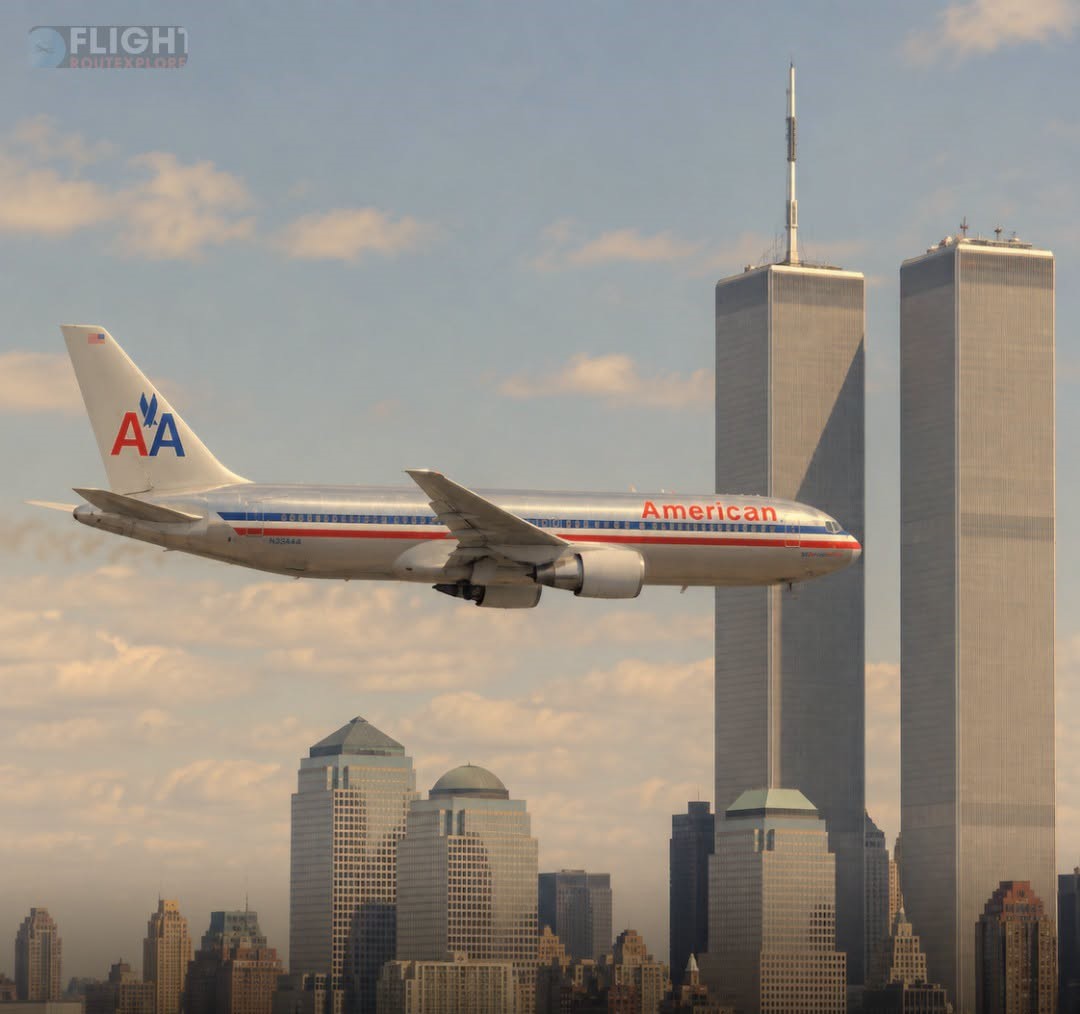
American Airlines Flight 11, a Boeing 767-223ER, departed Boston Logan International Airport at 7:59 a.m. for Los Angeles. It carried 92 people, including five hijackers.
At approximately 8:14, as the aircraft climbed through 26,000 feet, normal communication with air traffic control ended. The hijackers had taken control of the aircraft and disabled or manipulated its communications.
The aviation system began detecting something was wrong. Flight 11 stopped responding to instructions, and its transponder was subsequently turned off. Controllers struggled to determine exactly what had happened while simultaneously dealing with another aircraft that would soon become part of the attack.
United Airlines Flight 175, another Boeing 767 flying from Boston to Los Angeles, departed at 8:14. Its crew had actually reported a suspicious radio transmission apparently associated with Flight 11. Within minutes, Flight 175 was also hijacked.
At 8:46:40, American 11 slammed into the North Tower of the World Trade Center in New York. The aircraft was carrying thousands of gallons of jet fuel, and its impact immediately transformed a commercial aviation emergency into a catastrophic mass-casualty event.
Seventeen minutes later, the aviation world witnessed something almost unimaginable. At 9:03:11, United 175 struck the South Tower. The second impact made it unmistakably clear that this was not an isolated hijacking or conventional aviation emergency. Two commercial airliners had deliberately been used as weapons against the same target.
But two more hijacked aircraft were still in the sky.
American Airlines Flight 77, a Boeing 757, had departed Washington Dulles International Airport at 8:20 for Los Angeles with 64 people aboard. The hijacking began around 8:51. For a time, its disappearance from normal communications did not immediately lead controllers to identify it as another hijacked aircraft.
At 9:29, the aircraft’s autopilot was disengaged while it was approximately 38 miles west of the Pentagon. Controllers subsequently detected a primary radar target moving rapidly eastward. Flight 77 turned toward Washington before descending at high speed toward the Pentagon.
At 9:37:46, the Boeing 757 struck the Pentagon at approximately 530 mph.
Meanwhile, United Airlines Flight 93 had become the final aircraft in the plot. The Boeing 757 departed Newark International Airport at 8:42 for San Francisco—more than 25 minutes behind its scheduled departure because of normal morning traffic.
That delay would prove significant.
The hijackers did not seize Flight 93 until approximately 9:28, considerably later than the takeovers of the other three aircraft. By then, passengers had begun learning what was happening on the ground through telephone calls.
At 9:24, the cockpit had received a warning from United’s dispatcher about the attacks and the possibility of cockpit intrusion. Five minutes later, the hijackers attacked.
But the passengers and crew eventually realized that their aircraft was being used as a weapon. They organized an attempt to retake the cockpit. Cockpit voice recorder evidence captured sounds of the struggle, including the pilots’ distress calls. At 10:03:11, Flight 93 crashed into a field near Shanksville, Pennsylvania, at approximately 580 mph.
It never reached its intended target.
The passengers’ revolt remains one of the defining aviation stories of September 11. Investigators concluded that the aircraft was headed toward Washington, although its precise intended target could never be established with absolute certainty.
The aviation consequences were immediate and unprecedented.
At 9:25 a.m., the FAA ordered a nationwide ground stop, halting all civilian aircraft departures. At 9:45, it ordered aircraft already airborne to land at the nearest suitable airport as soon as practical. More than 4,500 aircraft were operating under instrument flight rules when the unprecedented shutdown began. By 12:15 p.m., the skies over the contiguous United States were essentially empty of commercial and private aircraft.
For the first time in U.S. aviation history, the entire national airspace system had effectively been shut down because of a security threat.
The consequences extended far beyond the four aircraft. Thousands of flights were canceled, while hundreds of aircraft already in the air were diverted to airports across the United States and Canada. Airports suddenly became temporary destinations for passengers who had no idea when they would be able to continue their journeys.
More importantly, September 11 exposed vulnerabilities in the assumptions underlying commercial aviation security. Cockpit doors could be breached. Hijacking protocols had been developed primarily around the possibility of hostage-taking and negotiation—not suicide attacks in which the aircraft itself was the weapon.
The attacks produced a fundamental transformation.
The Aviation and Transportation Security Act was signed into law on November 19, 2001, creating the Transportation Security Administration and transferring federal responsibility for aviation security to the new agency.
Cockpit security was dramatically strengthened, passenger and baggage screening was transformed, intelligence-sharing requirements expanded, and the philosophy of dealing with hijackings changed permanently.
Before September 11, the overriding assumption was that a hijacked airliner might eventually land somewhere and that the passengers could be held hostage. After September 11, everyone in aviation understood a terrifying new possibility: the aircraft itself could be the weapon.
Four ordinary scheduled flights therefore became four extraordinary chapters in aviation history.
American 11. United 175. American 77. United 93.
Their routes were ordinary. Their aircraft were ordinary. Their crews were doing what airline crews had done countless times before.
But on September 11, 2001, commercial aviation became the battlefield—and the aviation industry that emerged afterward was fundamentally different from the one that entered the morning.