
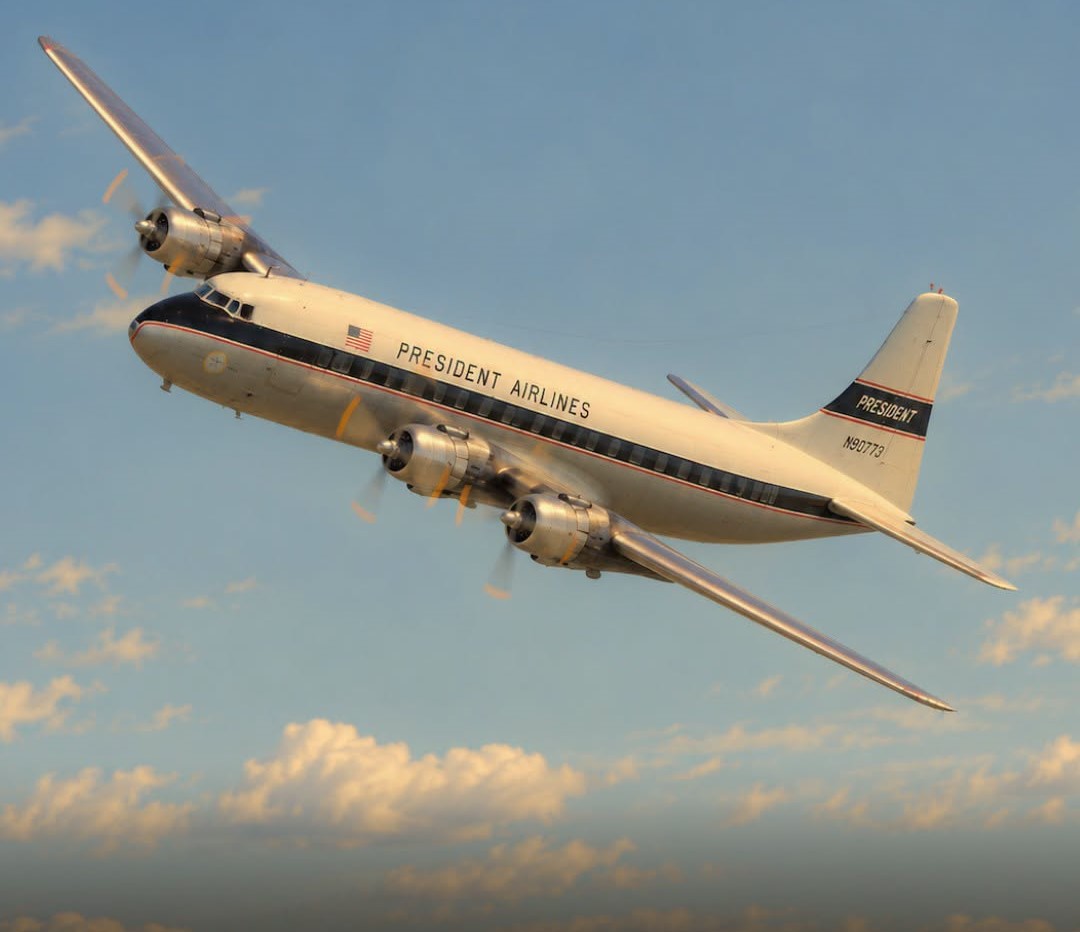
On September 10, 1961, a President Airlines Douglas DC-6B named Theodore Roosevelt disappeared into the River Shannon shortly after taking off from Shannon Airport in Ireland.
The tragedy killed all 83 people aboard — 77 passengers and six crew members — making it the deadliest aviation disaster to occur on Irish territory.
The aircraft, registered N90773, was operating a non-scheduled international passenger flight from Düsseldorf, West Germany, to Chicago, with planned stops at Shannon and Gander, Newfoundland, for refueling.
After arriving at Shannon, the four-engine DC-6B was prepared for the transatlantic leg of its journey. The aircraft took off from Runway 24 during nighttime conditions, but within moments, something went badly wrong.
After becoming airborne, the crew was cleared to make a right-hand turn. Instead, the aircraft began turning left. The turn continued and became increasingly steep, eventually reaching a bank angle of approximately 90 degrees or more.
At that point, the pilots were unable to regain control of the aircraft. The DC-6 descended rapidly and crashed into the River Shannon approximately 5,000 feet from the end of the runway. There were no survivors.
The crash was particularly devastating because it happened so soon after takeoff, leaving the crew with virtually no time or altitude to diagnose the problem and recover. The aircraft plunged into the river with such force that the accident became one of Ireland’s most significant aviation disasters.
Investigators faced a difficult question: why had an experienced crew suddenly allowed a large airliner to enter such an extreme bank shortly after departure? The evidence pointed toward a possible failure involving the aircraft’s flight-control or flight-instrument systems.
Investigations concluded that a malfunctioning attitude indicator, a fault involving the starboard ailerons, or a combination of both could have contributed to the loss of control. Poor weather conditions and possible crew fatigue were also identified as contributing factors.
An attitude indicator was especially critical in the circumstances because it provided pilots with information about the aircraft’s pitch and bank attitude. If its indications became unreliable, maintaining the correct aircraft attitude could become extremely difficult, particularly at night or in poor visibility.
A flight-control problem affecting the ailerons could have further complicated the crew’s attempt to control the aircraft.
The disaster also had consequences for President Airlines itself. The company, a supplemental carrier that had acquired the operating certificate of California Eastern Airways in 1960, went out of business not long after the crash.
The loss of the Theodore Roosevelt remains a haunting chapter in Irish aviation history. What began as a routine refueling stop on a transatlantic journey ended only minutes later in catastrophe, with 83 lives lost and investigators left to reconstruct how an apparently normal departure turned into an unrecoverable spiral over the River Shannon.