
On September 8, 2015, British Airways Flight 2276 was preparing to leave Las Vegas McCarran International Airport for London Gatwick.
The aircraft was a 16-year-old Boeing 777-236ER, registration G-VIIO, carrying 157 passengers and 13 crew members. At about 4:13 p.m., the aircraft began its takeoff roll on Runway 07L.
The flight had only reached about 90 mph when the crew suddenly heard and felt what the captain later described as a catastrophic engine failure. The No. 1 engine, the General Electric GE90 on the left wing, suffered an uncontained failure.
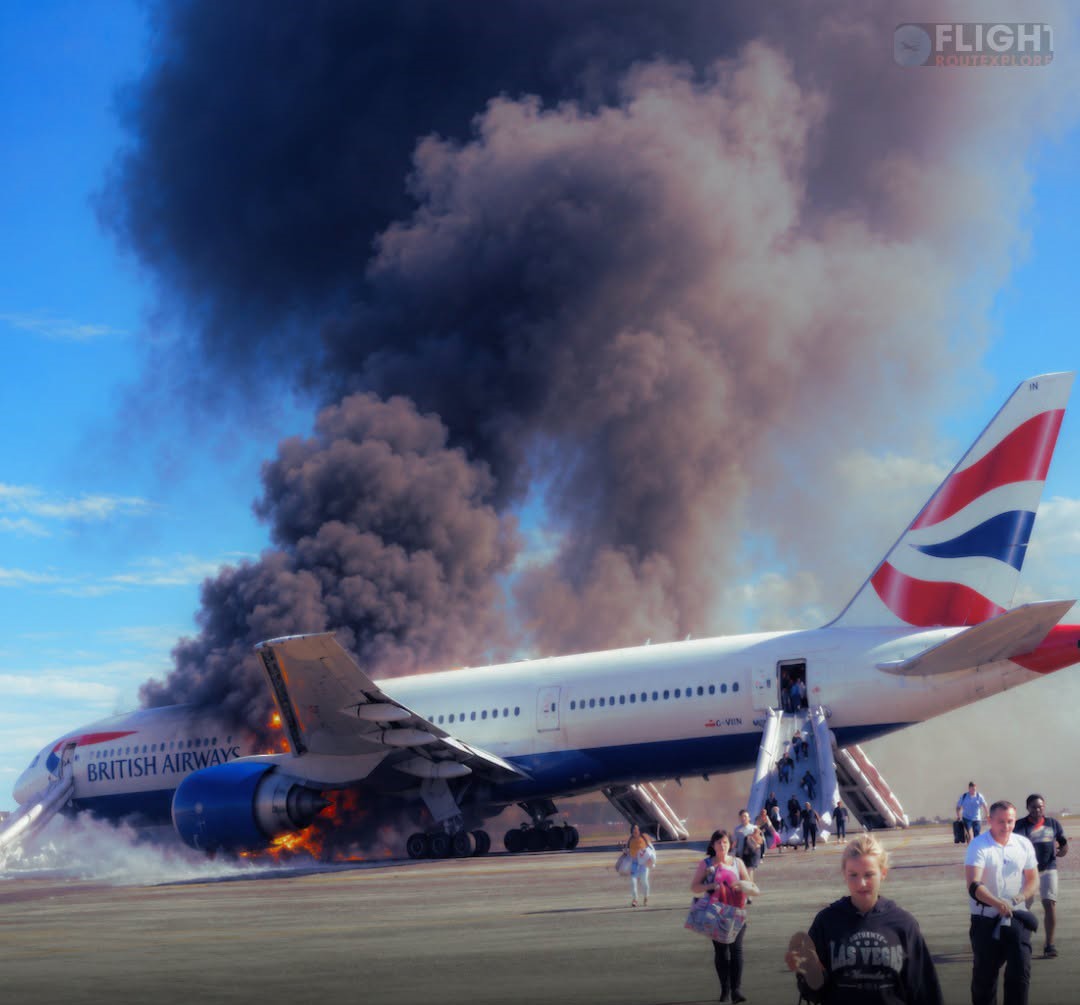
Pieces from inside the engine broke through its casing, while a fire rapidly developed around the engine and left side of the aircraft.
Because the aircraft was still travelling far below its takeoff decision speed of approximately 170 mph, the pilots were able to reject the takeoff. They applied the brakes and brought the 777 to a stop on the runway.
The crew immediately ordered an evacuation as flames continued to burn near the left wing and fuselage.
All 170 occupants escaped using the emergency exits and slides. Firefighters arrived and extinguished the blaze within minutes.
However, the evacuation was not without injuries: one cabin crew member suffered a serious injury and 19 passengers suffered minor injuries, many associated with the emergency evacuation. Remarkably, there were no fatalities.
The aircraft itself was substantially damaged. Fire affected the No. 1 engine, its pylon, the inboard section of the left wing and portions of the fuselage. The flames also caused significant damage to the forward part of the aircraft. The runway was closed, disrupting other flights at the airport.
The subsequent investigation revealed that the failure began deep inside the GE90’s high-pressure compressor. Investigators found that the stage 8–10 spool had fractured, sending metal fragments through the engine case.
The failure originated from a low-cycle fatigue crack in the web of the stage 8 compressor disk. Investigators could not determine exactly what initiated the crack.
The broken compressor components also caused the engine’s main fuel supply line to detach from the fuel pump. Fuel was released and ignited, producing the intense fire that spread toward the aircraft.
Investigators concluded that inadequate inspection procedures for the stage 8 disk web contributed to the accident because there was no inspection procedure specifically designed to detect the type of cracking that ultimately caused the failure.
Despite the severity of the fire, the crew’s decision to reject the takeoff at relatively low speed proved critical. Instead of becoming an airborne emergency, Flight 2276 became a dramatic runway evacuation in which every person survived. The damaged Boeing 777 was later repaired, flew to Victorville for further work, and returned to passenger service in March 2016.