
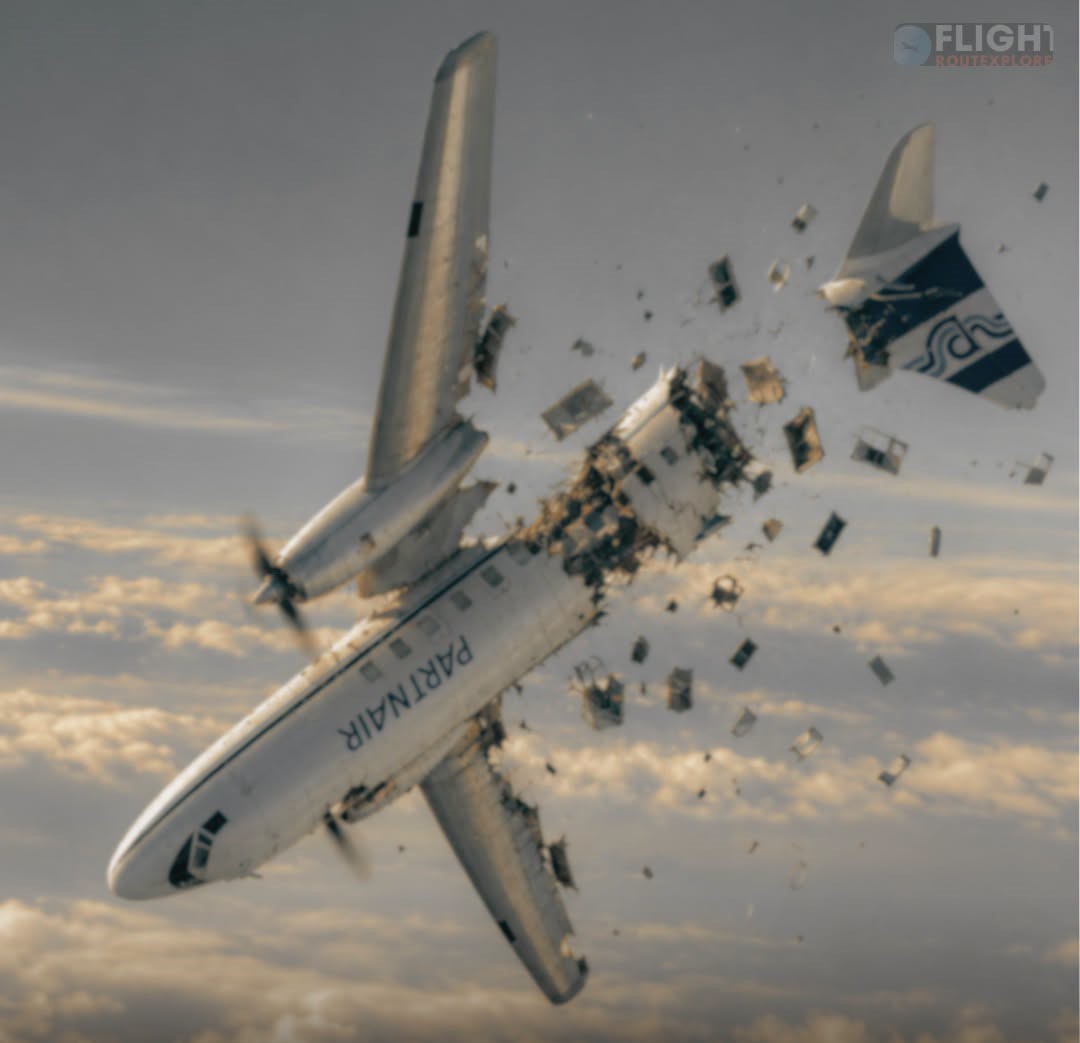
On September 8, 1989, Partnair Flight 394 was cruising at 22,000 feet over the North Sea when a disaster unfolded with almost no warning.
The Partnair Convair CV-580, registration LN-PAA, was carrying 50 passengers and five crew members from Oslo, Norway, to Hamburg, West Germany. All 55 people aboard were killed.
The flight was already facing problems before departure. One of the aircraft’s two main generators had been inoperative for days and could not be repaired.
The crew therefore planned to keep the auxiliary power unit, or APU, running throughout the flight to provide the second required power source. The aircraft eventually departed Oslo at 15:59 after a delay caused by an unpaid catering bill.
At cruising altitude, the Convair passed near a Norwegian F-16 fighter. The fighter pilot was startled by the aircraft’s unexpected proximity and contacted air traffic control. Later, the fighter became the focus of speculation that its possible supersonic shock wave had damaged the Convair.
Investigators ultimately rejected that theory, finding no evidence that the F-16 had passed close enough to cause the catastrophic damage.
As Flight 394 approached the Danish coast, controllers suddenly saw the aircraft deviate from its course and descend rapidly. It crashed into the Skagerrak about 18 kilometres north of Hirtshals, Denmark.
The wreckage was scattered across an area roughly two kilometres wide, showing that the aircraft had broken apart in the air. Investigators recovered 50 of the 55 bodies, and approximately 90 percent of the aircraft was eventually reconstructed.
The investigation initially faced another mystery: the cockpit voice recorder contained no recording of the accident. It had stopped shortly before takeoff because its power supply had been incorrectly rewired years earlier to the aircraft’s generator. With that generator inoperative, the recorder lost power just as the aircraft departed.
Investigators eventually found the critical evidence in the tail. The flight data recorder showed abnormal vibrations that had existed for months. Those vibrations temporarily disappeared after a major overhaul in Canada, when one worn tail attachment bolt was replaced.
They later returned and progressively increased. Examination of the recovered hardware revealed that three of the four bolts securing the vertical stabilizer to the fuselage were counterfeit. They had been improperly heat-treated and could withstand only about 60 percent of their intended breaking strength.
The counterfeit bolts and their associated sleeves gradually wore down, allowing the tail structure to vibrate. At the same time, the APU’s broken front mount allowed the APU to vibrate excessively. Investigators concluded that the two sources of vibration eventually reached resonance, dramatically amplifying the oscillations.
The violent movement caused the tail structure and rudder to fail, leading to loss of control and the aircraft breaking apart at altitude.
The crash became a landmark case in aviation safety because something as seemingly ordinary as a replacement bolt had catastrophic consequences. It also exposed the danger posed by counterfeit aircraft parts entering maintenance systems.
In the aftermath, the United States introduced reforms and intensified enforcement against suppliers of suspected unapproved aircraft parts. Partnair itself did not survive the disaster and filed for bankruptcy on October 11, 1989.