
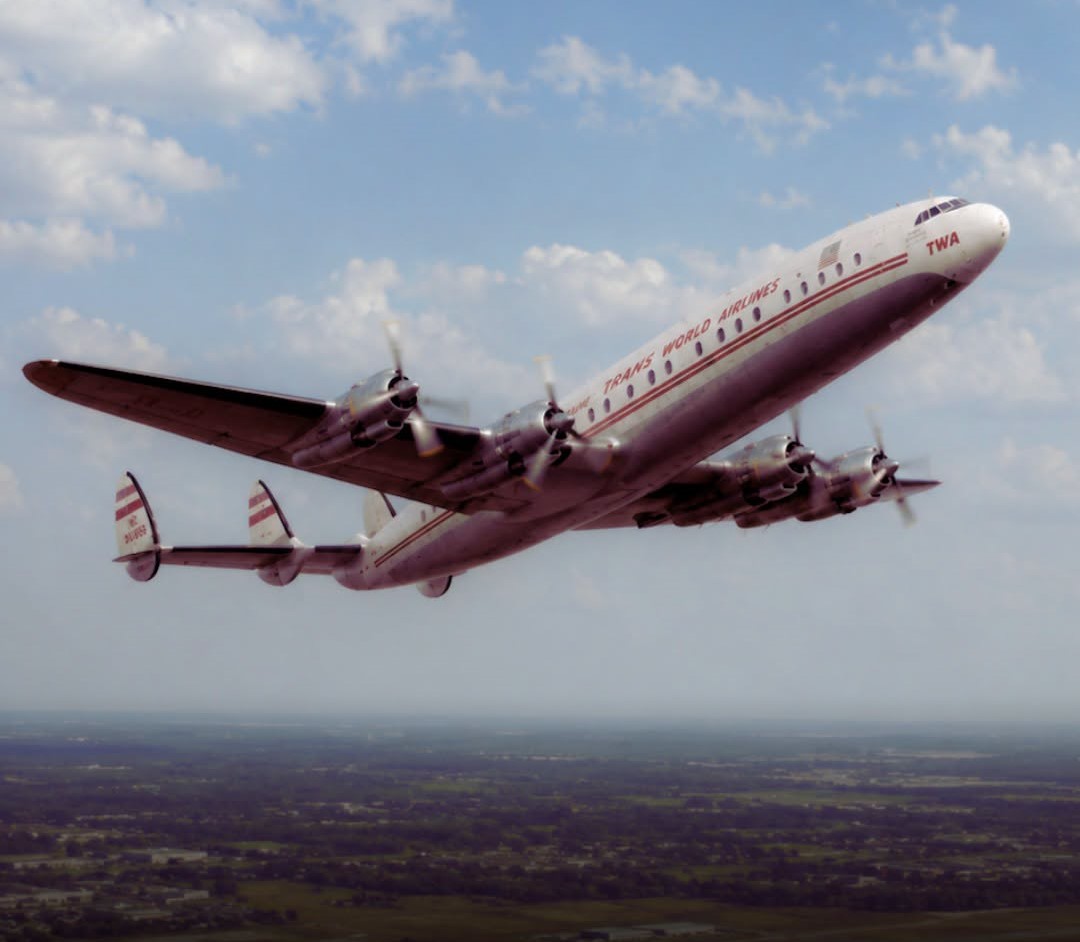
On September 1, 1961, a routine overnight passenger flight from Boston to Los Angeles became one of the deadliest aviation disasters in American history when a four-engine Lockheed L-049 Constellation suddenly pitched violently upward just minutes after departing Chicago.
The aircraft, named Star of Paris and registered N86511, was carrying 73 passengers and five crew members. All 78 people aboard were killed. What made the disaster particularly haunting was that investigators eventually traced the catastrophe to something almost unbelievably small: a 5/16-inch nickel-steel bolt that had disappeared from a critical part of the aircraft’s elevator control system.
TWA Flight 529 was operating a scheduled service from Boston to Los Angeles, with planned stops at New York, Pittsburgh, Chicago and Las Vegas. The aircraft had already completed several stages of its journey when it arrived at Chicago Midway Airport shortly after 1 a.m. local time.
At Midway, a new flight crew took over the aircraft, while fuel and oil were added for the next leg to Las Vegas. There was nothing obviously wrong with the Constellation when it prepared for departure.
At approximately 2:00 a.m., Flight 529 departed Midway Airport from Runway 22 and began climbing westward. The aircraft was expected to climb to 5,000 feet before continuing toward Las Vegas. The first few minutes appeared normal. The crew had no reason to expect that the airplane’s flight controls were about to become dangerously compromised.
Only about five minutes after takeoff, while the aircraft was climbing, something went catastrophically wrong. The Constellation suddenly pitched its nose sharply upward. Instead of continuing its controlled climb, the airplane entered an extreme nose-high attitude. The unexpected pitch-up rapidly reduced the aircraft’s airspeed and produced an accelerated stall.
The crew attempted to regain control, but the airplane was no longer responding normally to their inputs. The pilots were fighting a flight-control problem at precisely the moment when they needed immediate and precise control of the elevators. The aircraft descended rapidly and crashed into a field near Willowbrook, in DuPage County, southwest of Chicago. The impact destroyed the aircraft and produced a debris field approximately 200 feet wide and 1,100 feet long. There were no survivors.
The loss of 78 lives made the accident one of the most significant U.S. airline disasters of its time. The crash was especially shocking because it happened only minutes after departure, during a phase of flight when an airliner is relatively close to the ground and has little altitude available to recover from a sudden loss of control.
Investigators from the Civil Aeronautics Board began examining the wreckage to determine why an apparently serviceable Constellation had abruptly pitched upward. At first, the physical evidence offered no simple explanation. The aircraft had not suffered an obvious engine failure, fire or collision. Investigators therefore focused closely on the flight-control systems and began reconstructing the aircraft from the wreckage.
Their examination eventually revealed a crucial clue: a 5/16-inch AN-175-21 nickel-steel bolt was missing from the parallelogram linkage of the elevator boost system. The discovery was far more significant than it initially appeared. Investigators found evidence around the relevant mechanism, including scuff marks and grease patterns, indicating that the bolt had not simply been torn away during the impact. It had apparently fallen out before the aircraft struck the ground.
That tiny missing component had enormous consequences. The Lockheed L-049 Constellation used a hydraulic boost system to help the pilots move the elevators. The elevators are among the aircraft’s most important flight-control surfaces because they control pitch — whether the airplane’s nose rises or falls. If the elevator control mechanism becomes uncontrollable, the pilots can effectively lose their ability to command the aircraft’s pitch.
According to the investigation, the missing bolt caused the elevator system to become uncontrollable while the aircraft was in hydraulic boost mode. The resulting elevator movement forced the nose dramatically upward. The airplane then lost airspeed and entered an accelerated stall from which the crew could not recover. The CAB ultimately concluded that the bolt had most likely worked itself loose shortly before the accident.
But investigators uncovered another disturbing part of the sequence. The Constellation had a provision that allowed pilots to disconnect the hydraulic elevator boost and operate the elevators manually through a direct mechanical linkage. In theory, this provided a means of regaining control if the hydraulic boost system malfunctioned.
In practice, however, the accident exposed a serious weakness in that arrangement. As the aircraft pitched upward, the pilots apparently tried to switch the elevator system to manual control while simultaneously applying forward pressure on the control column in an attempt to force the nose down. The investigation found that this combination of conditions could make it extremely difficult — and potentially impossible — to move the control mechanism far enough to disconnect the hydraulic system.
That meant the pilots could have been trapped in a vicious cycle. They needed to push the nose down to prevent the aircraft from stalling, but the very forward pressure they were applying could prevent them from successfully switching the elevator system to manual control. With the aircraft continuing toward a stall and the pilots unable to regain normal elevator authority, there was almost no time or altitude available to recover.
The CAB’s final investigation took more than a year. On December 18, 1962, the board published its final report and identified the loss of the AN-175-21 nickel-steel bolt from the elevator boost-system linkage as the probable cause of the accident. The failure resulted in loss of aircraft control during the climb, ultimately leading to the fatal stall and crash.
The investigation was significant not merely because it identified a missing bolt, but because it demonstrated how a seemingly insignificant component could create a chain of failures with catastrophic consequences. The bolt itself was tiny compared with the enormous Constellation, yet its loss affected one of the aircraft’s essential flight-control systems. The accident became a striking example of how aviation disasters can result from a combination of mechanical failure and limitations in the design used to recover from that failure.
The aftermath also raised questions about the design of the elevator boost system. Investigators urged the Federal Aviation Administration to require a redesign that would allow pilots to shift the elevator system to manual control more easily, even while applying nose-down pressure. According to the historical account of the accident, the FAA instead asked the manufacturer to incorporate procedural changes into the aircraft’s flight manual rather than mandating the recommended physical redesign.
For the families of the 78 victims, the technical explanation could never lessen the human tragedy. Passengers had boarded the aircraft expecting an ordinary overnight journey across the United States. Instead, within minutes of leaving Chicago, their aircraft became uncontrollable and plunged into the ground.
The crash site itself remained undeveloped even as suburban Chicago expanded around it. Over the decades, vegetation gradually covered much of the area. Sixty years after the disaster, on September 1, 2021, a memorial dedicated to those who died was unveiled at Prairie Trail Park in Willowbrook, a short distance from the original crash site.
TWA Flight 529 is remembered today for an unsettling lesson in aviation safety: sometimes the most consequential failure is not a dramatic explosion, an engine fire or a visible structural break. In this case, the disaster began with a small bolt that was no longer where it was supposed to be. Its disappearance disabled a critical part of the elevator-control system, the resulting pitch-up pushed the aircraft into an accelerated stall, and the crew had only moments to fight a failure that the aircraft’s own control-system design made exceptionally difficult to overcome.
On that September night in 1961, 78 people lost their lives near Chicago. The investigation ultimately reconstructed the sequence from fragments of wreckage and traces left behind by a missing piece of hardware. The tragedy of TWA Flight 529 was therefore not simply that a mechanical component failed. It was that a component smaller than a human hand could trigger a chain of events from which an entire airliner and everyone aboard had virtually no chance to escape.