
On July 19, 1989, one of the most extraordinary chapters in aviation history unfolded over the American Midwest when United Airlines Flight 232 suffered a catastrophic failure that left its pilots with virtually no conventional way to fly the aircraft. What followed became known around the world as the “Impossible Landing”—a desperate 44-minute struggle in which a crippled McDonnell Douglas DC-10 was guided toward an airport using only the power of its remaining engines.
Although the aircraft ultimately crashed during landing, the remarkable actions of the flight crew saved 185 of the 296 people on board and forever changed aircraft design, maintenance procedures, and pilot training.
United Flight 232 was a scheduled service from Denver, Colorado, to Chicago, Illinois, with a continuing leg to Philadelphia. On board were 285 passengers and 11 crew members. The aircraft, a McDonnell Douglas DC-10-10 registered as N1819U, departed Denver without incident and climbed to its cruising altitude of 37,000 feet.
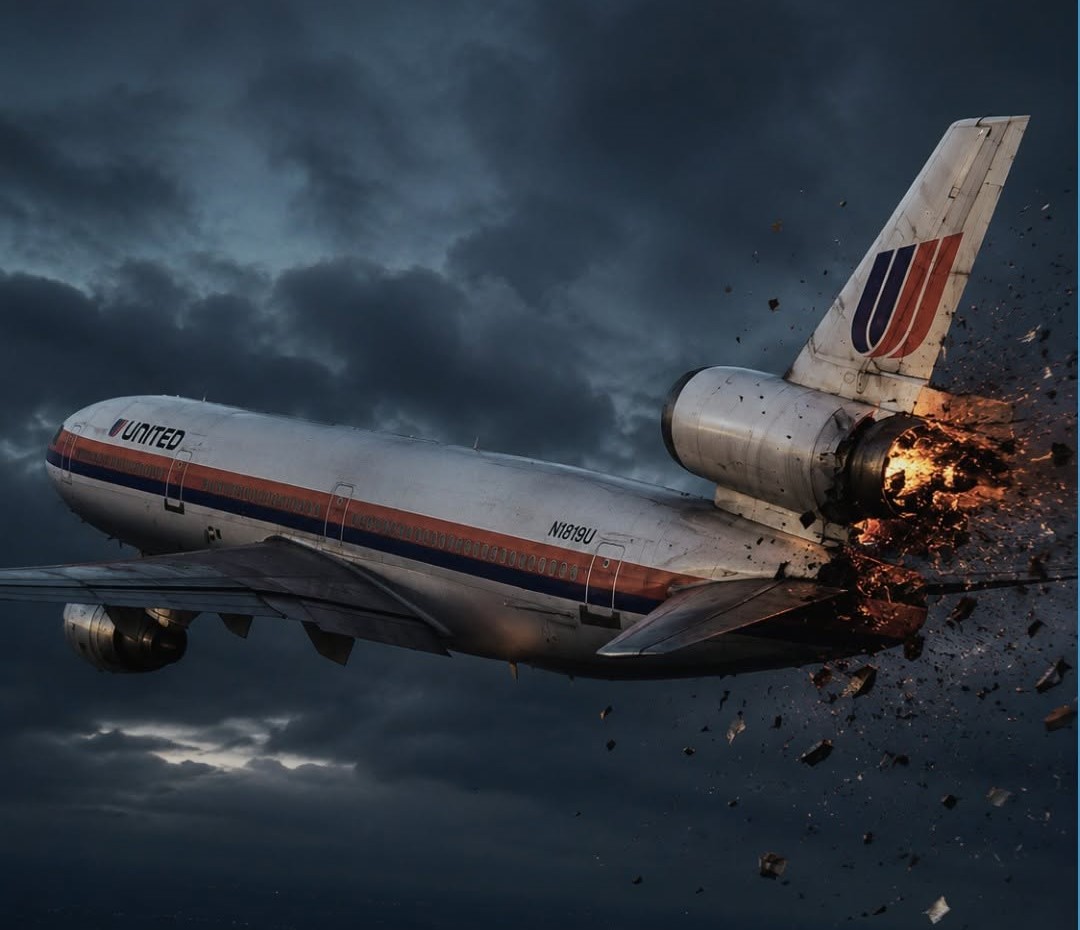
At approximately 3:16 p.m. Central Daylight Time, while cruising over Iowa, the peaceful flight was shattered by a deafening explosion. Captain Alfred “Al” Haynes and his crew initially suspected a bomb or another major structural failure because the entire aircraft violently shook.
The source, however, was the No. 2 engine mounted in the aircraft’s tail. The engine had suffered an uncontained catastrophic failure, meaning its internal rotating fan disk burst apart with tremendous force, sending razor-sharp fragments in every direction.
An engine failure alone was not supposed to bring down a DC-10. Commercial aircraft are designed to continue flying safely even after losing one engine. But the exploding fan disk created a far more devastating problem. High-speed metal fragments sliced through all three independent hydraulic systems located in the tail section.
These systems powered every major flight control surface, including the elevators, rudder, and ailerons. Engineers had believed that the simultaneous loss of all three hydraulic systems was so unlikely that no specific emergency checklist even existed for such a scenario. Within moments, hydraulic pressure dropped to zero, leaving the pilots unable to control the aircraft using the yoke or rudder pedals.
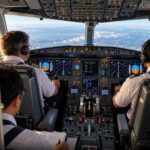
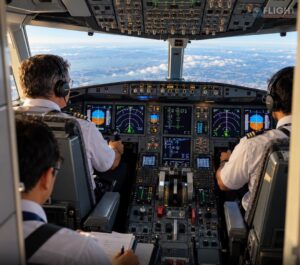
First Officer William Records attempted to control the aircraft, but the DC-10 continued banking and descending to the right. Captain Haynes soon realized that the only remaining controls capable of influencing the aircraft were the two wing-mounted engines. By reducing thrust on one engine and increasing it on the other, the crew discovered they could slowly alter the aircraft’s direction. The response was sluggish, unpredictable, and unlike anything pilots were ever trained to perform, but it was the only option available.
Adding an extraordinary twist to the emergency, Captain Dennis Fitch, a United Airlines DC-10 training captain who happened to be traveling as a passenger, volunteered his assistance. After entering the cockpit, Fitch concentrated almost entirely on managing the throttles while Captain Haynes, First Officer Records, and Flight Engineer Dudley Dvorak coordinated the rest of the emergency. Their teamwork became one of aviation’s greatest examples of Crew Resource Management, a philosophy emphasizing communication, cooperation, and shared decision-making inside the cockpit.
As the crippled aircraft continued descending, air traffic controllers guided Flight 232 toward Sioux Gateway Airport in Sioux City, Iowa. Every maneuver required careful coordination because engine thrust responded slowly, and every throttle movement affected the aircraft several seconds later. The DC-10 repeatedly entered long oscillations, alternately climbing and descending while turning in wide arcs. The crew could not precisely control speed, descent rate, or alignment with the runway. They were simply trying to keep the airplane airborne long enough to reach an airport.
Meanwhile, the cabin crew prepared passengers for an emergency landing. Flight attendants calmly demonstrated brace positions, reassured frightened travelers, and ensured the cabin was as ready as possible for impact. Emergency responders at Sioux Gateway Airport rapidly assembled around the runway after receiving word that an uncontrollable airliner was approaching.
At approximately 4:00 p.m., Flight 232 approached Runway 22. The aircraft was descending much faster than normal and traveling at roughly 215 to 240 mph, significantly above a typical landing speed. Without functioning flight controls, the crew could not properly flare the aircraft before touchdown or stabilize its approach. The right wing struck the runway first, followed almost immediately by the right engine. The landing gear collapsed, the aircraft cartwheeled, broke into several sections, and erupted into a massive fireball before coming to rest upside down across the airfield.
The crash was devastating, but the outcome could have been far worse. Of the 296 people aboard, 185 survived, while 111 lost their lives, including one flight attendant and 110 passengers. Considering that experienced test pilots later failed to reproduce a survivable landing in flight simulators under identical conditions, investigators concluded that the crew’s extraordinary performance significantly increased the number of survivors.
The National Transportation Safety Board launched an extensive investigation to determine why the accident occurred. Investigators eventually recovered the shattered engine fan disk, which had been thrown miles away from the crash site. Detailed metallurgical analysis revealed that the catastrophe began years before the flight. A tiny microscopic defect had been introduced into the titanium alloy fan disk during manufacturing. Over thousands of flight cycles, this defect gradually developed into a fatigue crack that routine inspection procedures failed to detect. On July 19, 1989, the crack reached a critical size, causing the fan disk to burst apart at extremely high rotational speed.
The investigation concluded that the probable cause of the accident was the failure of inspection and quality-control procedures to detect the fatigue crack originating from the previously undetected metallurgical defect in the General Electric engine’s titanium fan disk. The resulting debris severed all three hydraulic systems, exposing an extremely rare vulnerability in the aircraft’s design.
The accident triggered sweeping safety improvements across the aviation industry. Inspection methods for titanium engine components were significantly enhanced using more advanced non-destructive testing techniques. Aircraft manufacturers re-evaluated hydraulic system protection against uncontained engine failures, and additional safeguards were incorporated into later aircraft designs. NASA also conducted years of research into propulsion-controlled aircraft, exploring whether damaged airplanes could be controlled using engine thrust alone. Although researchers demonstrated that thrust-only control was possible under some circumstances, they found it was generally too imprecise for reliable landings without sophisticated computer assistance. The lessons learned from Flight 232 later influenced experimental flight-control technologies and emergency control systems.
Perhaps the greatest legacy of United Flight 232 was not technological but human. Captain Al Haynes consistently rejected the label of hero, insisting that the survival of so many people resulted from exceptional teamwork among the cockpit crew, flight attendants, air traffic controllers, airport firefighters, and emergency medical personnel. The accident became a landmark case study in Crew Resource Management, demonstrating how effective communication, mutual respect, and shared problem-solving can dramatically improve outcomes even during seemingly hopeless emergencies.
More than three decades later, United Airlines Flight 232 remains one of the most remarkable examples of courage, professionalism, and resilience in aviation history. Faced with an aircraft that had effectively become uncontrollable, four pilots improvised a method of flight that had never been attempted in an airliner, keeping the DC-10 in the air long enough to give nearly two-thirds of those aboard a chance to survive. While the aircraft could not be saved, the lessons learned from that extraordinary day continue to make commercial aviation safer around the world.