
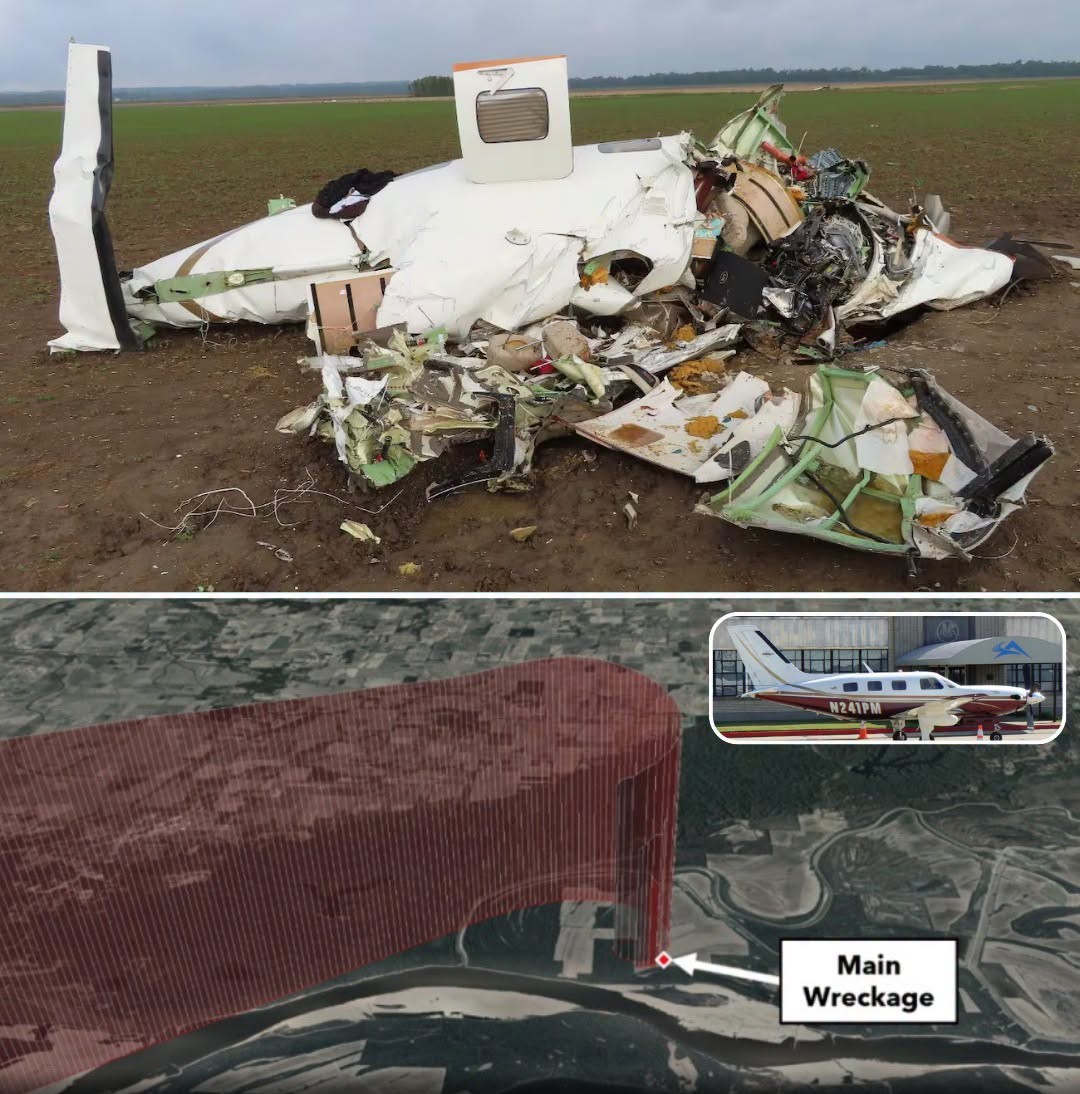
The National Transportation Safety Board (NTSB) has released its final report into the fatal May 12, 2024 crash of a Piper PA-46-500TP Malibu Meridian near Marianna, Arkansas, providing new insight into the chain of events that led to the aircraft’s in-flight breakup and the deaths of both people on board.
The turboprop aircraft, registered as N241PM, departed Pensacola, Florida, on an IFR flight to Batesville, Arkansas, with the pilot, one passenger, and two dogs aboard. During the cruise, the pilot reported that the aircraft’s satellite weather radar was not functioning and later requested assistance navigating around weather. While descending from Flight Level 280, air traffic controllers advised the pilot of moderate turbulence ahead and issued progressively lower altitude clearances.
As the aircraft descended through 20,000 feet, investigators found that its speed rapidly increased beyond the aircraft’s maximum operating limit of 187 knots calibrated airspeed. The descent rate exceeded 3,000 feet per minute before briefly stabilizing. Moments later, the aircraft deviated from its previously stable course, suggesting it was no longer under autopilot control. Within about 20 seconds, it entered a tightening right-hand turn, accelerated even further, and disappeared from radar at approximately 7,800 feet. Air traffic controllers immediately lost radio contact and initiated search procedures.
The investigation determined that the aircraft exceeded its structural design limitations during the high-speed descent. The excessive aerodynamic loads caused catastrophic structural failure, leading to an in-flight breakup. Large portions of the aircraft, including sections of the wings and tail, separated before impact, leaving investigators to recover wreckage spread across the accident area.
Although weather analysis identified strong vertical wind shear and the likelihood of moderate turbulence, investigators found no evidence that structural icing had accumulated on the aircraft despite the presence of supercooled liquid water within clouds. The report also considered the possibility of spatial disorientation but concluded that the experienced instrument-rated pilot likely lost control because the aircraft had already sustained structural damage from exceeding its airspeed limitations.
The NTSB determined that the probable cause of the accident was the pilot’s exceedance of the airplane’s design limitations, which resulted in an in-flight breakup. The findings also cited the aircraft’s wing spar and airspeed limitations being exceeded, along with environmental conditions that affected the operation of the flight.
This accident serves as another reminder of how quickly a combination of turbulence, high descent rates, and excessive airspeed can overwhelm even a capable aircraft. The report highlights the critical importance of remaining within certified operating limits, particularly during instrument meteorological conditions and turbulent descents, where structural margins can be be exceeded in a matter of seconds.