
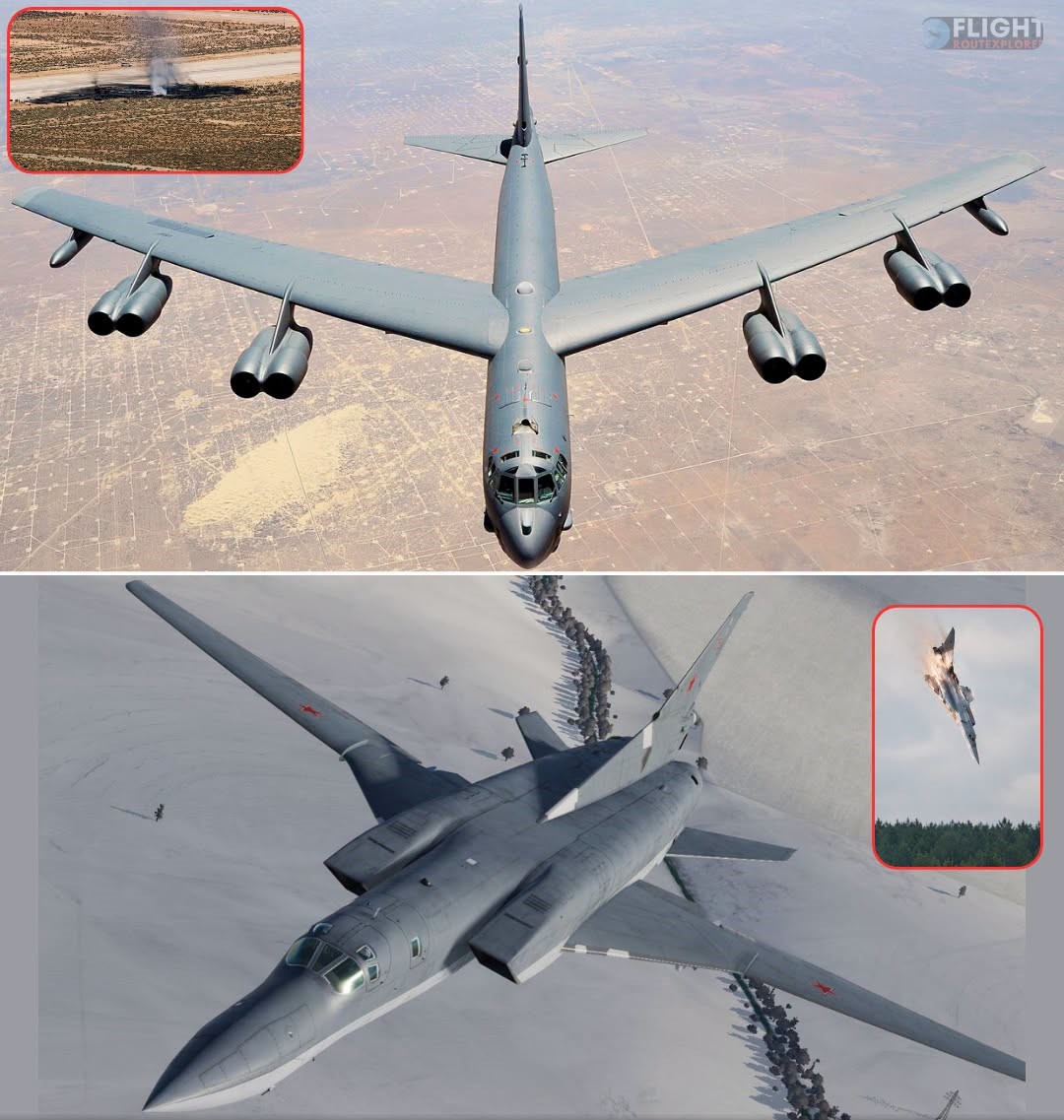
In a rare and striking coincidence, both a US Air Force B-52 Stratofortress and a Russian Aerospace Forces Tu-22M3 strategic bomber crashed on Monday, June 15, 2026, in completely separate incidents.
The B-52 crash resulted in eight fatalities at Edwards Air Force Base in California, while the Russian Tu-22M3 crashed in Siberia with all four crew members safely ejecting.
Both military powers have launched official investigations into the exact causes of these high-profile losses, which have put a global spotlight on aging strategic aviation fleets.
US Air Force B-52 Crash:
The long-range heavy bomber went down at 11:20 AM on June 15, 2026, on the airfield at Edwards Air Force Base in the Southern California desert.
All eight people on board were killed. According to Air Force officials, the crew consisted of military personnel, government civilians, and flight test specialist contractors.
Aerospace giant Boeing confirmed that two of its employees were among the victims.
The aircraft, assigned to the 412th Test Wing, was conducting a routine flight shortly after takeoff. The mission was specifically linked to a high-priority radar modernization program.
The aircraft caught fire upon impact and was severely destroyed. The Air Force has opened a comprehensive investigation, noting that there is currently no immediate indication of what triggered the failure.
Russian Aerospace Forces Tu-22M3 Crash:
The supersonic bomber crashed near the village of Kamenka in the Irkutsk region of southeastern Siberia, roughly 30 kilometers from Belaya Air Base.
There were no fatalities. All four crew members successfully activated their ejection seats before impact. Local residents located the pilots, who were subsequently hospitalized for medical evaluation. There were no casualties or damage reported on the ground.
The aircraft was on a routine training flight and was approaching to land when the incident occurred. The Russian Defence Ministry clarified that the aircraft was flying without a combat payload or live ammunition.
Verified social media footage captured the swing-wing bomber nose-diving sharply into a heavily wooded area, causing a massive post-crash explosion and a prominent column of black smoke. Preliminary findings from Russian aviation authorities point toward an engine failure as the probable cause.
The twin disasters have ignited widespread debate among defense analysts regarding the reliance on decades-old airframes. The B-52 and Tu-22M3 (NATO reporting name “Backfire”) have both been continuously upgraded to carry out modern cruise missile and deterrence missions because newer replacement platforms, such as America’s B-21 Raider and Russia’s PAK DA programs, face lengthy developmental timelines.