
On 13 June 1996, Garuda Indonesia Flight 865, a McDonnell Douglas DC-10-30 named Kalimantan, prepared for departure from Fukuoka Airport in Japan on a scheduled international service to Jakarta, Indonesia, with a stop in Bali. On board were 275 people, including 260 passengers and 15 crew members. What began as a routine departure would become one of the most dramatic runway overruns involving a wide-body aircraft.
At approximately 12:06 p.m. local time, the three-engine DC-10 was cleared for takeoff from Runway 16. The aircraft accelerated normally down the runway, and the crew was approaching the critical stage of the takeoff roll when a serious problem occurred. The No. 3 engine, mounted on the right side of the tail section, suffered an internal failure. A turbine blade that had exceeded the manufacturer’s recommended service life fractured, leading to severe engine damage and a fire.
The engine failure happened at a very high speed, after the aircraft had already passed V1, the decision speed beyond which pilots are generally committed to continuing the takeoff because there may not be enough runway remaining to stop safely. The aircraft’s nose had already rotated upward and it was close to becoming airborne.
Faced with the sudden engine failure, the captain made the critical decision to reject the takeoff. He later stated that he was concerned the damaged aircraft might strike nearby buildings or objects if it continued the climb. The crew deployed brakes, ground spoilers, and thrust reversers in an attempt to stop the 230-ton aircraft, but there was simply not enough runway remaining.
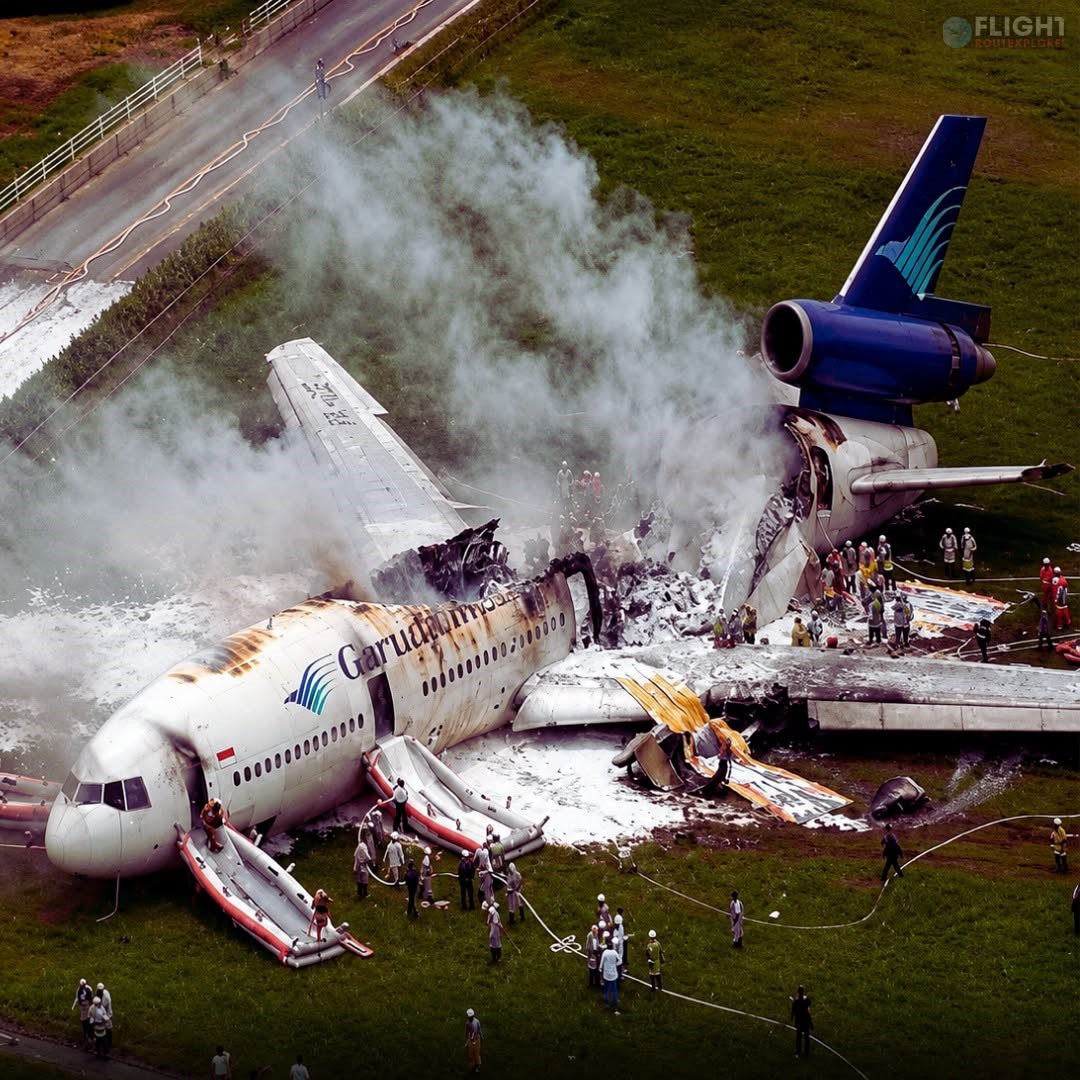
The DC-10 continued beyond the end of the runway, crashed through a perimeter fence, crossed a road and a drainage ditch, and finally came to rest approximately 620 meters beyond the runway. The violent movement tore away the landing gear and both wing-mounted engines. The fuselage broke apart in two locations, and a massive fire erupted in the central section of the aircraft.
Despite the catastrophic damage, most passengers were able to evacuate the aircraft. However, three passengers lost their lives. Two passengers died from injuries caused by the violent impact, while another passenger was knocked unconscious and was unable to escape the fire. Around 170 other occupants suffered injuries, many of them caused during the crash sequence and evacuation.
Investigators examined the wreckage and discovered that the initial engine failure was caused by a turbine blade that had remained in service for 6,182 operating cycles, exceeding General Electric’s recommended replacement limit of 6,000 cycles. The failure caused the engine to disintegrate and ignite.
However, the investigation concluded that the engine failure alone should not have resulted in the destruction of the aircraft. The DC-10 was designed to continue takeoff and safely climb even after losing one engine. The accident investigators determined that the main cause of the disaster was the captain’s decision to abort the takeoff after the aircraft had exceeded the safe reject speed. The report also criticized Garuda Indonesia’s maintenance and flight operations departments for inadequate coordination, which allowed the overused turbine blade to remain installed on the engine.
The crash of Flight 865 became a powerful lesson in aviation safety. It demonstrated the importance of respecting V1 takeoff procedures and highlighted how a combination of maintenance shortcomings and human decision-making can turn a serious but manageable mechanical failure into a catastrophic accident.
Garuda Indonesia Flight 865 remains one of the few accidents where a large DC-10 was destroyed not because it failed to fly with an engine out, but because the crew attempted to stop after they had already reached the point where taking off was the safer option.