
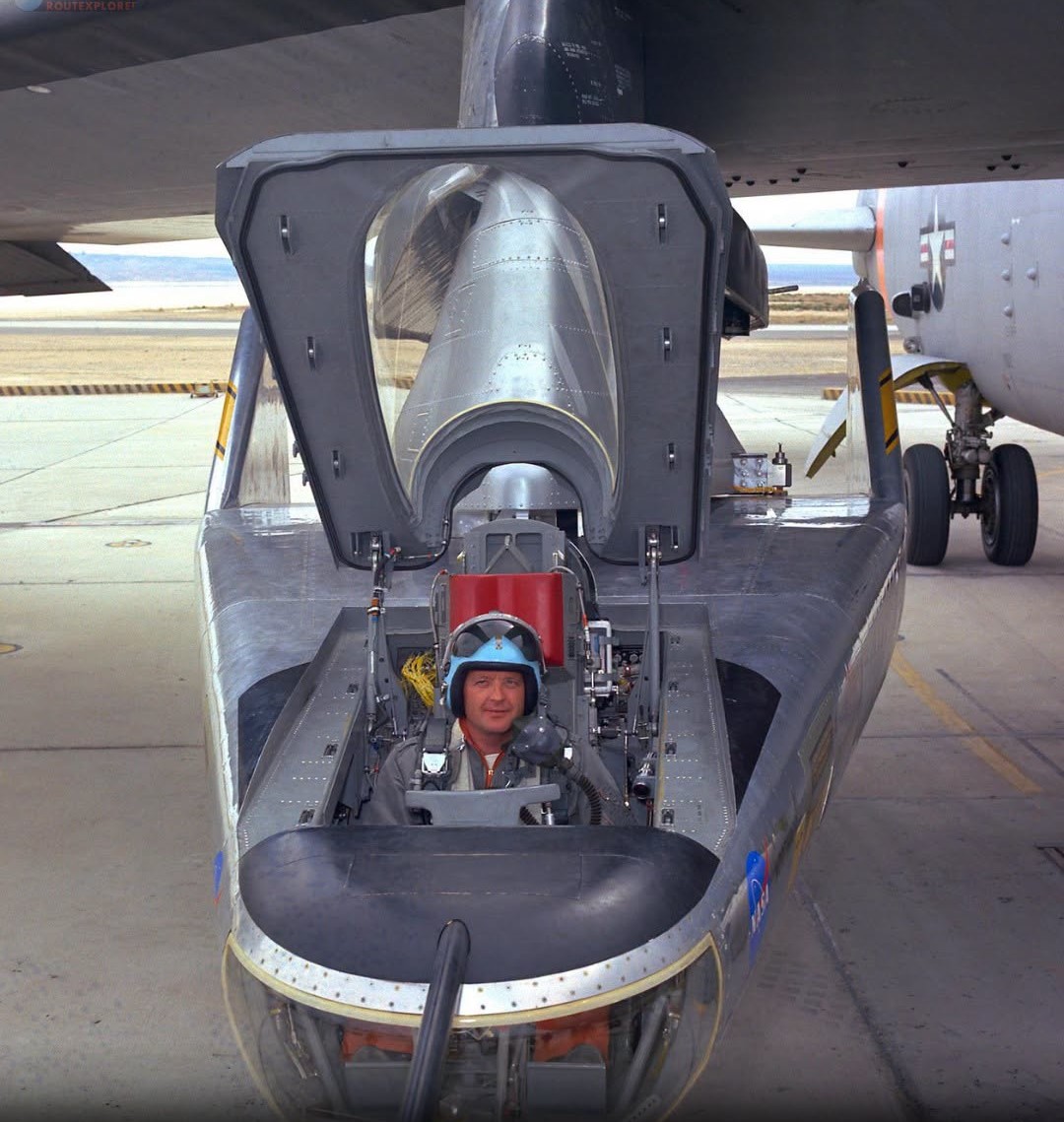
In 1966, NASA research pilot Milt Thompson sat inside one of the most unusual aircraft ever flown — the M2-F2 “heavyweight” lifting body research vehicle.
With its broad, rounded fuselage and almost nonexistent conventional wings, the M2-F2 looked more like a spacecraft than an airplane. And that was exactly the point. 
NASA researchers were exploring a revolutionary question: Could the shape of a vehicle’s body itself generate enough lift to allow a spacecraft to glide through the atmosphere and land on a runway?
To test the idea, the M2-F2 was attached to a wing pylon beneath NASA’s modified B-52 mothership. The massive bomber carried the experimental vehicle high into the sky with the research pilot already strapped inside the cramped cockpit.
At the designated altitude, the lifting body was released.
No conventional takeoff. No launch from a runway.
The M2-F2 simply dropped away from the B-52 and began its experimental flight. After completing the planned test maneuvers, the pilot had to guide the unpowered vehicle back toward Edwards Air Force Base, gliding to a wheeled landing on the vast dry lakebed or runway.
These flights were challenging and unforgiving. With no engine available for a second attempt, the pilot had to carefully manage altitude, speed and energy all the way to touchdown.
The M2-F2 was part of NASA’s pioneering lifting-body research program, which studied aircraft capable of producing aerodynamic lift primarily through the shape of their fuselage rather than large conventional wings.
The knowledge gained from the M2-F2 and other lifting-body vehicles helped influence the development of the Space Shuttle — particularly the concept of a spacecraft returning from orbit and making a controlled, unpowered runway landing.
Decades later, lifting-body ideas appeared again in NASA’s X-38 experimental vehicle program during the 1990s.
Pictured: NASA research pilot Milt Thompson seated in the M2-F2 while the experimental aircraft is attached to the B-52 mothership before a 1966 test flight.
A strange-looking aircraft. A B-52 mothership. A daring drop from the sky.
And research that helped shape the future of reusable spacecraft.