
Few accidents in aviation are as horrifying — or as misunderstood — as a person being pulled into a jet engine. While extremely rare, these incidents are almost always fatal within seconds due to the unimaginable forces generated by modern turbofan engines.
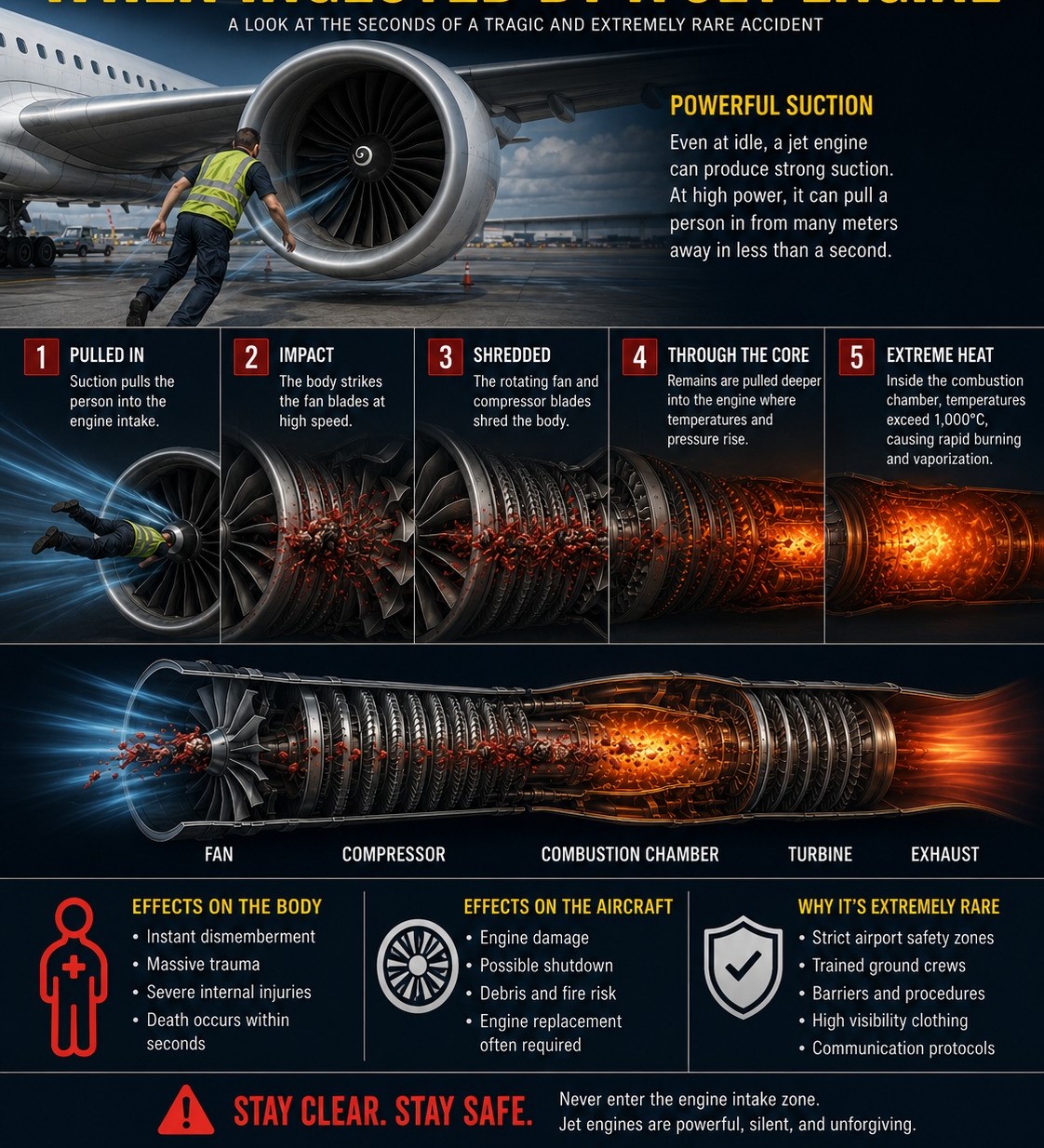
Jet engines may appear smooth and controlled from the outside, but at close range they become powerful vacuum-like machines capable of pulling in massive volumes of air at tremendous speed. Depending on engine size and power setting, the suction can extend dozens of feet in front of the aircraft.
A commercial jet engine works by rapidly drawing air into the front intake. At idle power the airflow is already dangerously strong, but during taxi, takeoff, or high thrust settings, the suction force increases dramatically.
Once a person enters the “ingestion zone,” escape becomes nearly impossible. Victims can be knocked off their feet and violently pulled toward the spinning fan blades within a fraction of a second.
The front fan of a large airliner engine can rotate at thousands of RPM, with blade tips sometimes moving faster than the speed of sound.
The first contact is typically with the large titanium fan blades at the front of the engine. These blades are engineered to withstand bird strikes and extreme pressure, making them devastatingly powerful against the human body.
The impact causes:
* Massive blunt force trauma
* Instant dismemberment
* Severe skeletal destruction
* Immediate organ rupture
* Catastrophic blood loss
Medical experts and accident investigators state that death is generally instantaneous or occurs within moments due to unsurvivable injuries.
If the body passes beyond the fan section, it enters the compressor stages where air pressure and temperatures rapidly increase.
Inside the engine:
* Rotating compressor blades shred remaining tissue
* Extreme heat causes rapid burning and vaporization
* Components moving at high velocity fragment biological material
* Combustion temperatures can exceed 1,000°C (1,832°F)
In many cases, only partial remains are recoverable after such an incident.
Despite the horrifying nature of the accident, the aircraft itself can also suffer serious damage.
Human ingestion can:
* Damage fan blades
* Cause severe engine imbalance
* Trigger engine shutdowns or fires
* Send debris through internal components
* Require complete engine replacement
Pilots are trained for engine failure scenarios, but an ingestion event creates an emotionally devastating situation for crews, passengers, and ground personnel alike.
Airports enforce strict safety zones around operating engines. Ground crews undergo intensive training to avoid intake danger areas, especially around:
* Large widebody aircraft
* Military fighter jets
* Aircraft operating at high thrust
* Wet or slippery ramp conditions
Modern airports also use barriers, escort procedures, and communication protocols to minimize the risk.
Behind every headline involving a jet engine ingestion is a deeply traumatic event affecting families, witnesses, pilots, first responders, and airport workers. Many aviation professionals describe these incidents as among the most psychologically devastating accidents they may ever encounter.
While public curiosity about such events is understandable, aviation experts stress that these tragedies highlight the immense power of aircraft engines and the importance of strict airport safety procedures.