

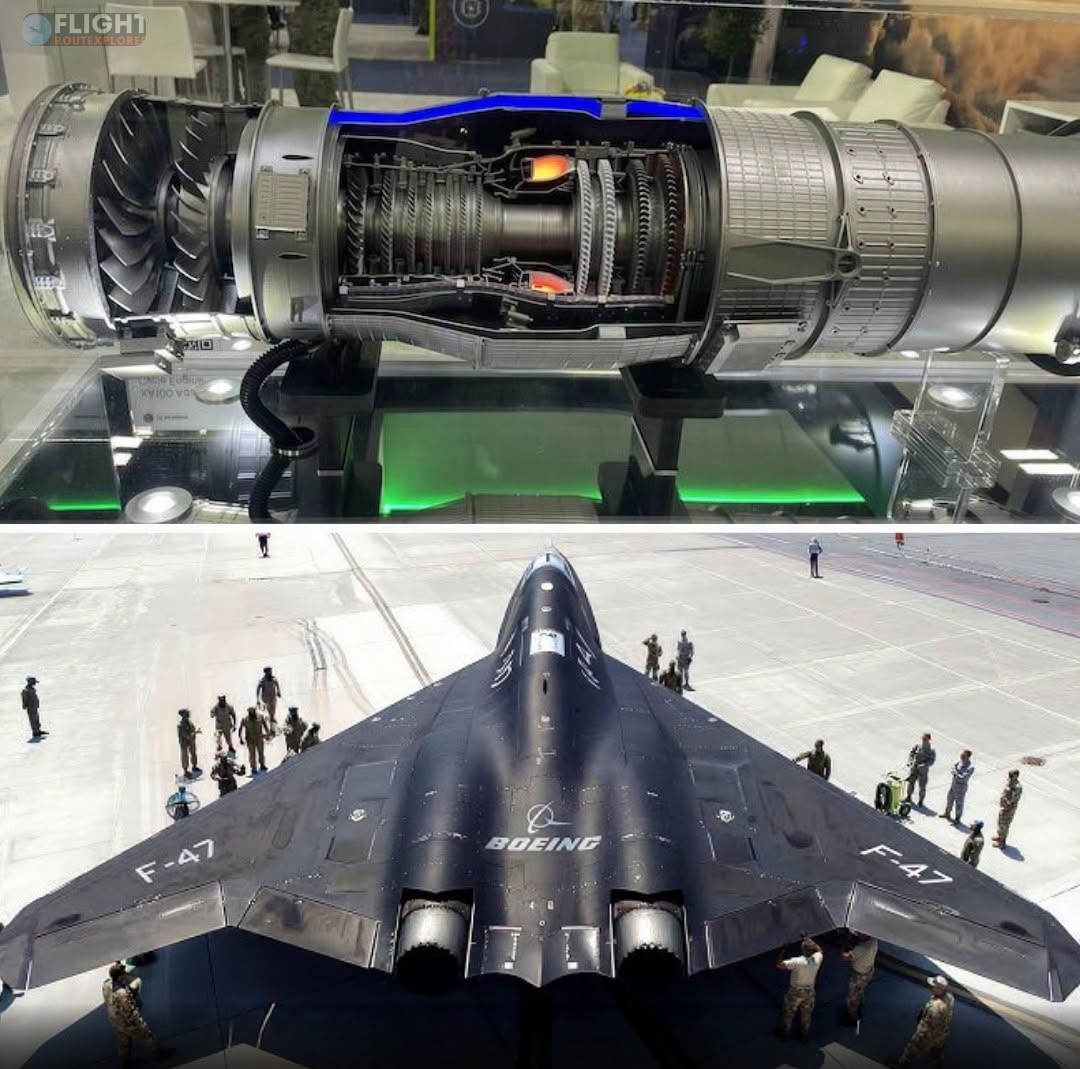
GE Aerospace Clears XA102 Engine for Assembly, Marking Major Step Toward Boeing F-47 Fighter
GE Aerospace has announced a significant milestone in the development of the U.S. Air Force’s next-generation fighter aircraft. On May 11, 2026, the company successfully completed the Assembly Readiness Review (ARR) for its XA102 adaptive cycle engine under the Next Generation Adaptive Propulsion (NGAP) program.
The successful review confirms that the engine’s design, manufacturing processes, and supply chain are all progressing on schedule, allowing the program to move into the assembly phase later this year. The XA102 is expected to power the future Boeing F-47 sixth-generation fighter, which is being developed to deliver unmatched air superiority in future combat environments.
The XA102 features an advanced three-stream adaptive cycle design that can intelligently redirect airflow depending on mission requirements. It can prioritize fuel efficiency and cooling during long-range operations or deliver maximum thrust for high-performance combat missions. Although GE Aerospace has not officially released the engine’s specifications, it is expected to produce between 35,000 and 40,000 pounds of thrust.
The engine also incorporates advanced ceramic matrix composite (CMC) materials that allow it to operate at higher temperatures while improving durability, efficiency, and overall performance. In addition, the XA102 has been designed using a fully digital engineering process, replacing traditional 2D drawings with a model-based digital framework that integrates design, manufacturing, and inspection into a single system.
GE Aerospace noted that the critical design review for the XA102 was completed in December 2023, and all demonstrations associated with the first phase of the model-based engine program have now been successfully completed. Flight testing is expected to begin in the late 2020s.
The XA102 builds upon the success of the earlier XA100 engine and is expected to provide greater range, improved thermal management, enhanced survivability, and sufficient power for next-generation sensors, electronic warfare systems, and advanced weapons. As one of the U.S. Air Force’s most important propulsion programs, NGAP is laying the foundation for the future of military aviation.