

Early Thursday morning, Michal Ruprecht went to Uganda’s Entebbe International Airport at 2AM to catch a flight. At the airline counter, he told the agent that he was headed to Michigan.
“He did this sort of double look and asked me, was I sure I was going to Michigan?” he recalls.
Ruprecht, a medical student and freelance reporter, was returning home after a month-long reporting trip to Uganda, where he was working on stories for NPR.
The man at the counter showed Ruprecht a memo from U.S. Customs and Border Protection. “He tells me that I have to arrive at Washington Dulles International Airport (IAD),” Ruprecht says, “The first thing that was going through my head was denial. I wasn’t sure if this was real.”
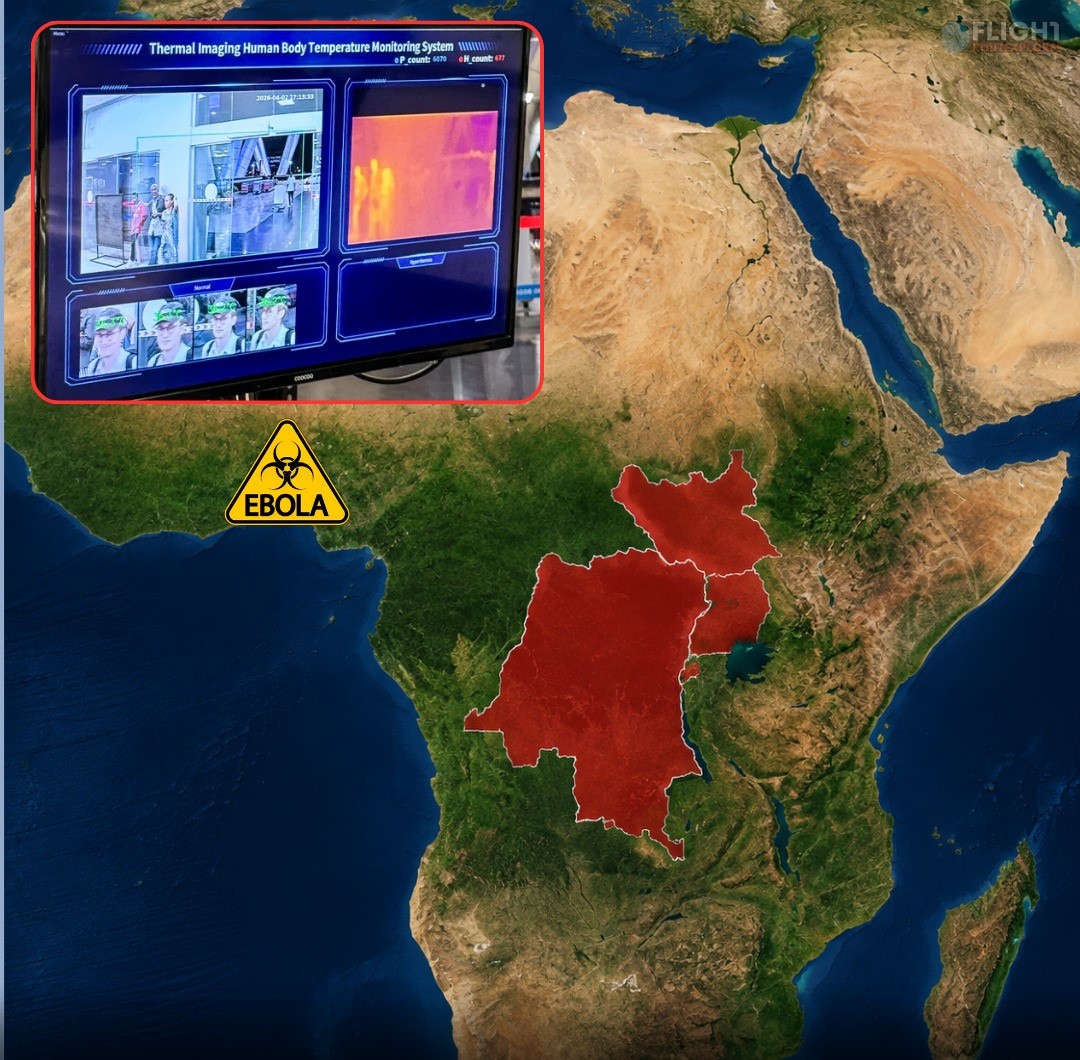
Ruprecht was one of the first passengers to fly under a policy announced just hours before: all Americans who have passed through Uganda, South Sudan or the Democratic Republic of Congo (DRC) in the past 21 days must fly into IAD, an airport in a Virginia suburb of Washington, DC.
Friday evening, it was announced that two additional U.S. airports will start screening in the next few days—the Hartsfield-Jackson Atlanta International Airport and the George Bush Intercontinental Airport in Houston.
The African countries, the DRC and Uganda, have been hit by a growing Ebola outbreak, which the World Health Organization declared a public health emergency of international concern on May 17. Already, there are 800 suspected cases and more than 180 suspected deaths, according to the WHO.
A major component of the U.S. response has been travel restrictions, on those who have recently come through affected countries: routing U.S. citizens to specified entry points, reserving the right to deny entry to permanent residents and barring most others.
At the Ugandan airport, Ruprecht frantically rebooked his flights. When he arrived at Dulles airport after 20 hours of travel, he was flagged for extra screening.
Officials for the U.S. Centers for Disease Control and Prevention ushered him into a temporary clinic. “They put these tarps up that created pseudo-doctor office rooms,” Ruprecht says, “It looked like a makeshift campsite.”
A CDC official checked his temperature with a handheld thermometer pointed at his forehead. “He actually told me my temperature was a bit high,” Ruprecht says, “He asked me, was I nervous? I said ‘Yes!’ ” His second and third temperature checks were in the normal range, so they moved on to questions.
Ruprecht confirmed he had no symptoms of Ebola, and that he did not treat patients or attend funerals in Uganda. They finished by taking his contact information. “It took 5 to 10 minutes, it was pretty quick,” he says, “I’ll be honest, it was pretty anticlimactic.”
In the 2014-2016 Ebola epidemic, many passengers flying from affected areas received thermometers and burner phones and printout instructions for next steps.
Ruprecht got none of that, but he made his connecting flight home to Michigan.
On Friday afternoon, he got a text message from CDC describing the symptoms of Ebola disease, including fever, rash, nausea and vomiting, and directing him to call his health department for advice and to isolate immediately if he develops them.
After CDC staff conduct initial risk assessments on passengers arriving at the airports, they’ll notify state health departments at the travelers’ destinations.
Health departments would then follow up, says Dr. Laurie Forlano, state epidemiologist for Virginia. “Some people will be monitored or checked on daily. Some will not require that frequency, and that’s dependent upon their exposure risk,” Forlano says.
Forlano says the state is prepared for this effort and they’ve done it in past outbreaks, but it takes a “tremendous amount of work.” How was it going, after day one? “I think in the beginning of any response like this, a little chaos is part of the gig,” Forlano says.
The Ebola monitoring adds to a slate of other health issues Virginia is dealing with, including a measles outbreak and monitoring for hantavirus.
And the nation’s public health system is not at its peak, says Dr. Jeanne Marrazzo, a former top official at the National Institutes of Health and CEO of the Infectious Diseases Society of America. “In the last five years in particular, we’ve seen decimation of local, regional and state public health staffing and funding for programs,” Marrazzo said at an IDSA press briefing May 21, “I don’t know that we are as well prepared as we should be at those levels.”