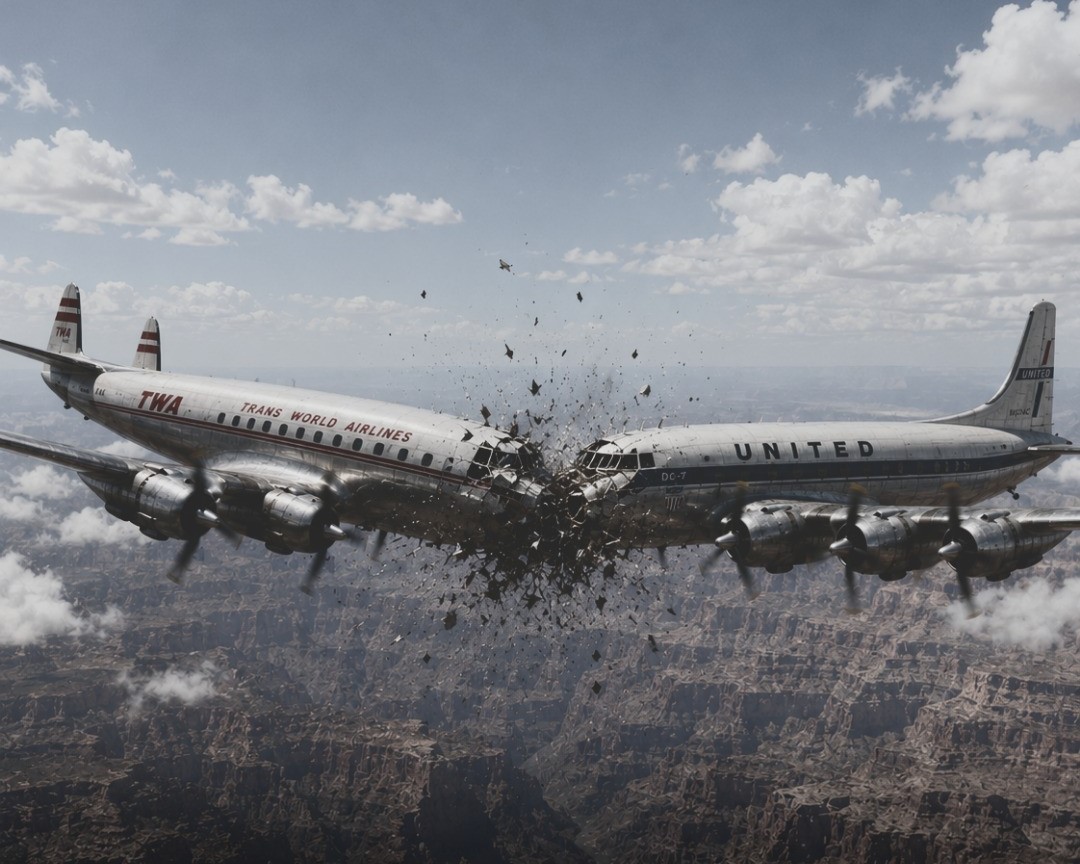
The June 30, 1956, midair collision above the Grand Canyon killed all 128 aboard TWA Flight 2 and United 718. Pilots struggled to see each other due to constant bearing, decreasing range, and cockpit obstructions.
The hardest airplane to see in the sky may be the one flying directly toward you.
That should be impossible. It’s an airplane, after all. But if you’re flying a plane and there’s another one steadily approaching, it may not look like it’s actually moving. In fact, it might appear to stay in virtually the same spot while slowly getting bigger.
In navigation, this is a concept called constant bearing, decreasing range: the bearing stays the same, the distance shrinks, and if both craft stay on the same course, they both arrive at the same point.
Here’s where it gets dangerous: Human eyes are very good at noticing movement. If a plane is crossing from left to right, that’s easy to see. But if a plane appears fixed against the sky, and it’s still far away, it’s much harder to spot. By the time the plane becomes big enough for your eyes to register it as a threat, you might only have seconds to react.
This is one reason why the “see and avoid” rule in aviation—pilots must visually spot and steer clear of other aircraft—is flawed. For decades, safety investigators have warned that pilots can’t always be expected to see another plane in time, even if the weather is perfect. A Transportation Safety Board of Canada report found that if two aircraft are flying toward the same point, each can look basically frozen in the other pilot’s windshield, even as they get closer.
The FAA has said pilots need 12.5 seconds to see an object, recognize it as an aircraft, understand it as a collision threat, decide what to do, react, and wait for the airplane to respond. In fast-moving aircraft, that’s a dangerously small margin.
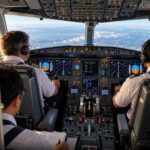
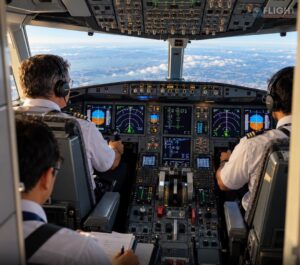
One more wrinkle is that cockpits make things worse. Window posts can block parts of the sky, and clouds can cover an approaching plane until the last moment. Pilots are also, well, pilots. While they’re scanning the sky, they’re also managing instruments, radios, navigation, weather, passengers, and more.
All of these factors help explain what was, at the time, The Worst Disaster in American History: the June 30, 1956 midair collision of TWA Flight 2 and United Airlines Flight 718 above the Grand Canyon. The crash killed all 128 people on both planes and revealed a fatal flaw in an aviation system that still relied heavily on pilots seeing and avoiding each other in open sky.
On that day, both aircraft were flying in uncontrolled airspace and depended on visual separation. If the other plane was hidden by something in the cockpit, a cloud, glare, or constant bearing, the warning may have come too late.
So while the warning signs were there, the system wasn’t built to act on them. Without radar coverage or rules requiring controllers to step in, the last line of defense was the pilots’ ability to see each other in the sky.
And they didn’t.