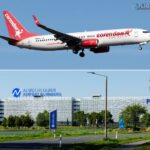

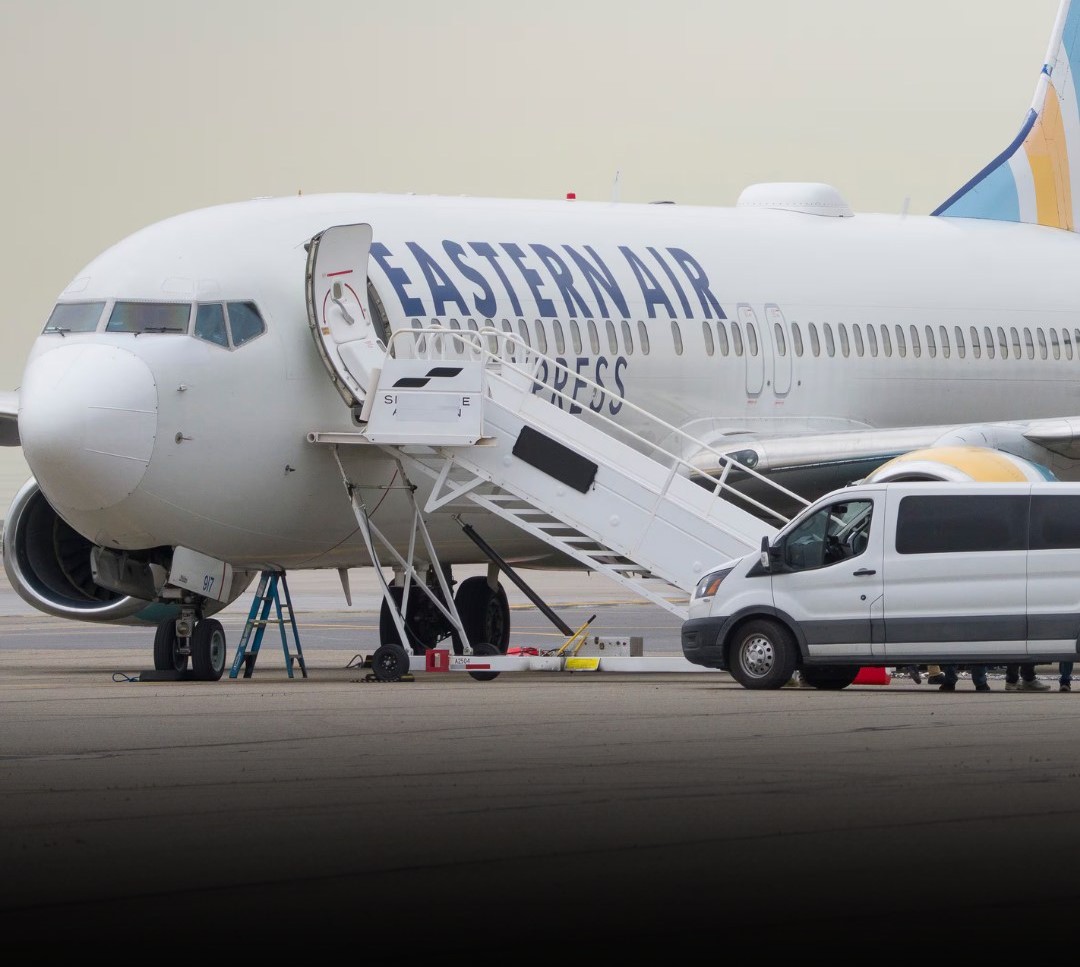
The planes seem to come through Salt Lake City International Airport on a fairly routine schedule — twice a week, on Monday and Thursday mornings, usually landing around 10 a.m. and taking off by noon.
People in handcuffs and ankle restraints boarded at least two of them in recent months, Salt Lake Tribune journalists have observed.
But U.S. Immigration and Customs Enforcement would not confirm any details about what it calls “removal flights,” citing “operational security concerns.”
Since the start of the year through April, 46 such “removal flights” have stopped at Salt Lake City’s airport — 12 in January, 13 in February, 12 in March plus nine in April, according to Human Rights First. The nonprofit compiles data on ICE flights to detention centers within the U.S. and deportation flights out of the country.
That’s down somewhat from a peak of 18 ICE flights moving through Salt Lake City’s airport last December, according to Savi Arvey, who runs the nonprofit’s ICE Flight Monitor.
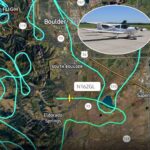
The Monday-and-Thursday pattern emerged when The Salt Lake Tribune independently reviewed March, April and May flights through the flight-tracking website ADS-B Exchange.
How many people ICE is moving out of Salt Lake City is difficult to determine. For one recent flight, a Salt Lake Tribune journalist observed some 40 people, cuffed and shackled, being moved from windowless white vans and up the steps of a plane.
Gloria Cardenas, a Taylorsville immigration attorney, said ICE flights have come through Salt Lake City for years, usually once a week.
What’s new, she said, “is the amount of flights will likely increase because of the use of ‘expedited removal’” under President Donald Trump.
When ICE moves a detained person, Cardenas said, the agency won’t tell anyone ahead of time, including family members and attorneys. ICE cites “security purposes” for that policy, she said.
“If I represent a client in Salt Lake City, I have to move quickly to keep them here,” Cardenas said. “If I don’t, then they are going to [get] their transfer somewhere else, and we won’t know until they get to that next location.”
The ICE flights through Salt Lake City that The Tribune reviewed mostly arrived from Mesa, Arizona. There have been four exceptions — one from Harlingen, Texas, on March 12; a late-night flight from Boston on April 16; and two from El Paso, Texas, on May 14 and 21.
The Monday flights have all left Salt Lake City for the Southern California Logistics Airport in Victorville, California. It’s a former U.S. Air Force base near Los Angeles, now used for business, military and freight aircraft, relieving pressure from the busy LAX.
From Victorville, the Monday flights then travel to El Paso, a border city on the Lone Star State’s far western tip, across the Rio Grande from Juarez. ICE maintains two facilities near El Paso and a neighboring U.S. Army base, Fort Bliss. One of those facilities is the massive Camp East Montana, where some 3,000 immigrants are detained and three have died, NPR reported in April.
The Thursday flights usually come from Mesa, then leave Salt Lake City for Harlingen, Texas, on the southern end of the state in the Lower Rio Grande Valley. ICE’s Harlingen field office oversees seven detention facilities in the valley, according to the agency’s website.