
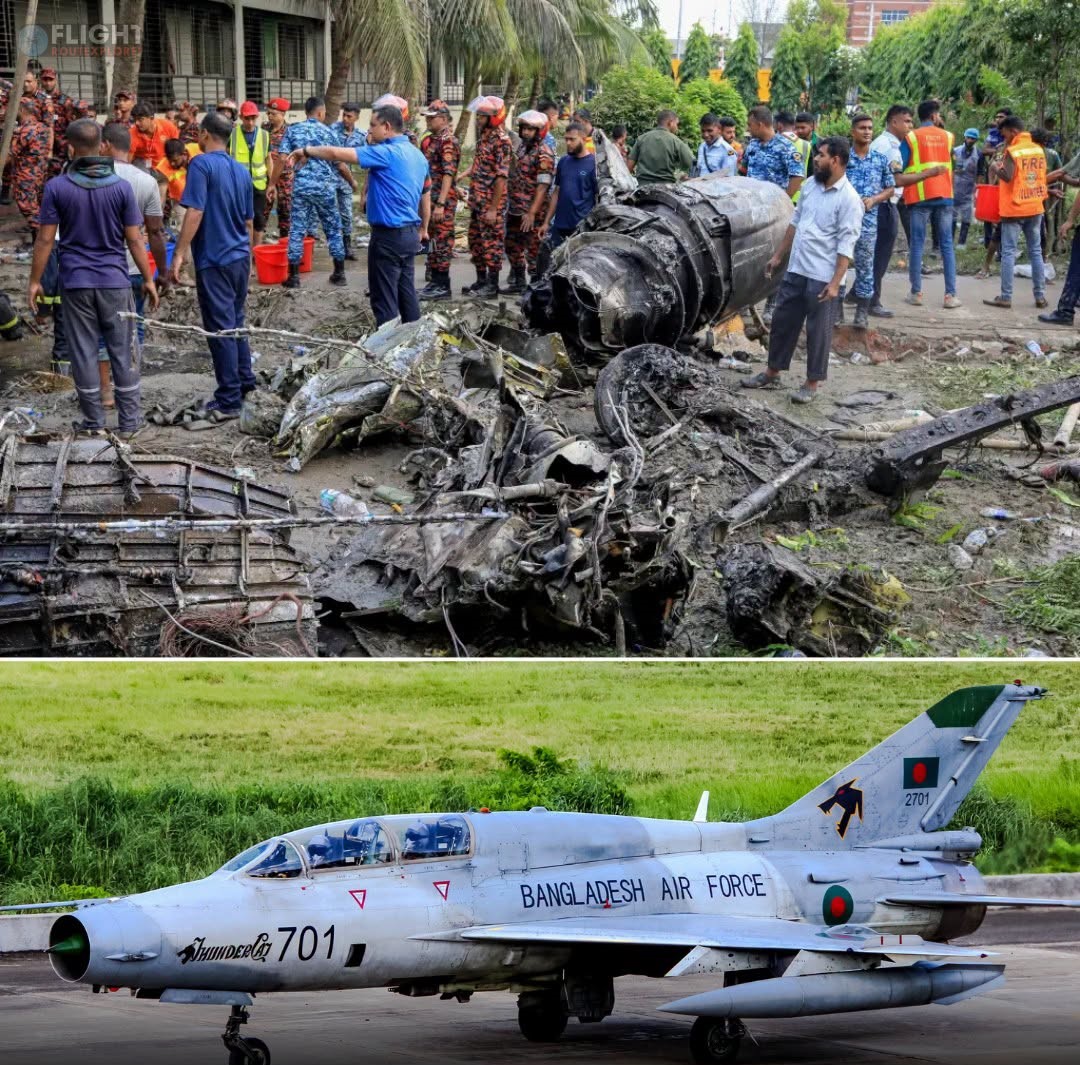
On July 21, 2025, Bangladesh witnessed one of the darkest days in its aviation history when a Bangladesh Air Force Chengdu FT-7BGI, a two-seat trainer version of the Chinese-built J-7 fighter, crashed into the campus of Milestone School and College in Uttara, Dhaka.
What began as a routine military training sortie ended just minutes later in a devastating tragedy that claimed the lives of dozens of people, most of them children, and left hundreds of families forever changed.
The aircraft, carrying the callsign THUNDERCAT 701, took off from Bangladesh Air Force Base Bir Uttom A. K. Khandker at approximately 1:06 p.m. local time. The flight was intended to be a routine solo training mission for Flight Lieutenant Towkir Islam Sagar.
Shortly after becoming airborne, the fighter experienced serious control problems. Initial reports from military officials indicated that the aircraft had suffered a technical malfunction, leaving the pilot struggling to maintain control as the jet rapidly lost stability.
As the emergency unfolded, air traffic controllers instructed the pilot to eject. However, the aircraft was flying at such a low altitude that a safe ejection was extremely difficult.
According to military statements released after the accident, the pilot instead focused on steering the crippled aircraft away from densely populated neighborhoods in an attempt to minimize civilian casualties. Witnesses later reported seeing the jet flying unusually low before it suddenly descended toward the Milestone School and College campus. Communication with the control tower was lost moments before impact.
Only minutes after takeoff, the aircraft slammed into the Haider Ali Building inside the school complex during school hours while students were attending classes. The fighter crashed through part of the structure, triggering a massive explosion and an intense fire fueled by aviation fuel. Thick black smoke quickly engulfed the building as frightened students, teachers, and parents desperately tried to escape. CCTV footage later showed the aircraft entering one side of the building and exiting through the other before the wreckage came to rest amid flames and debris.
Emergency services responded rapidly. Firefighters, military personnel, police officers, volunteers, and local residents rushed into the burning buildings to rescue trapped children and teachers. Nine fire service units, multiple ambulances, and Border Guard Bangladesh personnel participated in the rescue operation. Victims suffering severe burns and traumatic injuries were transported to hospitals across Dhaka, with even a Dhaka Metro train being used to help move casualties quickly. The rescue effort continued well into the evening as crews removed wreckage and searched for survivors.
The disaster ultimately claimed 37 lives, including the pilot and 36 people on the ground, while another 173 people were injured, many with severe burns. Among those killed were numerous students, making the crash one of the deadliest aviation disasters ever to affect a school campus in Bangladesh. The tragedy became widely known throughout the country as the “Milestone Tragedy.”
The emotional aftermath was immense. Bangladesh declared a national day of mourning, flags flew at half-mast, and special prayers were held across the country. The Ministry of Education postponed Higher Secondary Certificate examinations scheduled for the following days to allow grieving families and students time to recover from the shock. Memorials were established outside the school, where thousands gathered to lay flowers and pay tribute to the victims.
Public anger quickly followed the mourning. Students and citizens organized demonstrations demanding accountability, greater transparency regarding the casualty figures, and the retirement of aging military aircraft still being used for training over densely populated urban areas. The protests spread across Bangladesh, resulting in clashes with security forces and increased pressure on government officials. The tragedy also sparked renewed debate over military flight safety and whether training missions should continue over major cities.
In the immediate aftermath, military authorities initially stated that the aircraft had suffered a mechanical failure shortly after takeoff and praised the pilot for attempting to divert the fighter away from heavily populated areas. Bangladesh Air Force officials promised a comprehensive investigation while assuring the public that injured victims would receive continued medical care.
However, the official investigation later revealed a different conclusion. After interviewing approximately 150 witnesses, aviation experts, first responders, and victims’ families, and examining 168 separate pieces of evidence, the investigation committee submitted its findings in November 2025. The final report concluded that the crash was primarily caused by pilot error, which resulted in a loss of control of the aircraft. This finding differed from the early assumption that a technical malfunction alone had caused the disaster. Despite the final conclusion, the investigation acknowledged the complexity of the emergency and documented the pilot’s final actions during the accident sequence.
The crash remains one of the most heartbreaking aviation tragedies in Bangladesh’s history. It exposed difficult questions about military flight operations, aging aircraft, pilot training, and emergency decision-making in densely populated cities. More importantly, it serves as a painful reminder that a routine training flight lasting only a few minutes can change countless lives forever.