
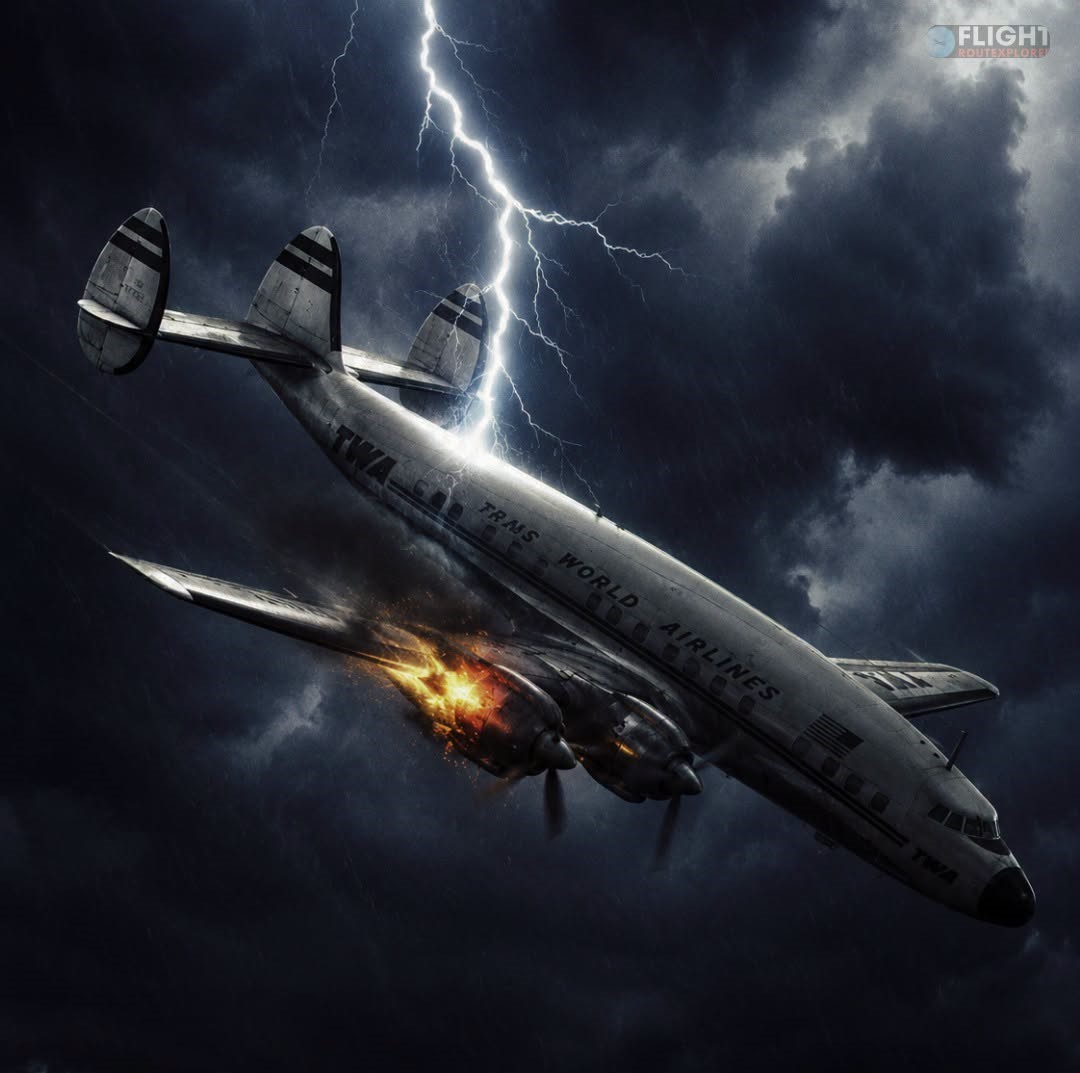
On June 26, 1959, one of aviation’s most unusual and devastating disasters unfolded over northern Italy when Trans World Airlines Flight 891 broke apart in mid-air after being struck by lightning.
What made the accident especially remarkable was that the aircraft itself survived the lightning strike for only moments before an invisible chain reaction inside one of its fuel tanks caused a catastrophic explosion.
The tragedy claimed all 68 lives on board and became one of the most important cases in the history of aircraft lightning protection.
TWA Flight 891 was a scheduled international passenger service operated by a Lockheed L-1649A Starliner named Star of Severn. The aircraft had begun its journey in Athens, Greece, and had already completed scheduled stops in Rome and Milan.
It was continuing toward Paris before later legs to Shannon, Gander, and finally Chicago. On board were 59 passengers and nine crew members representing several different nationalities, although most were American.
The weather over northern Italy was far from ideal on the afternoon of June 26. Low clouds, rain showers, poor visibility and active thunderstorms covered the region around Milan’s Malpensa Airport. Despite the unfavorable weather, the aircraft departed normally and climbed into the overcast while following its planned route toward Paris.
Approximately twelve minutes after takeoff, the crew radioed air traffic control, reporting that they were climbing through about 10,000 feet. Nothing in the transmission suggested that the flight was experiencing any difficulty. Only minutes later, however, witnesses on the ground observed a blinding flash of lightning in the storm clouds followed almost immediately by a massive explosion high above them.
Residents watched in horror as the Lockheed Starliner suddenly disintegrated in mid-air. Burning wreckage scattered across a wide area near the towns of Olgiate Olona and Marnate. Large sections of the aircraft fell separately while smaller fragments rained over farmland and residential areas. There was no chance for the crew to regain control. All 68 passengers and crew members lost their lives instantly, making it the deadliest aviation accident in the world during 1959 and the first fatal accident involving the Lockheed Starliner.
Recovery teams arrived quickly, but the aircraft had been completely destroyed. Investigators faced the difficult task of collecting thousands of scattered pieces from several miles of countryside. The widespread debris pattern immediately suggested that the aircraft had broken apart while still in flight rather than after impact with the ground.
The Italian investigation lasted more than a year as experts carefully reconstructed the aircraft and examined every possible cause. Initially, investigators considered structural failure, sabotage, engine malfunction and bomb explosion. However, no evidence supported any of these theories. The wreckage instead revealed signs of an internal explosion within the aircraft’s wing fuel system.
The final report concluded that the aircraft had most likely been struck by lightning while flying through the thunderstorm. Rather than directly destroying the aircraft, the lightning produced static electrical discharges known as streamer corona around the fuel tank vent outlets. These electrical discharges ignited gasoline vapors escaping from the vent system of fuel tank number seven. The resulting explosion inside the tank was so powerful that it caused an immediate structural failure. Investigators believed a second explosion or pressure wave then affected the adjacent fuel tank, causing the aircraft to break apart almost instantly.
The investigation revealed that the disaster was not caused simply by the lightning bolt itself but by the interaction between lightning-induced electrical effects, fuel vapor, and the aircraft’s venting design. This finding transformed the aviation industry’s understanding of how thunderstorms could threaten aircraft, even when a lightning strike did not directly damage the airframe.
The tragedy led manufacturers, regulators and airlines to examine fuel tank vent systems and lightning protection far more closely. Engineers introduced improved grounding methods, better vent designs and enhanced lightning protection features intended to prevent electrical discharges from igniting fuel vapors. The accident also influenced later investigations into other lightning-related crashes, including Pan Am Flight 214 in 1963, which further strengthened international fuel tank safety standards.
More than six decades later, TWA Flight 891 remains one of the most significant examples of how a seemingly survivable lightning strike can trigger a hidden chain of events inside an aircraft. The lessons learned from the disaster continue to influence modern aircraft certification, fuel system design and lightning protection, helping make commercial aviation significantly safer than it was in the late 1950s.