
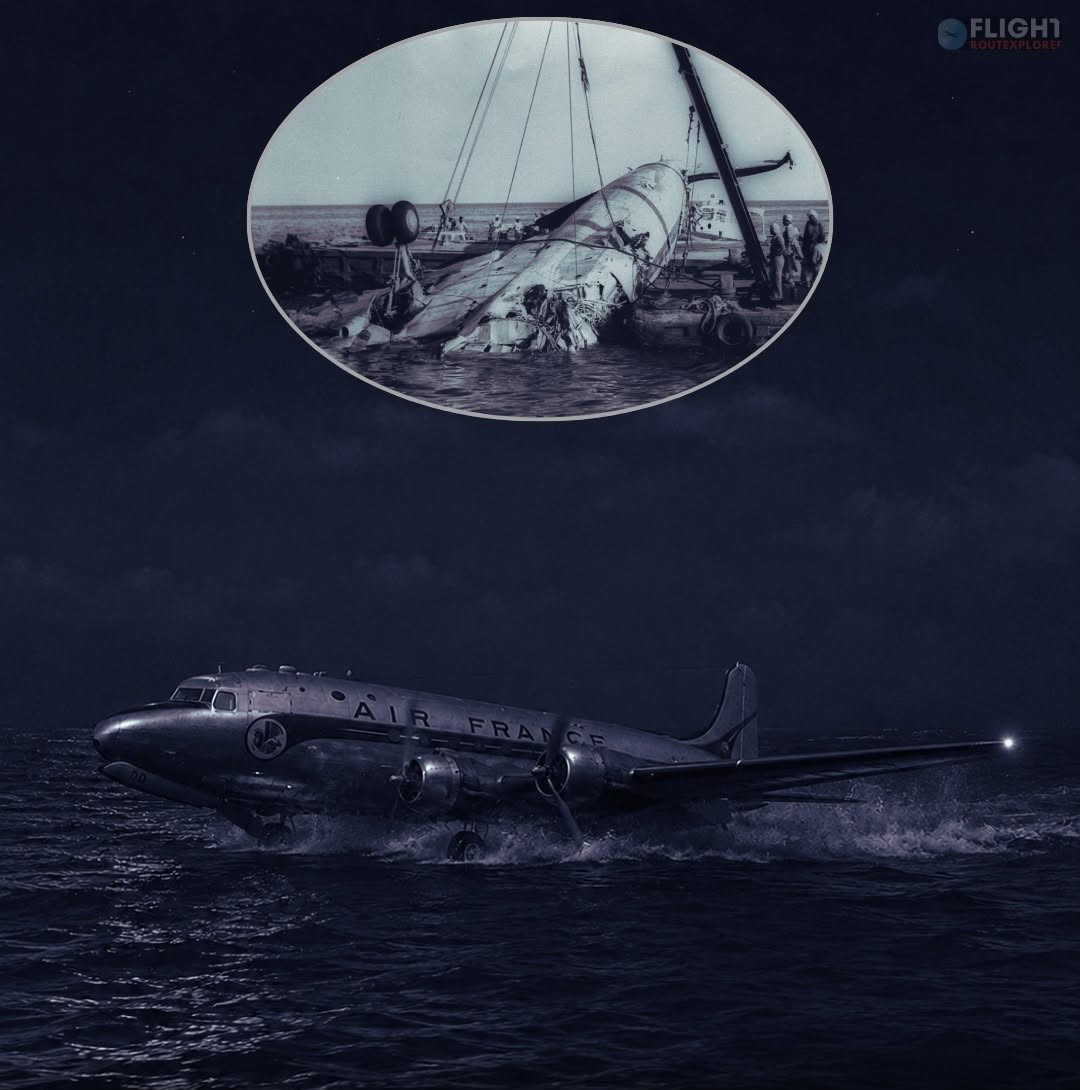
On 14 June 1950, aviation history witnessed one of its most astonishing and tragic coincidences when an Air France Douglas DC-4 named Ciel de Gascogne crashed into the waters off Bahrain while approaching the airport. The tragedy became even more shocking because just two days earlier, another Air France Douglas DC-4, Ciel de Picardie, flying the same route, had crashed into nearly the same location under remarkably similar circumstances.
The two accidents remain one of the most extraordinary sequences in commercial aviation history: two aircraft of the same model, operated by the same airline, flying the same Saigon–Karachi–Bahrain–Paris route, approaching the same runway at Bahrain at almost the same time of night, and both disappearing into the sea only miles apart.
The first accident occurred on 12 June 1950. Air France DC-4 Ciel de Picardie, registered F-BBDE, departed Karachi at 16:05 local time for the next stop at Bahrain during its long journey from Saigon to Paris. As the aircraft approached Bahrain after sunset, the crew began a timed instrument approach, as the airport lacked modern radio landing aids and adequate approach lighting.
At 20:42, the crew contacted Bahrain approach control and reported their altitude of 6,500 feet. They were cleared to descend to 2,000 feet. The aircraft passed over the airfield at approximately 1,000 feet and later reported that it was on the downwind leg of the approach. At 21:15, the pilots reported they were on final approach and received clearance to land on Runway 29. Moments later, the aircraft struck the sea around 3.3 miles from the runway. Rescue operations found the wreckage in shallow water, but 46 of the 52 people aboard lost their lives. Only six survived, with three of them spending nearly eight hours in the sea before being rescued.
Before investigators could fully understand what had happened, tragedy struck again.
On 14 June 1950, Air France DC-4 Ciel de Gascogne, registered F-BBDM, departed Karachi at 16:43 on exactly the same route. The aircraft reached Bahrain at night and reported overhead the airport at 21:41. At 21:52, the crew reported they were performing the procedure turn and received clearance to land.
However, just like the aircraft before it, the DC-4 descended too low during its approach and slammed into the Persian Gulf less than a mile from the site of the first crash. The accident killed 40 of the 53 occupants, including many families and children. Thirteen people survived after spending hours waiting for rescue in the dark waters.
The back-to-back disasters shocked the world. Newspapers described the second accident as an almost impossible repetition of the first. In only 48 hours, Air France had lost two nearly identical four-engine airliners and 86 passengers and crew members in the same stretch of sea off Bahrain.
A special investigation commission was dispatched to Bahrain and initially examined both accidents together. The original 1950 investigation concluded that both crews had descended below safe altitude during their timed approaches. For the first crash, investigators suggested that the captain failed to properly monitor altitude and rate of descent, and they also considered fatigue as a possible factor. For the second crash, the captain was said to have failed to maintain a safe altitude of around 300 feet until the runway lights became visible.
The investigations also highlighted shortcomings at Bahrain Airport, which at the time lacked radio landing systems and adequate approach lighting. As a result, restrictions were introduced on night operations by French aircraft while safety improvements were considered.
For decades, pilot error remained the accepted explanation. However, the story took a dramatic turn in 1994 when the wreckage of Ciel de Gascogne was rediscovered on the seabed during a hydrographic survey. The discovery allowed independent researchers to re-examine the accidents using historical weather records.
Their research suggested that both aircraft may have encountered severe weather phenomena known today as microbursts — intense downward blasts of air that can force an aircraft rapidly toward the ground. These dangerous weather events were poorly understood in 1950, and the researchers argued that the crews may have been victims of atmospheric conditions beyond their ability to predict or escape.
The later findings cast significant doubt on the original pilot-error conclusions and led to recommendations that the pilots should be exonerated. The Bahrain DC-4 tragedies are now remembered not only for their immense loss of life but also as a lesson in how aviation understanding evolves with time.
More than seven decades later, the events of June 1950 remain almost unbelievable. The chances of two identical aircraft from the same airline, operating the same route, crashing during the same phase of flight at the same airport and within 48 hours of each other are extraordinarily rare. The twin Bahrain DC-4 disasters stand as one of the most haunting coincidences ever recorded in aviation history.